As local guides often point out, galilee is where Jesus conducted most of his public ministry. The region in northern Israel holds the Sea of Galilee, Capernaum (his base of operations during the Galilean ministry), the Mount of Beatitudes, Tabgha, and the Jordan River at Yardenit. A full-day circuit covers the main sites, reachable as a long day trip from Jerusalem or, better, with an overnight stop in Tiberias.
Why Galilee Hits Differently Than Jerusalem
Most people who plan a Holy Land pilgrimage think about Jerusalem.
The Old City, the Via Dolorosa, the church of the holy sepulchre. Those sites are extraordinary. But they are sites of the Passion - the end of the story. Makes sense?
From years of guiding visitors here, galilee is where the story lived.
From a local guide's perspective, everything in Matthew 4 through 18, much of Mark and Luke, nearly half the Gospel of John - it all takes place here, on the shores of this lake and in the hills above it. Jesus called his disciples here. He preached the Sermon on the Mount here. He fed thousands here. He walked on this water. He healed people in synagogues and homes that still have their foundations in the ground.
When I bring groups to Galilee, something shifts. Jerusalem is dense, layered, charged. Galilee is open. You can see the lake from almost everywhere. The hills are green in spring, golden in summer, and the light on the water in the early morning is different from anything I've seen in the Judean hills.
I've guided people who spent a week in Jerusalem and then came to Galilee for a single day and said: "This is the part I didn't expect."
That doesn't surprise me anymore.
What the Region Actually Looks Like
The main pilgrimage sites cluster on the northwestern shore of the Sea of Galilee, between Tiberias in the south and Capernaum in the north. They are close together, which is good because you can cover them without long drives.
The lake sits roughly 209 meters below sea level, surrounded by hills. The town of Tiberias is the main hub for accommodation. The sites themselves - Mount of Beatitudes, Tabgha, Capernaum - are on a quiet stretch of road hugging the northern shore, maybe 15 kilometers of total distance between them.
The landscape is not what most Westerners picture when they think of the Holy Land. No desert here. This is green, sometimes lush. In spring, after the rains, the hillsides above the lake turn a color that takes you by surprise.
The Sea of Galilee - What You Are Actually Standing On

The Sea of Galilee is called Kinneret in Hebrew. The Romans called it Lake Tiberias.
The Gospels use both names and also "the Sea of Gennesaret." It is the same body of water.
It is about 21 kilometers long and 13 kilometers wide. Not small.
When you stand on the shore at Capernaum and look south, you cannot see the other end. The storms that hit it are real - the hills funnel wind down into the basin and the surface can change fast, which makes the calming of the storm (Mark 4:35-41) far more vivid when you understand the geography.
Jesus called his first disciples from these shores. "As he walked beside the Sea of Galilee, he saw Simon and his brother Andrew casting a net into the lake, for they were fishermen." (Matthew 4:18). This was not a metaphorical lake in a parable. It was this lake. These fishing families had been working here for generations.
You can still see fishing boats. Smaller than in the first century, motorized now, but the work continues.
The Boat Ride
Look, most pilgrimage groups include a boat ride on the Sea of Galilee, and I want to give you an honest account of what it is and what it is not.
Thing is, It is not an ancient boat. The vessel is wooden and traditional-looking, but it is modern. The ride lasts roughly an hour. There is usually music, sometimes a brief reading or prayer. That's the difference.
Here is what it is: a way to understand the scale. When you are out on the water and you look back at the shore where Capernaum sits, or up at the hills above Tabgha, the landscape organizes itself in a way that does not happen from shore. You get a sense of the distances Jesus and the disciples traveled by boat, moving between villages. Every single one.
For many people, that is genuinely moving. I have watched people cry on that boat. Not from anything the guide or crew said.
Just from being on the water with the hills around them and Matthew 14 in their heads.
Worth it? Yes. Especially if you have already read the Gospels and know what happened on this lake. That's the difference.
Capernaum - Jesus' Headquarters

"Leaving Nazareth, he went and lived in Capernaum." (Matthew 4:13)
This is the site I take most seriously when I guide groups. Not because it is the most dramatic, but because it is the most real.
Capernaum was a working fishing town on the northern shore of the lake. Customs house, synagogue, residential quarters, fishing industry. When Jesus relocated here from Nazareth, he moved into a community he already knew - Peter and Andrew were from here, as was James and John. He was not a stranger arriving in a foreign city. He was joining people he had probably worked alongside. And it works.
The ruins you walk through today are from multiple periods layered on top of each other. The most visible structure is a large white limestone synagogue from the 4th or 5th century. But beneath it, visible through the glass floor in places, are the black basalt foundations of the 1st-century synagogue. The one where Jesus taught. (Luke 4:31 tells us he taught in the synagogue there on the Sabbath, and the people were astonished at his authority.). No question. Makes sense?
A few meters from the synagogue is the octagonal Byzantine church.
Built in the 5th century. It sits on elevated supports so you can look down through the floor at the excavated remains beneath it.
Look, those remains are the insula, the residential block identified by archaeologists as Simon Peter's house. The house mentioned in Mark 1:29-31, where Jesus healed Peter's mother-in-law. Early graffiti and lamp findings suggest this honestly home was used as a place of Christian gathering from a remarkably early date. That's the difference.
I had a group from South Korea here a few years ago. One man in the group stood at the synagogue ruins for a long time, maybe 20 minutes, while the others walked around. When he came back to where I was waiting he said quietly: "He was right here. Not a church built in memory. Right here."
That is honestly the Capernaum moment. It happens to almost everyone who gives it time.
What Most Visitors Miss
Look, Most tour groups focus on the synagogue and the octagonal church, which are the main structures. But behind them, to the east, the excavation continues. There are residential streets, doorways, basalt walls from 1st-century homes. This was a real town. Real families lived and worked here. Seeing the neighborhood - not just the religious monuments - shifts how you understand Jesus moving through daily life.
Also: the site closes in the afternoon, and midday crowds can be heavy. Morning visits are better. Big difference.
The Mount of Beatitudes

Interested in seeing our collection? → Browse Tours to Jerusalem
Real talk: The traditional site of the Sermon on the Mount sits on a hill above the northwestern shore of the lake. Matthew 5-7 - the Beatitudes, the Lord's Prayer, the teachings on salt and light and the lilies of the field - took place here, or near enough that the view from this hill is effectively the view Jesus' audience would have seen.
The Church of the Beatitudes was genuinely built in 1938, designed by Antonio Barluzzi (who also designed other pilgrimage churches in the region). It is octagonal, with eight windows corresponding to the eight Beatitudes. The garden surrounding the church is the reason to come. No question.
The view from the garden: the full sweep of the Sea of Galilee below, the hills of the Golan in the distance, the northern shore where Capernaum sits. In the morning light, before the tour buses arrive, it is genuinely quiet.
This is the most important thing I tell people about the Mount of Beatitudes: arrive early.
By 10am, the site fills up. Groups arrive on schedule, walk through quickly, photograph the church, and leave. That is not the experience the place offers. The place offers you a hillside, a view, and Matthew 5. If you get there at 8am with the garden mostly to yourself and read the Sermon on the Mount out loud - slowly - the geography does something. That matters.
I am a guide, not a theologian.
But from what I have seen: people who rush this site regret it. People who sit with it do not.
Tabgha - Two Churches, Two Essential Moments

Tabgha is not a single site. It is a name for a stretch of northwestern shoreline where two distinct churches stand, a short walk from each other. Both cover moments from the Gospels that people know well but have never visualized until they are actually there. Every single one.
The Church of the Multiplication of Loaves and Fishes
John 6:1-15. Matthew 14:13-21. Five loaves, two fish, five thousand people fed, twelve baskets left over.
The church here is Benedictine, active, and requires modest dress. But the reason to come is the floor. That matters.
The original mosaic dates to the 4th century, making it one of the oldest surviving Christian mosaic floors in this region. The most famous image is at the front of the church, below the altar: a basket of bread flanked by two fish. Simple. Old. Worn smooth by time. Worth it.
Pilgrims who expect something more elaborate are sometimes surprised by how quiet it is. That is the right reaction, I think. The simplicity of the mosaic matches the story.
And it shows.
The church is cool inside even in summer, and the staff are respectful of visitors who come to pray rather than photograph. Both are welcome, at different moments.
My daughter asked me this morning why people travel so far just to walk where we walk every day. I told her: because they can feel where it comes from.
The Church of the Primacy of St. Peter
Real talk: This one is a few minutes' walk from the Multiplication church, toward the water. It is smaller, more basic, and often less crowded.
Think about that.
John 21:15-17. After the resurrection, Jesus appears on the shore of the lake. The disciples have been fishing all night and caught nothing. He tells them to cast the net on the other side. They haul in 153 fish. They realize who he is. He has a charcoal fire going and has already been cooking fish and bread. That matters.
Then he turns to Peter - who had denied him three times - and asks him three times: "Do you love me?" Three times Peter says yes. Three times Jesus says: "Feed my lambs. Take care of my sheep. Feed my sheep." That is the whole scene. And it is why this small church on the shore does something to people that the bigger, more famous sites sometimes do not.
The basalt rock inside the church, called Mensa Christi (the Table of Christ), is identified by tradition as the place where Jesus and the disciples ate that morning. The rock is real, ancient, worn. You can touch it. And it shows. Call me biased, but nothing beats being here in person.
This is the one that catches people off guard. The multiplication story is famous. The Primacy of Peter story is equally big - it is the restoration scene, the moment when a man who had failed publicly is given back his purpose. Pilgrims who have experienced failure, who have had to rebuild trust, who understand what it means to be given a second chance - this site does something particular for them.
I have seen more tears here than at the more famous churches. I could be wrong here, but the setting helps. The sound of the lake. The simplicity of the building. The rock.
The Full Galilee Circuit - A Practical Day Route
Here is the order I use with private groups, moving roughly from south to north along the shore.
Start early. If you are coming from Jerusalem, leaving by 6am gets you to the Mount of Beatitudes before the crowds. The circuit above, without the boat ride or Yardenit, takes a comfortable 4 to 5 hours on the ground. Add the boat ride for a full day. Add Yardenit only after the site confirms current hours and baptism arrangements.
Day Trip vs. Overnight
A day trip from Jerusalem to Galilee is possible but long. Five hours of driving in a single day, on top of four to five hours at the sites. It is doable. It is tiring. Think about that.
My recommendation: if your itinerary allows it, spend at least one night in Tiberias. The town is nothing special, but it puts you at the lake. You can walk to the water in the morning before sites open. You can see the lake at dawn and at dusk. Not even close.
Some of the best moments in Galilee happen before and after the sites.
Yardenit and Jordan River Baptism
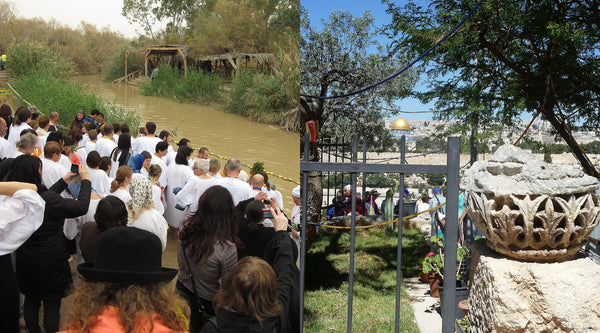
Yardenit is at the southern end of the Sea of Galilee, where the Jordan River flows south from the lake. During normal operation, the purpose-built site offers changing facilities, white baptism robes, accessible river ramps, and organized areas for prayer and immersion.
Yardenit's current pages publish different hour tables. Check the official Yardenit website close to travel and contact the operator before planning a ceremony.
Yardenit is not the traditional lower-Jordan setting associated with Jesus' baptism. Qasr el-Yahud near Jericho is the other main Jordan River baptism site, where the official Israel Nature and Parks Authority page provides current visit information.
For a Galilee day, plan Capernaum, Tabgha, the Mount of Beatitudes, Magdala, or a confirmed boat ride. Add Yardenit only after direct confirmation of current hours and ceremony arrangements.
What Most Groups Miss in Galilee
Here is the honest version of this, from 15-plus years of guiding here.
Most organized tours arrive at each site, spend the scheduled time, and move on.
That is not wrong. But Galilee rewards a slower pace more than almost anywhere else in the Holy Land. No question.
Worth saying: The shoreline of the Sea of Galilee at dawn, before the sites open. If you are staying in Tiberias, get up early and walk to the water. The lake at 6am, with the hills quiet and no one else around, gives you something that no guided tour can replicate. No question.
I'll be straight with you: The residential section of Capernaum, behind the synagogue. Most groups do not get there. The foundations of 1st-century houses. The street level of a working town from Jesus' time. Think about that.
The garden at the Mount of Beatitudes, on a weekday morning in March or April. Green, quiet, Matthew 5 in your lap.
The Primacy church at Tabgha at 7:30am, when you are one of three people inside and you can sit with John 21 for as long as you want.
Let me put it this way: These are not secret sites. They are right in front of everyone. The difference is time.
Every single one.
Key Takeaways
- Galilee is where Jesus spent most of his active ministry years. The Gospels record more healings, teachings, and miracles in this region than in Jerusalem.
- The main pilgrimage sites (Mount of Beatitudes, Tabgha, Capernaum) are clustered within a few kilometers of each other on the northwestern shore of the Sea of Galilee.
- Capernaum preserves the ruins of the 1st-century synagogue where Jesus taught, and the excavated remains of what archaeologists identify as Peter's house.
- The Church of the Multiplication at Tabgha contains a 4th-century mosaic floor with the loaves and fishes image, one of the oldest surviving Christian mosaics in the region.
- Yardenit supports Jordan River baptisms, but its current official pages publish inconsistent hour tables. Confirm access and ceremony arrangements directly before travel.
- A full Galilee circuit of the four main sites takes 4 to 5 hours on the ground. A confirmed boat ride can make it a full day; add Yardenit only after current access and ceremony arrangements are confirmed.
Related Reading
Planning a broader Holy Land pilgrimage? These guides cover the other major stops:
- The Complete Nazareth Guide 2026 - Galilee's other essential stop, where Jesus grew up (this one especially)
- The Mount of Olives Jerusalem Guide 2026 - the Jerusalem counterpart to Galilee
- How to Walk the Via Dolorosa in Jerusalem in 2026 - when your itinerary moves south from Galilee
- Visiting Masada in 2026 - for the southern end of the Holy Land circuit
If you want to see Galilee properly and connect it to the rest of the pilgrimage circuit, take a look at our Holy Land day tours and reach out through our contact page to plan something that fits your group and your schedule.
Frequently Asked Questions
How far is Galilee from Jerusalem, and how do you get there?
Galilee is roughly 2 to 2.5 hours from Jerusalem by private vehicle, depending on the route and starting point. A focused site circuit is possible as a long day, while an overnight in Tiberias gives the day more breathing room.
Can you do Galilee as a day trip from Jerusalem?
Yes, but it is a long day. Leaving Jerusalem by 6am and returning by 8pm is realistic if you focus on the main northwestern shore circuit (Mount of Beatitudes, Tabgha, Capernaum). Adding the boat ride and Yardenit extends it further. For groups who want to move at a more relaxed pace, an overnight in Tiberias is strongly recommended.
What are the most important biblical sites in Galilee for Christian pilgrims?
The four core sites are: the Sea of Galilee (where Jesus walked on water, calmed the storm, and called his first disciples), Capernaum (his ministry headquarters and the location of the 1st-century synagogue and Peter's house), the Mount of Beatitudes (Sermon on the Mount), and Tabgha (the two churches covering the multiplication of loaves and the restoration of Peter). Add Yardenit after confirming current hours and baptism arrangements directly with the site.
What is so significant about Capernaum?
Capernaum was Jesus' base of operations during his Galilean ministry. Matthew 4:13 says he moved there from Nazareth. He taught in its synagogue (Luke 4:31), healed Peter's mother-in-law in Peter's house (Mark 1:29-31), and healed the paralytic whose friends lowered him through the roof (Mark 2:1-12). The archaeological site preserves the basalt foundations of a 1st-century synagogue and the excavated remains of an insula identified as Peter's house, with a Byzantine church built over it.
Matthew 4:13 says he moved there from Nazareth. He taught in its synagogue (Luke 4:31), healed Peter's mother-in-law in Peter's house (Mark 1:29-31), and healed the paralytic whose friends lowered him through the roof (Mark 2:1-12). The archaeological site preserves the basalt foundations of a 1st-century synagogue and the excavated remains of an insula identified as Peter's house, with a Byzantine church built over it.
What happened at Tabgha in the Bible?
Tabgha covers two distinct biblical events. The Church of the Multiplication marks the traditional location of John 6:1-15 and Matthew 14:13-21, where Jesus fed five thousand people with five loaves and two fish. The Church of the Primacy of St. Peter covers John 21:15-17, the post-resurrection scene where Jesus appeared on the shore, cooked fish with the disciples, and restored Peter with the threefold question "Do you love me?" Both churches are worth time.
Can you get baptized at the Jordan River in Galilee?
Yardenit is the organized baptism site at the southern end of the Sea of Galilee. Its official website now publishes opening hours, but the hour tables on its current pages are inconsistent. Contact Yardenit directly to confirm access and baptism arrangements for your date. Qasr al-Yahud near Jericho is the other main Jordan River baptism site.
How much time do you need to see the main Galilee sites?
A focused circuit covering the Mount of Beatitudes, both Tabgha churches, and Capernaum takes roughly 4 to 5 hours on the ground, not counting driving time. A Sea of Galilee boat ride adds about an hour. Add Yardenit only after the site confirms current hours and baptism arrangements.
What is the difference between visiting Galilee and visiting Jerusalem for a pilgrim?
Jerusalem is where the Passion took place. The Old City holds the Via Dolorosa, Gethsemane, and the Church of the Holy Sepulchre - sites connected to Jesus' arrest, trial, crucifixion, and resurrection. Galilee is where his public ministry happened: the teaching, the healing, the calling of disciples, the miracles on the lake. Jerusalem tends to feel dense and layered with history and tension. Galilee is open, rural, and the sites are quieter. For many pilgrims, Galilee is the unexpected emotional center of the trip.
Elias Boaz is a licensed tour guide from Bethlehem - birthplace of Jesus Christ - and the founder of Elijah Tours. He has guided thousands of pilgrims through Bethlehem, Jericho, and the Jordan River Valley - and coordinates Holy Land tours with trusted licensed guides across the region. He writes to help visitors truly understand what they're seeing.