Qasr el-Yahud is the baptism site on the western bank of the Jordan River near Jericho, traditionally associated with the baptism of Jesus (Matthew 3:13–17). The official Israel Nature and Parks Authority page provides seasonal hours, says the last entry is one hour before closing, and requires visitors to coordinate a time in advance.
I have watched people walk down to this water expecting marble and gold. What they find is a narrow, muddy-green river barely wider than a village road - and somehow that makes the weight of it land harder, not softer.
Now let me tell you the part the brochures leave out. I've stood at Qasr el-Yahud more times than I can count. Every single time, the same thing happens to first-timers. They walk down toward the water expecting something grand - marble, columns, the weight of two thousand years made visible and impressive. What they find instead is a narrow, muddy-green river barely wider than a village road, with Jordan sitting right there on the far bank, close enough that you could call across to someone. And then they go quiet. Not disappointed quiet. Something else. Because the smallness of it is exactly the point.
What Qasr el-Yahud Actually Is
The name means "Castle of the Jews" in Arabic - a reference, most scholars think, to the old crossing of the Israelites rather than any actual castle. No fortress here. What you'll find is a set of wooden platforms and stone steps leading down into the Jordan, a few changing rooms, and a stretch of river that has carried more meaning per square meter than almost anywhere on earth. That's not tourism talk. I mean it.
It sits in the lower Jordan Valley, near where the river finishes its long run south toward the Dead Sea, around 400 meters below sea level. The air is heavy down there. Dense and warm in a way that surprises people. In summer its brutal - I'll come back to that.
Here's what most visitors dont realize: this exact bend of the river shows up in Scripture three separate times, across three completely different eras. Same water. Same bank. Three stories.
The Baptism of Jesus
This is the headline. Matthew, Mark, and Luke all describe Jesus coming from Galilee to be baptized by John in the Jordan. Matthew 3:16–17 is the moment - the heavens opening, the Spirit descending "like a dove," the voice. For Christians, this is where the public ministry of Jesus begins. Not in a temple. Not in Jerusalem. In a river, with a wild-looking prophet who ate locusts.
When you stand on those steps, you're looking at the traditional location of that event. Whether you're Catholic, Orthodox, Protestant, Coptic - it doesn't matter. This is shared ground. Everybody comes here.
Older Than the Gospels
But the river was already sacred long before John showed up.
The Book of Joshua (chapter 3) places the crossing of the Israelites into the Promised Land right around here - the waters piling up so the people could cross on dry ground. And 2 Kings 2:5–14 sets the dramatic exit of the prophet Elijah at this same stretch, where he struck the water with his cloak, crossed over, and was taken up in a chariot of fire. Three layers. Joshua, Elijah, Jesus. One riverbank. I tell my groups: you are standing in a place the Bible keeps returning to, like it cant quite leave it alone. That's the difference between this site and almost anywhere else I take people.
The Two Banks - Qasr el-Yahud and Bethany Beyond the Jordan
Here's something that confuses almost everyone. There are two baptism sites facing each other across this narrow river, in two different countries. Think about that for a second.
The western bank - where you'll be standing - is Qasr el-Yahud, reached from the Jericho side. The eastern bank, in the Kingdom of Jordan, is Al-Maghtas, known as "Bethany Beyond the Jordan" (John 1:28 names "Bethany beyond the Jordan" as where John was baptizing). That eastern site was inscribed as a UNESCO World Heritage Site in 2015 and is where most of the archaeology - old churches, baptismal pools - has been excavated.
So which is "real"? Honestly, the river has shifted its course over the centuries, and the events happened on and around the water, not at a fixed GPS pin. Both banks honor the same tradition. You'll see pilgrims on the Jordanian side waving at pilgrims on yours. Same river. Same story. Different passport.
Why It Was Closed for Decades - and How It Reopened
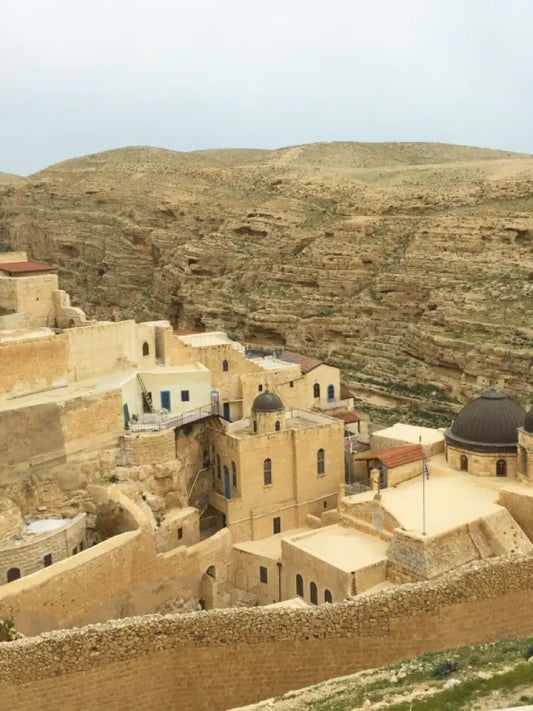
For most of the late twentieth century, you could not come here. The whole area became a closed military zone, and the surrounding land - a cluster of historic monasteries known as the "Land of the Monasteries" - was fenced off and seeded with landmines. The churches sat empty and crumbling behind the wire for over forty years. Forty years. That still gets me when I think about it.
The baptism site reopened in 2011, managed today by the Israel Nature and Parks Authority. A place sealed for a generation, opened again within living memory.
The bigger cleanup came later. The HALO Trust, the international demining organization, worked alongside the national mine-clearance authority to remove landmines and unexploded ordnance from the grounds around seven or eight of those abandoned churches - Franciscan, Greek Orthodox, Ethiopian, Romanian, Russian, Syrian, Coptic. That clearance work ran through roughly 2018 to 2023. The churches are slowly being restored. Every single one.
This is why you'll see signs telling you to stay on the marked paths. The baptism area is completely safe and has been for years. But the wider valley still has zones that arent cleared, so you keep to the boardwalks and you dont wander. Simple rule. Follow it.
Qasr el-Yahud vs. Yardenit - Which Should You Choose?
This is the question I get most. There's a second, more famous-to-tourists baptism site up north called Yardenit, at the southern tip of the sea of galilee where the Jordan flows out. Groups love it because its easy, landscaped, and has a big gift shop. But it is not the traditional baptism site. It opened in 1981 as a managed alternative when Qasr el-Yahud was still off-limits.
Here's the honest comparison:
My take? If you are already in Galilee, check Yardenit's official status before making plans because the operator currently marks that site temporarily closed. For a lower-Jordan visit near Jerusalem, Bethlehem, or Jericho, coordinate Qasr el-Yahud in advance.
How to Get to Qasr el-Yahud

people near dome theater - Photo by Laura Siegal on Unsplash
There's no bus that drops you at the gate. None. So you've got two realistic options: a taxi, or a tour.
From Jerusalem, Bethlehem, or Jericho
From Jerusalem it's about a 45-minute drive east on Route 1 toward the Dead Sea, then north a short way on Route 90. From Jericho, the world's oldest city, you're only about 15 minutes away. From Bethlehem, where I'm based, it's a straightforward run down into the valley - a route I know well by now.
A taxi from Jerusalem and back, with waiting time, will cost you a fair bit and you'll be on the driver's clock. The smoother way is a guided day that builds the site into a sensible route, so you're not paying a meter to sit and wait - which brings me to the next part.
Combine It With Jericho and the Dead Sea
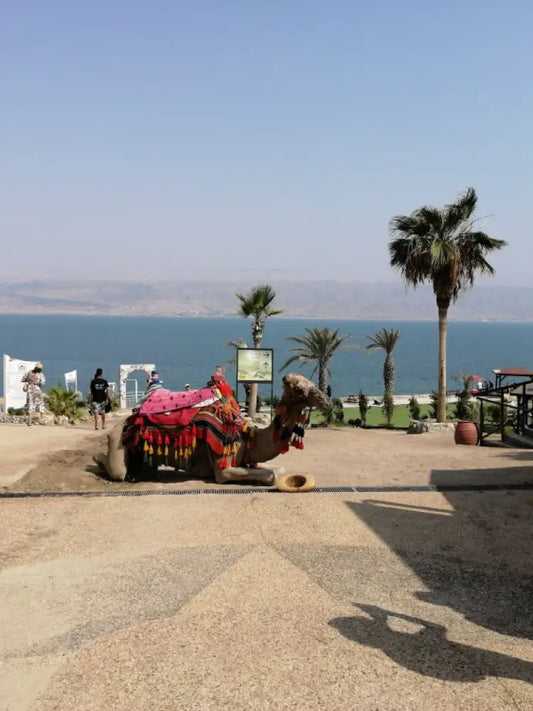
This is the move. The geography hands you a perfect loop. Jericho, Qasr el-Yahud, and the Dead Sea all sit within a short drive of each other in the same valley. Walk the ancient ruins of Jericho in the morning, stand in the Jordan by midday, float in the Dead Sea by afternoon. One day. Three of the most extraordinary places on the planet. No question.
We run this exact route as a private day, and it's one of my favorites to guide - you can see how I'd structure a longer trip in my 7-day Holy Land pilgrimage itinerary, and you can look at our private Holy Land tours or shorter day tours if you want someone else handling the driving and the timing. That matters more than people think.
What to Expect When You Arrive

a river running through a dry grass covered field - Photo by Wendi Wells on Unsplash
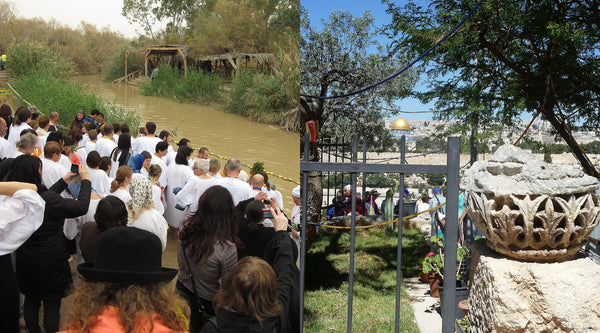
Entry is free. Wooden platforms, railings, steps going right down into the river. Changing rooms to one side. White baptismal robes sold near the entrance if you want one. The water is not a swimming pool - it's a real river, so it runs murky and greenish, and yes, there are little fish that'll nibble at your feet. That part always gets a laugh. Always.
Most days it's quieter than people expect. Then on certain feast days its packed wall to wall. Both versions are worth seeing, depending on what you're after.
Can You Get Baptized or Renew Your Vows?
Immersion and renewal ceremonies use the designated river area while visitors wear the required white robe, subject to current site rules. Bring your own clergy if the group wants a formal religious service.
Confirm the ceremony plan, robe arrangements, accessible route, and water-entry rules when coordinating the visit. Stay on marked paths and inside the managed visitor area.
What to Bring and Wear
Keep it simple:
- A white robe (buy one on-site) or modest swimwear to wear underneath
- Water shoes or sandals - those steps get slippery
- A towel and a change of clothes
- Lots of water and serious sun protection - the valley is hot and exposed (this one especially)
- Your passport stays in your pocket; you dont need it to enter the water
When to Go

Qasr el-Yahud uses seasonal opening hours, and the official page says the last entry is one hour before closing. Coordinate a time before travel. The Jordan Valley does not mess around in summer. July and August can push past 40°C, sometimes higher, and there's almost no shade down there. If you come in summer, go early - before the heat sits on you like a blanket. I write more about surviving the season in my guide to visiting the Holy Land in summer.
The big day here is Epiphany - Theophany, the Orthodox churches call it - in January, when the celebration of Christ's baptism brings huge, joyful crowds down to the water. Beautiful to witness. Also very crowded. You've been warned.
For most pilgrims, spring and autumn are the sweet spot. Comfortable temperatures, manageable crowds, and the light in that valley in the late afternoon is something else entirely. Worth timing your visit around if you can.
If you want the fuller story of this river - what it's meant to people across centuries - I wrote a separate reflection on the Jordan River and its meaning.
Key Takeaways
- Qasr el-Yahud near Jericho is the traditional lower-Jordan setting associated with Jesus' baptism (Matthew 3); coordinate the visit in advance and recheck seasonal hours.
- It sits directly across a narrow stretch of the Jordan River from Jordan's "Bethany Beyond the Jordan" (Al-Maghtas), a UNESCO World Heritage Site since 2015.
- Closed for decades as a mined military zone, the baptism site reopened to pilgrims in 2011; the surrounding historic churches were cleared of landmines roughly between 2018 and 2023.
- Yardenit is a modern baptism complex near the Sea of Galilee, but its operator currently marks it temporarily closed; Qasr el-Yahud is the traditional lower-Jordan setting.
- There's no public transport - reach it by taxi or a private/day tour, ideally bundled with Jericho and the Dead Sea in a single loop.
🌱 Plan Your Holy Land Tour


Frequently Asked Questions

brown mosque at daytime - Photo by Toa Heftiba on Unsplash
Where exactly is Qasr el-Yahud, and is this really where Jesus was baptized?
Qasr el-Yahud is on the western bank of the Jordan River, about 10 km east of Jericho and roughly 400 meters below sea level. It's the traditional site of Jesus' baptism described in Matthew 3:13–17, and it directly faces the site of Bethany Beyond the Jordan on the Jordanian bank.
Is Qasr el-Yahud safe to visit, given the old minefields?
Yes. The baptism site reopened in 2011 and is completely safe - you stay on wooden platforms and marked paths. Old mined zones in the wider valley were fenced off, and demining of the surrounding churches ran from about 2018 to 2023. Just follow the signs and don't wander off the boardwalks.
Can you actually be baptized or immersed in the water there?
Yes. Visitors regularly enter the river for full immersion, a symbolic dip, or to renew baptismal vows. Many groups bring their own clergy and hold a short service on the steps. There's no fee to go in and white robes are available to buy at the entrance.
Qasr el-Yahud or Yardenit - which is the "real" baptism site?
Qasr el-Yahud is the traditional, historical location near Jericho. Yardenit, near the Sea of Galilee, is a comfortable managed alternative that opened in 1981 when Qasr el-Yahud was closed. If you want the actual traditional site, choose Qasr el-Yahud - and entry is free.
Related Reading

a view of the old city of jerusalem - Photo by David Holifield on Unsplash
- The Jordan River: A Sacred Place of Baptism, Renewal, and Faith
- How to Plan a 7-Day Holy Land Pilgrimage Itinerary in 2026
- Visiting the Holy Land in Summer: Heat, Crowds, and How to Do It Right
If you'd like to stand in that river yourself - and let me handle the route, the timing, and the heat - come talk to me directly.
Bring a towel. The Jordan does the rest.
Elias Boaz is a licensed tour guide from Bethlehem - birthplace of Jesus Christ - and the founder of Elijah Tours. He has guided thousands of pilgrims through Bethlehem, Jericho, and the Jordan River Valley - and coordinates Holy Land tours with trusted licensed guides across the region. He writes to help visitors truly understand what they're seeing.