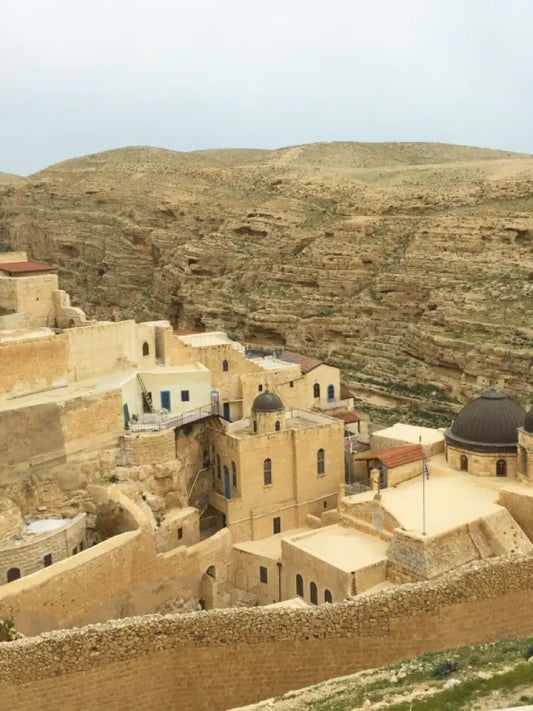
As a Bethlehem-based tour guide, masada is a desert fortress built by Herod the Great on a mesa above the Dead Sea, best reached from Jerusalem or Bethlehem on a half-day or full-day trip. You can hike the Snake Path (45-60 minutes, -- or maybe I should say 900 steps) or take the cable car (3-4 minutes). The site takes 2.5 to 4 hours to explore properly.
What Masada Is (and Why Christian Pilgrims Go There)
After guiding many groups through the Holy Land, masada was built by Herod the Great around 37 BCE on the top of a natural rock plateau, about 450 meters above the floor of the Judean Desert, with the Dead Sea visible to the east and the Jordanian mountains beyond it. Two palaces. Elaborate storehouses. Bathhouses and cisterns fed by an aqueduct system. All of it carved out of desert rock.
As local guides often point out, the reason it matters to pilgrims is not the architecture, though the architecture is genuinely impressive. It is the timeline.
Herod the Great is honestly the king in Matthew 2. He is the one who ordered the massacre of the infants in Bethlehem. I grew up in Beit Sahour, minutes from the Church of the Nativity, and Herod is not an abstraction there. His fingerprints are everywhere in this region: in Jerusalem, in Jericho, and on this plateau. When you stand at Masada and understand the kind of ruler Herod was, the desperation behind Mary and Joseph's flight to Egypt begins to make more sense.
After Herod's death, the fortress passed through various hands. During the Jewish-Roman War, a group of Jewish Zealots held Masada against the Roman legions for several years (no joke), until 73 or 74 CE, long after Jerusalem fell. The Roman siege is honestly visible from the top of the mesa. Eight military camps. A circumvallation wall built to prevent escape. A massive ramp on the western side, constructed by the Romans to reach the walls. All of it still standing after two thousand years. Call me biased, but nothing beats being here in person.
I bring this up because some pilgrims wonder why a non-Christian site belongs on their Holy Land itinerary. The answer is that understanding the Roman world of the first century makes the New Testament world three-dimensional. The Jerusalem that authentic jesus walked, the authority that crucified him, the political tensions running through the Gospels: Masada puts flesh on all of it. Makes sense?
The Sunrise Hike (Snake Path): What Actually Happens
Starting Time and What to Bring
The Snake Path gate at the eastern base of Masada opens at 5:00am. If you are coming from Bethlehem with a private guide, that means leaving by 3:00 or 3:30am at the latest.
From Jerusalem, slightly later.
Before you dismiss that departure time: I have done this with hundreds of groups, and I have never heard a single person say afterward that it was not worth it. Not one. You get the idea.
What you need for the hike: - At least 2 liters of water per person (more in shoulder season) - Closed shoes with grip. The steps are uneven and the footing in the dark requires attention - A headlamp or phone torch - Layers. The Judean Desert is cold before dawn, even in months that feel warm during the day
See our complete guide to what to pack for a Holy Land pilgrimage for a fuller packing list, including desert-specific items most visitors forget.
The Hike Itself
The Snake Path is 1.3 km long with roughly 900 steps. Most people with average fitness complete it in 45 to 60 minutes. It is not technical climbing. A guide who's been doing this 30 years would explain it better, but it is steep in sections, the steps are uneven, and there are stretches without guardrails on the drop side. You are walking in the dark, on an unfamiliar path, on a desert mountain. Respect that. No question.
In the dark, the path feels longer than it is. You hear other hikers ahead and behind you. The stars are amazing in the Judean Desert, no light pollution for kilometers. The first suggestion of light on the horizon usually appears when you are about halfway up. That matters.
By the time you reach the top, you can see the outline of the mesa, the dark shapes of the ruins, and to the east, the Dead Sea below you catching the earliest color. The Jordan mountains are a ridge against the sky. Every single one.
What the Sunrise Looks Like From the Top
And then it happens.
I am not going to oversell it. I am a practical guide, not a poet. But I have watched hundreds of people stand at the top of Masada at sunrise, looking east over the Dead Sea, and I have watched what it does to them. Worth it.
Groups from different countries, most of whom barely spoke to each other on the way up, standing together in the cold. Nobody talking -- not unlike what my mother always said about hospitality, that the best welcome doesn't need explanation, and honestly the same logic applies to guiding. Just the Dead Sea below going from black to silver to gold as the sun lifts over Jordan.
A group from Texas I took up a few years ago: third day of their trip, still finding their feet. One of them came off the summit in the morning light and said to me, "I didn't expect to feel Romans up here. I expected to feel Jesus.". Not even close. Makes sense?
I told him: you have to understand the world Jesus lived in before you can fully feel Jesus in it. That is why Masada matters.
(Just reminded of a pilgrim from Ohio who came three times before she finally made it -- that's a whole other story.)
The Cable Car Option (and Who Should Take It)
The cable car runs from the eastern base of the mountain to a station near the top. The ride takes 3 to 4 minutes. It gives you a different view of the scale of the cliff that you simply do not get on foot in the dark. Not even close.
Take the cable car if: - You are traveling with children under about 10 - Anyone in your group has mobility limitations - You are visiting in June, July, or August (more on this below) - Your itinerary combines Masada with a Dead Sea stop in the same morning - You need to be back in Jerusalem or Bethlehem by early afternoon. Big difference.
Honest position: if you have reasonable fitness and you are visiting between September and May, the sunrise hike is the better experience. Not because the cable car is wrong, but because arriving before the crowds, in the silence, watching the sun come up, changes what Masada is for you. The cable car lands you in the middle of a tourist site. The hike lands you on a mountain. You know what I mean? If you ask me, this is what makes the Holy Land different from any other destination.
Honestly, but the cable car is a real and valid way to experience the ruins. You see everything the hikers see. You just arrive differently. Every single one.
(Side note: I'm writing this between two back-to-back groups today. Worth pausing to get this down properly.)
What You'll See at the Top
Interested in seeing our collection? → Browse Tours to Jerusalem

a domed building with a gold roof , Photo by Jonny Gios on Unsplash
Herod's Northern Palace
This is the most photographed structure on Masada, and for good reason. Herod built a three-tiered hanging palace on the northern tip of the plateau, hanging off the cliff face at three different levels connected by internal staircases. The engineering is extraordinary for 37 BCE. Think about that. This is the kind of thing that drives me crazy about generic tour packages.
What remains: sections of fresco painted walls (protected now from the elements), mosaic floors, column bases, and views from the northern terrace that look almost straight down into the desert below.
The lowest terrace sits about 100 meters below the plateau top. Every single one.
The Western Palace and Storehouses
The western palace was Herod's main administrative complex on the site. Larger in footprint than the northern palace. You can make out distinct rooms, corridors, and bathrooms. And it works.
The storehouses are the part that arrests people. Long, narrow rooms arranged in parallel rows, originally used to hold grain, oil, wine, and other supplies for what Herod intended as a last-resort refuge. The walls are almost fully intact. You walk between them and it feels immediately recognizable as storage, as a pantry, as something built by people who were planning to be here a long time. No question.
The Synagogue
This is the part most visitors rush past on their way to the northern palace, and that is a mistake.
The synagogue at Masada is one of the oldest known synagogue structures in the world. It was already in use when the Zealots held the fortress during the siege. Scrolls found here, when excavated in the 1960s, matched texts that also appeared among the Dead Sea Scrolls discovered near Qumran, about 40 km to the north. And it shows.
For Christian pilgrims, this matters. Jesus read from scrolls in synagogues that looked like this. The Judaism of the first century is not abstract when you are standing in a room where it was practiced under Roman siege. That's the difference.
The Roman Siege Works (Visible from the Mesa Top)
Walk to the western edge of the mesa and look down. You can see the Roman ramp that the legions built to reach the walls, using thousands of tons of stone and earth compacted into a slope against the cliff. You can also see the remnants of the circumvallation wall that surrounded the base of the mountain, and the eight camps that housed the Roman forces during the siege. That's the difference.
Two thousand years. And it is still there, undisturbed, because nobody lives near it and nobody had reason to build on it. The Judean Desert preserves things. And it shows.
Honestly, for context on what was happening in Jerusalem while Masada was under siege, and on the Roman-era city that Jesus walked, our Mount of Olives Jerusalem Guide 2026 covers that world in detail. Not even close.
The Mosaic Floors
Scattered across several structures at Masada are mosaic floors in remarkably good condition. The patterns are geometric throughout: no figures, no faces, no animals.
Jewish law at the time prohibited representational imagery in religious and domestic contexts. Every single one.
The contrast with Roman mosaics of the same era (which often depict mythological figures and portraits) makes you understand something about the difference in culture and belief that created the collision of the first century. That's the difference.
Combining Masada With a Dead Sea Day

brown rock formation during sunset , Photo by Cristina Gottardi on Unsplash
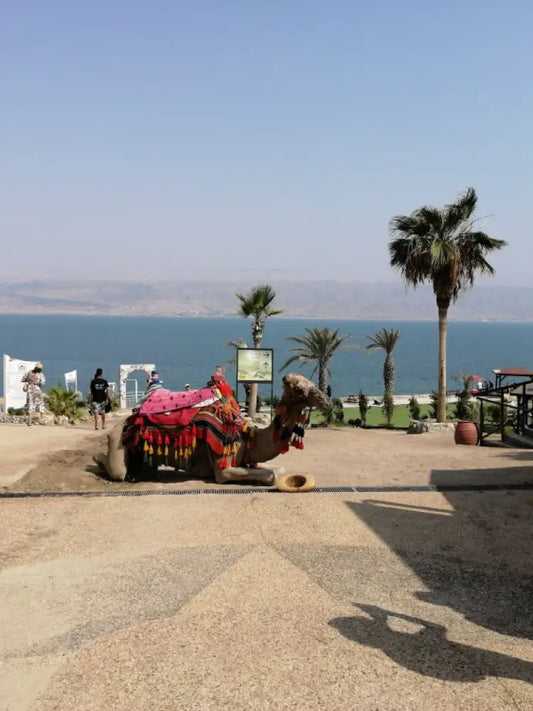
Most people who visit Masada combine it with a Dead Sea float on the same day. The Dead Sea is about 30 minutes north of Masada along the shore road, and the combination is genuinely the most efficient way to include both in a pilgrimage itinerary. That matters.
If you are planning a full Holy Land week, our 7-day Holy Land pilgrimage itinerary guide suggests Masada and the Dead Sea as a natural Day 5, following Jericho on Day 4. The Jericho and Dead Sea region works well as a cluster.
A note on food: Masada has a cafeteria near the cable car station. It is basic and not cheap. The better option, and what I always recommend, is to pack a lunch from Bethlehem or your hotel and eat at the Dead Sea beach after the float. A meal at the water's edge after a morning at Masada is one of those quiet, good moments in a pilgrimage. Worth it.
If you have a full day and want to add more, Jericho sits between Bethlehem and Masada on the map. Some groups include Mount of Temptation and the ancient authentic tell es-sultan ruins in Jericho before continuing south to Masada. That is a long day (I keep meaning to write a whole separate post about this part specifically and never do -- consider this your preview). Manageable with a private guide who knows the pacing, but it is a lot for first-time visitors. That's the difference.
We offer private [day tour](/collections/day-tours-israel)s combining Masada and the Dead Sea that depart from Bethlehem or Jerusalem, timed around the sunrise or the cable car depending on the group. If you want to add Jericho to your day tours itinerary, that is also possible, though I recommend it for people who have already seen Jericho separately.
Big difference.
What Most Visitors Get Wrong

aerial view of trees and buildings , Photo by Thalia Tran on Unsplash
The summer heat on the Snake Path is not just uncomfortable. It is dangerous.
July and August temperatures on the exposed eastern face of Masada can reach 40 degrees Celsius before 9am. I have seen visitors begin the hike in summer and turn back before the halfway point, dehydrated and shaken. The path has no shade. None. Take the cable car in summer, full stop. That matters.
Not bringing enough water. Even in cooler months, the desert dehydrates you faster than you expect. Two liters per person, minimum. The small water fountain near the cable car station top is not a substitute.
Spending all the time in the northern palace and missing the synagogue and the siege works. The northern palace is visually dramatic and it draws everyone. But the synagogue and the view of the Roman camps from the western edge are what make Masada historically significant. Do not skip them.
Expecting a Christian site. Masada is not a Christian biblical site in the way that Bethlehem, Jerusalem, the Sea of Galilee, or Nazareth are. It is a Jewish historical site from the period surrounding the Gospels. The pilgrims who get the most from it are the ones who approach it with that framing: not "where does Jesus appear here?" but "what was the world Jesus lived in actually like?"
Key Takeaways
Interested in seeing our collection? → Browse Tours to Bethlehem
- Masada is a UNESCO World Heritage Site located in the Judean Desert, approximately 90 km from Jerusalem
- Two access routes: the Snake Path hike (45-60 minutes, roughly 900 steps) or the cable car (3-4 minutes)
- Sunrise hiking via the Snake Path is strongly not recommended from June through August due to extreme desert heat
- The site preserves Herodian-era palaces, one of the oldest known synagogue structures, and Roman siege works visible from the mesa top
- A combined Masada and Dead Sea day trip is the most efficient way to visit both sites in one day from Jerusalem or Bethlehem
- The Roman siege camp and ramp from 73-74 CE are among the best-preserved Roman military installations anywhere in the world
Related Reading

brown mosque at daytime , Photo by Toa Heftiba on Unsplash
- Jericho Holy Land Guide 2026: The World's Oldest City for Christian Pilgrims
- What to Pack for a Holy Land Pilgrimage in 2026
- The Mount of Olives Jerusalem Guide 2026
- The Complete Nazareth Guide 2026 -- and this is the one most people overlook
Frequently Asked Questions

a view of the old city of jerusalem , Photo by David Holifield on Unsplash
Is the Masada sunrise hike worth it?
Yes, for visitors with reasonable fitness who are coming between September and May.
The hike takes 45 to 60 minutes, and the views from the top before dawn, looking east over the Dead Sea toward Jordan, are unlike anything else in the Holy Land. The silence before other visitors arrive, the cold, the first light: it is one of those hours people describe to others for years afterward. In summer (June through August) the heat is dangerous and the cable car is the better choice.
How long does it take to visit Masada?
Allow 2.5 to 4 hours on site, depending on how thoroughly you explore.
Add travel time from your base: Jerusalem is about 90 minutes each way, Bethlehem is slightly less. Most visitors combine Masada with a Dead Sea stop, which makes for a full day of roughly 10 to 12 hours from departure to return.
Can I visit Masada without a guide?
Yes. The site is well signposted, the museum at the cable car station is informative, and there is an audio guide option. You can navigate it independently. But a guide who understands the Roman siege, the Jewish context, and the connection to the New Testament world will make the visit genuinely different. The ruins become legible in a way they are not otherwise. Many visitors who go without a guide tell me later they wish they had not.
What is the best time of year to visit Masada?
October through April is the best window: manageable temperatures, the sunrise hike is comfortable, and crowds are lower than the summer school holidays. If you must visit in July or August, take the first cable car of the day and be back down before 11am. The heat on the exposed plateau in the middle of a summer day is significant. If you are planning a Holy Land trip and have flexibility on timing, our guide to the Holy Land in autumn makes the case for October and November as the best overall season for the region.
Can you do Masada and the Dead Sea in one day?
Yes, and it is the recommended combination. Masada in the morning, Dead Sea in the afternoon. The drive between them is about 30 minutes along the shore road. Most private tour groups from Bethlehem or Jerusalem do exactly this. Some groups also add Jericho, which is manageable if you start early and have a guide keeping the pace. For a practical route, see our complete Jericho guide.
How difficult is the Snake Path hike at Masada?
Moderately challenging. The path is 1.3 km long with roughly 900 steps, steep in sections, and uneven underfoot throughout. Most people with average fitness complete it in 45 to 60 minutes. It is not technical climbing, and there are no ropes or scrambling involved. But it is fully exposed (no shade anywhere), done mostly in the dark, and the footing requires real attention. Closed shoes with grip, water, and a headlamp are essential. Sandals are a bad idea. Open shoes are worse.
Elias Boaz is a licensed tour guide from Bethlehem , birthplace of Jesus Christ , and the founder of Elijah Tours. He has guided thousands of pilgrims through Bethlehem, Jericho, and the Jordan River Valley , and coordinates Holy Land tours with trusted licensed guides across the region. He writes to help visitors truly understand what they're seeing.