The Mount of Olives is a ridge just east of Jerusalem's Old City, across the Kidron Valley. It holds some of Christianity's most important sites: the Garden of Gethsemane, the Church of All Nations, Dominus Flevit, and the Pater Noster. Most pilgrims walk it downhill, top to bottom, in one morning. See what I'm getting at?
I have walked this hill more times than I can count, and I still think most people do it wrong. Not from carelessness. Nobody ever told them the one thing that changes the whole morning: start at the top, and walk down. Do that, and the Mount of Olives gives you everything it has.
I have walked this hill more times than I can count. Honestly. And I still think most people do it wrong. Not because theyre careless. Because nobody told them the one thing that changes the whole morning. So let me tell you.
Where the Mount of Olives Actually Is (and Why That Matters)
Here's what most visitors dont realize until they're standing there. The Mount of Olives is not some remote mountain you drive an hour to reach. It is right there - right across a narrow valley from the Old City walls. You stand at the top and look straight across at the Temple Mount, the golden Dome of the Rock sitting in the middle of it, the gray domes of the Holy Sepulchre poking up behind the rooftops further back. That close. That immediate.
The valley in between is the Kidron. In the Bible it is the valley David crossed when he fled Jerusalem, and the one Jesus crossed the night he was arrested, going from the city out to the garden. So when you walk down this hill toward Gethsemane, you are more or less walking the route of that night. People feel that, even when they dont know the geography. Something about it sits heavy. I see it on faces every time.
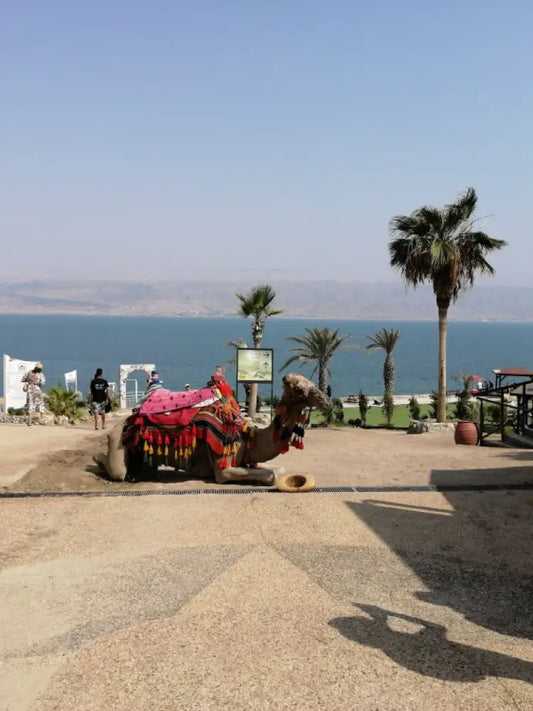
The slope itself is a working hillside, not a manicured park. Much of it is covered by an ancient Jewish cemetery - one of the oldest and largest anywhere - the white stone graves stacked down the hill in the morning sun. Churches are scattered along the descent. Taxis idle at the top. There are vendors, sometimes a man with a camel hoping youll pay for a photo. It is busier and more ordinary than people expect, and then you turn a corner into a quiet chapel and the ordinary just falls away.
Walk It Downhill. That's the Whole Secret.
Not gonna lie - if you remember one thing from this guide, remember this: start at the top and walk down.
Take a taxi from near the Old City up to the summit, to the area by the Chapel of the Ascension and the viewpoint. Then walk down the hill, stopping at each site as you go. Simple. The grade is steep and the lane is old and cobbled in places, so you finish at the bottom near Gethsemane having gone with gravity the whole way, not against it.
I have watched groups try to do it the other way, climbing up from Gethsemane in the heat. By the third stop theyre done. Red faces, no water left, nobody listening to a word about the Pater Noster because theyre just trying to breathe. Dont be that group. Walking down, you see the same sites in the same order the story moves, and you arrive at the garden - the emotional heart of the whole walk - at the end instead of the start. That order matters more than people think.
Wear real shoes. I mean it. Not sandals, not new white sneakers you want to keep clean. The stone is uneven and polished smooth by a few thousand years of feet. If youre coming in summer, bring water and start early, because this hillside has almost no shade and the Jerusalem sun is not gentle. I wrote a whole piece on surviving the Holy Land in summer heat if youre travelling between June and September, and honestly most of it applies to this hill specifically. Not just saying that because I've spent my life guiding people here.
One more thing, and this is the part most people overlook. This downhill route is also, not by accident, close to the Palm Sunday road. The Gospels describe Jesus coming over the Mount of Olives and down toward the city to the crowds with palm branches (Luke 19, Matthew 21). You are walking toward Jerusalem the way the triumphal entry came. I dont point that out to every group right away. I let them walk a bit first, then mention it, and you can see it land. Big difference.
The Sites, Top to Bottom

brown mosque at daytime , Photo by Toa Heftiba on Unsplash
Here is what you actually stop at, in the order you reach them coming down.
The Panoramic Viewpoint
This is the postcard. The whole Old City laid out in front of you, the Temple Mount filling the centre, the walls, the domes, the cemetery falling away below your feet. In the morning the light comes from behind you and lands on the city, and it glows. By afternoon youre looking into the sun and it all goes flat and hazy. No question.
Go early. Before the tour buses, the viewpoint is calm and you can actually stand and look. An hour later it is shoulder to shoulder with people taking the same photo. The view doesnt change. The experience of standing there does, completely. You get the idea.
The Chapel of the Ascension
Small. Plain. Domed. Tradition holds this as the place of the Ascension, where the disciples watched Jesus taken up into heaven (Acts 1:9-12). Inside theres a stone with a mark in it that pilgrims have honored for centuries as a footprint. Is it literally that? Im a guide, not a theologian, and I wont pretend to settle questions like that. But people have come here to remember the Ascension for a very, very long time, and that continuity is its own kind of weight. I've seen people tear up just standing in the doorway. No joke.
It is a quick stop. Modest. Easy to walk past if you dont know what it is, which is exactly the kind of thing that bothers me about rushing a hill like this.
The Church of the Pater Noster
A little further down. This is the spot tradition connects with Jesus teaching the disciples the Lord's Prayer, the Our Father (Luke 11). And here is what people love about it: the prayer is mounted on tiled panels all over the walls and cloister, in more than a hundred languages. You walk along and you hunt for your own. English, Tagalog, Korean, Amharic, Portuguese - whatever it is, its probably here somewhere.
I have watched a quiet older man from Poland find the Polish panel and just stop, and read it under his breath. The prayer he learned as a boy, on a wall on a hillside outside Jerusalem. That happens here a lot. Give yourself a few minutes to look. It's worth every one of them.
Dominus Flevit
The name means "the Lord wept." This is the small Franciscan chapel shaped like a teardrop, marking the place tied to Luke 19:41, where Jesus looked over Jerusalem and wept for it. Call me biased, but nothing beats being here in person.
Whoever designed the chapel did one perfect thing. The window behind the altar frames the Old City - the Temple Mount right in the middle - so when you sit inside facing forward youre looking at the exact view that drew those tears in the story. Quietly devastating, in the best way. A lot of people miss it because the chapel is small and easy to skip. Dont skip it.
(Side note: I always think about how the old streets of Bethlehem have somewhere between 2000 and 3000 years of continuous walking in them. This hill has the same quality. You're stepping where generations before you stepped. That's not a small thing.)
The Garden of Gethsemane and the Church of All Nations
At the bottom of the descent you reach the garden. Gethsemane. Ancient, gnarled olive trees behind a low fence, some of them very old, their trunks split and twisted like rope. The word Gethsemane comes from an olive press - which is what this place was - and the trees are the reason the name still fits. Every single one of them looks like it has a story.
My phone is blowing up with messages from a group I guided last month - they want to come back already. That's honestly the best feedback there is.
Next to the garden is the Church of All Nations, also called the Basilica of the Agony. Inside, in front of the altar, is a piece of exposed bedrock - the Rock of Agony - honored as the stone where Jesus prayed the night before the crucifixion (Matthew 26). The church is kept deliberately dim, the windows a deep violet, so you come in from the bright morning and your eyes take a second to adjust and then the whole room is this low purple hush. I never get tired of that transition.
This is where people go quiet. Every single time. I had a woman from Georgia - the American one, Augusta I think - sit down inside there one spring and not move for the better part of an hour. Her group went on ahead. I stayed. She didnt say anything and I didnt either. That was one of the better hours Ive had doing this job. The garden does that to people. You dont need me narrating over it.
The Tomb of the Virgin Mary
Down at the foot of the hill, near the Kidron, there is also the Tomb of the Virgin Mary - a church built down a long flight of stone steps into the rock. Many groups stop here on the way back toward the Old City. If you have time and your legs are still good, its worth the descent. If youre fading, its an easy one to save for another trip. No shame in that. You get the idea.
When to Go, What's Open in 2026, and How Long You Need

a hill covered in lots of trees on top of a hill , Photo by Kostas Morfiris on Unsplash
Go in the morning. (My father would have something to say about this - he always said the best guides dont talk too much, they let the place speak for itself. But on this particular point I'll keep talking.) Morning solves three problems at once: the light is right at the viewpoint, the crowds havent arrived, and the churches are open.
That last one matters more than people expect. Like a lot of churches in the Holy Land, the sites on the Mount of Olives generally run on a split schedule - open in the morning, closed for a stretch around midday, open again later in the afternoon. Show up at noon and you can find yourself standing outside locked doors at Gethsemane wondering what went wrong. So build your visit around an early start. Hours shift by season and by site, so if youre on a tight schedule its worth confirming the day before. Big difference.
As for 2026: the sites are open and pilgrims are visiting. Things are quieter than they were a few years back, and most of us are running private groups rather than the big bus crowds. Ill be honest with you - the quiet is its own gift. To stand at Dominus Flevit or in the garden with just your own small group and no crowd pressing through is a rare thing, and right now its more possible than usual. If youre weighing the timing of a trip at all, my honest breakdown of the seasons goes through the trade-offs month by month.
Here is the hill at a glance.
How the Mount of Olives Fits a Jerusalem Day, and a Whole Trip

A herd of sheep grazing on a lush green field , Photo by Devon MacKay on Unsplash
The Mount of Olives is a morning. Not a full day. And it fits together with the Old City almost too neatly to ignore.
Here is the route I run most often. Start at the top of the hill early, walk down through the sites to Gethsemane, then cross the Kidron and go up to the Old City through the Lions' Gate - which puts you right at the start of the Via Dolorosa. Walk the stations through the Muslim and Christian Quarters, and you finish at the church of the holy sepulchre. One of the great mornings of Christian travel, and most of it is on foot. By early afternoon youve walked from the Ascension to the empty tomb. That arc is not accidental.
A lot of my groups base in Bethlehem and come up to Jerusalem for the day, which works fine. You just want to plan the crossing into your timing so you still get that early start. If thats your plan, the practical side of getting between the two is covered in my guide to crossing at Checkpoint 300, so you know what the morning looks like before you do it. And if youre trying to slot the Mount of Olives into a longer pilgrimage, the way it sits inside a full week is laid out in my 7-day Holy Land itinerary.
Can you do the hill on your own? Yes. Honestly, yes. It is walkable, the sites are close together, and you wont get lost going downhill. What you miss without a guide is the why. Which stone, which window, which verse - what youre actually looking at when you pass a plain little chapel that turns out to be one of the most moving spots on the hill. Big group tours will get you to the sites. They wont always get you into them. If you want someone walking it with you who grew up an hour south of here and has done this descent a few hundred times, we run private Jerusalem tours and broader private Holy Land tours that build the Mount of Olives into the day at the right pace. Worth it.
Key Takeaways
- The Mount of Olives is best walked downhill, starting at the top by the viewpoint and finishing at the Garden of Gethsemane at the bottom.
- The main stops, in order, are the panoramic viewpoint, the Chapel of the Ascension, the Church of the Pater Noster, Dominus Flevit, and the Garden of Gethsemane with the Church of All Nations.
- Most churches here close around midday, so morning is the only reliable window, and morning light is also best at the viewpoint.
- You need two to three hours to walk it without rushing, and it connects directly to the Via Dolorosa and the Church of the Holy Sepulchre through the Lions' Gate.
- As of 2026 the sites are open and crowds are thinner than usual, which makes the quieter chapels like Dominus Flevit and Gethsemane especially worth your time.
🌱 Plan Your Holy Land Tour


Frequently Asked Questions

A herd of sheep grazing on a lush green field , Photo by Devon MacKay on Unsplash
How long does it take to walk the Mount of Olives?
Plan on two to three hours to walk it properly from the top down to the Garden of Gethsemane. You can rush it in under an hour, but you'll blow past the chapels that make the hill worth visiting. Going slow, with stops at the viewpoint, the Pater Noster, and Dominus Flevit, is the point.
Is the Garden of Gethsemane on the Mount of Olives?
Yes. The Garden of Gethsemane sits at the foot of the Mount of Olives, at the bottom of the slope near the Kidron Valley, right beside the Church of All Nations. It is the last major stop when you walk the hill downhill, and for most pilgrims it is the most moving one.
What is the best time of day to visit the Mount of Olives?
Early morning. The light falls on the Old City from behind the viewpoint and the whole panorama glows, the crowds haven't arrived yet, and the churches are open before they close for their midday break. By afternoon you're looking into the sun and waiting for locked doors to reopen.
Can you walk the Mount of Olives without a guide?
Yes, the hill is walkable on your own and the sites are close together going downhill. A guide mainly adds the context (yes, really) - which chapel marks what, which verse goes with which spot, and the small places most people walk straight past without realizing what they're looking at.
What can you see from the top of the Mount of Olives?
From the viewpoint you look straight across the Kidron Valley at Jerusalem's Old City: the Temple Mount and the Dome of the Rock in the center, the city walls, the rooftops, and the domes of the Church of the Holy Sepulchre beyond. The ancient Jewish cemetery covers the slope below you.
Related Reading

white dome building during daytime , Photo by Levi Meir Clancy on Unsplash
- Visiting the Holy Land in Summer: Heat, Crowds, and How to Do It Right
- What Actually Happens at Checkpoint 300: A 2026 Guide From Your Bethlehem Host
- How to Plan a 7-Day Holy Land Pilgrimage Itinerary in 2026 (I could write a whole post just about this)
- [Best Time to Visit Bethlehem -- you get the idea
If youre planning to come, plan the Mount of Olives for a morning and give it room to breathe. Walk down, not up. Sit a while in the garden before you cross back into the city. And if you want someone to walk it with you and tell you what youre seeing as you go, come find us. This hill does most of the work on its own. We just help you slow down enough to feel it.
Elias Boaz is a licensed tour guide from Bethlehem , birthplace of Jesus Christ , and the founder of Elijah Tours. He has guided thousands of pilgrims through Bethlehem, Jericho, and the Jordan River Valley , and coordinates Holy Land tours with trusted licensed guides across the region. He writes to help visitors truly understand what they're seeing.