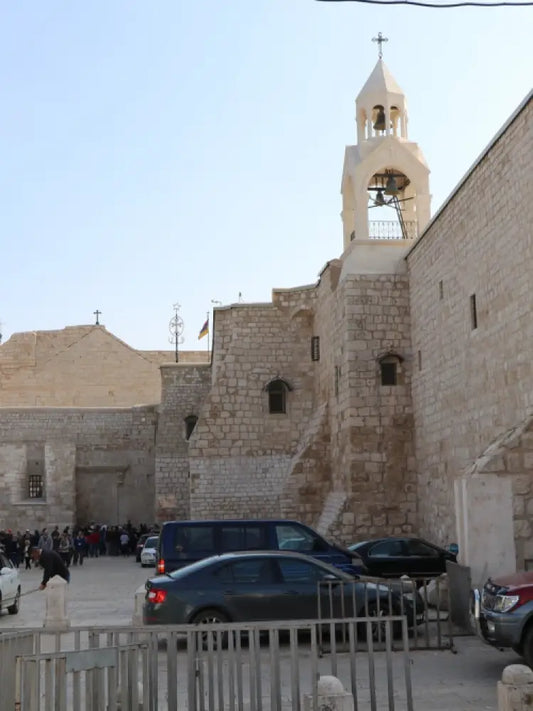
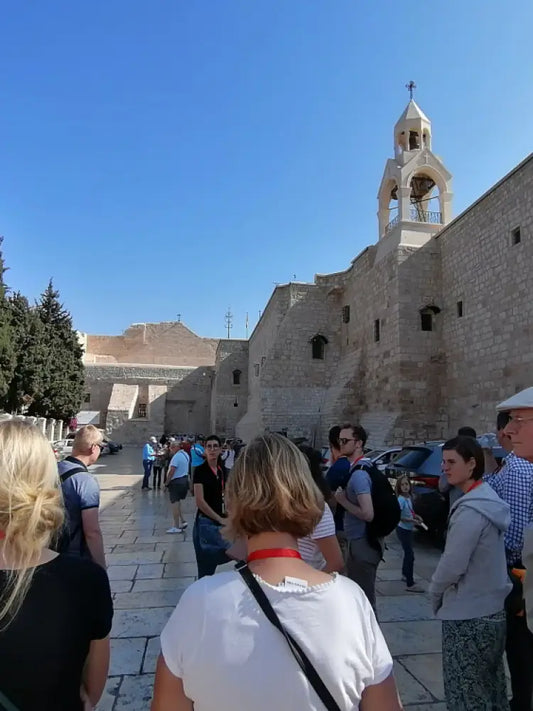
The Church of the Nativity sits on the spot Christians have marked as the birthplace of Jesus since the year 339. It is the oldest continuously used church in the Christian world.
📝 In This Article
- What the Church of the Nativity Actually Is
- Six Centuries of History, Three Denominations, One Star
- Walking In: The Door of Humility
- The Grotto of the Nativity — What You're Actually Looking At
- The Three Churches Under One Roof
- Logistics: When to Come, What to Wear, What to Skip
- What Most Guides Don't Tell You
- Pairing the Visit: A Half-Day Bethlehem Plan
- What You Should Know
- Frequently Asked Questions
- One Last Thing
- Related Reading
I grew up about five minutes from its door, in Beit Sahour. This is what to actually see when you go, when to come, and the parts most groups walk right past. Right?
There is honestly a particular kind of pilgrim I see every week. They come in through Manger Square, they shuffle along with the big group, they bend through the Door of Humility, they kneel at the silver star for maybe ninety seconds, and then they are pushed back out into the sun. They go home and tell people they saw the Church of the Nativity. They did not really see it. Not the half of it.
I want you to see it.
What the Church of the Nativity Actually Is
First built in 339 AD. Helena, mother of Emperor Constantine, ordered it — she was in her seventies when she made the journey here herself. She believed the cave underneath this hill was the place described in Matthew and Luke, the cave where Mary gave birth. The building she put on top of it has been here, with rebuilds and patches, for more than 1,680 years.
It is a UNESCO World Heritage Site (inscribed in 2012 — the first Palestinian site on the list). Three Christian denominations share it under an Ottoman-era arrangement called the Status Quo of 1852: the Greek Orthodox, the Roman Catholics (through the Franciscan custody of the Holy Land), and the Armenian Apostolic Church. Each one has its own keys, its own hours, its own column it sweeps. If you ever wondered why so many old churches in this region have a small flag of multiple Christian traditions hanging in different corners, this is why.
OK so most visitors I take in are surprised by two things at first. One — it is busier than they expected, with locals and pilgrims and priests in three different colored robes all moving through the same space. Two — it is much, much older than they realised. Older than most countries. If you ask me, this is what makes the Holy Land different from any other destination.
Six Centuries of History, Three Denominations, One Star
Helena, Constantine, and the first basilica
The original 4th-century church was a five-aisled basilica with an octagonal sanctuary built directly over the cave. Pieces of the original mosaic floor from that 339 building are still here. You walk over a glass panel near the entrance and look down — that is the actual floor that pilgrims walked on in the year of construction. People do not stop to look. They should.
Justinian's rebuild and why the Persians spared it
The Helena church burned down, probably during the Samaritan revolts in 529 AD. Emperor Justinian rebuilt it around 565. That building is, with patches, the one you walk into today. Then in 614 AD the Persians swept through Palestine and destroyed nearly every church in the country. The Church of the Nativity they left standing. The story locals still tell is that the Persian soldiers walked in, looked up at the 6th-century mosaic above the entrance — which showed the Magi dressed in Persian clothes — and decided to leave the building alone. True or not, thats the story we grew up with. I've told it a hundred times and it still lands.
The Crusaders, the Mamluks, and the silver star
Look, the Crusaders crowned Baldwin I King of Jerusalem here in 1100. They restored the church and added the mosaics on the upper walls — some of which were uncovered again during the restoration that ran from 2013 to 2020. After the Crusaders came the Mamluks, then the Ottomans. The famous fourteen-point silver star was placed in the grotto in 1717. Stolen in 1847 — and that theft, believe it or not, is considered one of the diplomatic sparks that set off the Crimean War in 1853. The star was replaced that same year by the Ottoman sultan. The one you see today is that 1853 replacement.
The Status Quo of 1852
To be honest, look — when you stand inside, youll see Greek Orthodox priests walking past Catholic friars walking past Armenian deacons. Every step they take is governed by a document signed in 1852 that fixed who cleans which column, who lights which lamp, who enters which door and at what hour. They sweep next to each other and do not speak. It is a strange and very human arrangement. It has held the church together for almost two centuries. Worth it. I've seen people tear up just standing in the doorway, trying to take it all in. No joke.
Walking In: The Door of Humility
The main entrance is so low that adults have to bend almost in half to get through. Roughly 1.2 metres high. About four feet. It was not always like that — the Crusader-era door was tall and grand, and you can still see the original arch above the current opening. Somewhere around the 16th century the entrance was bricked down to its present size, partly to stop looters riding horses inside, partly to force every visitor to bow on the way in. The name people gave it — the Door of Humility — stuck.
And it works.
OK so the first time most people walk through it, they laugh. The second time, they dont. There is something about physically bending your body to enter that does its own work. Bishops bend. Generals bend. Everybody bends. Every single one.
The Grotto of the Nativity — What You're Actually Looking At
The grotto is a small cave underneath the main altar — which is something pilgrims always ask about when we're on the route together, and honestly it's one of my favorite questions to answer. You go down about ten stone steps. The space is maybe ten metres long and three metres wide. The walls are lined with asbestos hangings — an old fire-protection layer, slightly faded — and dozens of small oil lamps from each of the three denominations. The smell of lamp oil alone is something you dont forget. Makes sense?
(Side note: I just got a voice message from a pilgrim I guided two years ago. She's coming back for the third time. Third. That's the whole job right there.)
The fourteen-point silver star
Set into the marble floor at one end of the cave is the silver star. No question.
The Latin inscription around it reads:
Hic de Virgine Maria Jesus Christus natus est. "Here, of the Virgin Mary, Jesus Christ was born."
Fourteen points are not random — they trace the genealogy in the Gospel of Matthew (fourteen generations from Abraham to David, fourteen from David to the exile, fourteen from the exile to the Messiah). People kneel and touch it. There is no rule against it. Most people put their forehead on the marble for a few seconds. I have watched grown men, atheists who came here to humour their wife, do this. It does something. Think about that.
The Altar of the Manger
Opposite the star, three steps down, is the Altar of the Manger — Catholic side. The original manger was carved out of the cave wall. The Catholics built a small altar in front of the spot where the wooden manger would have stood. This is the second thing to see and most groups never make it across the narrow cave to look properly. Cross over. And it works. Makes sense?
Queue logistics
The line to enter the grotto wraps around the side of the main basilica. Wait times vary wildly — almost nothing at 7am on a Tuesday in February, up to an hour at noon on a Saturday in May. The Armenian-side staircase down is almost always shorter than the Greek-side staircase. Almost nobody knows that. Now you do. Right?
The Three Churches Under One Roof
The space you walk into through the Door of Humility is the Greek Orthodox basilica — the main nave (my father would have something to say about this -- he always said the best guides dont talk too much, they let the place speak for itself). Forty-four pink limestone columns line it, each carved from a single block. Many have faded medieval frescoes of saints on them, hard to make out unless the light catches them right. The iconostasis at the far end — the wall of icons separating the altar — is 17th century. That matters. Makes sense?
(Just reminded of a pilgrim from Ohio who came three times before she finally made it — that's a whole other story.)
The Roman Catholic Church of St Catherine is to the north, accessible through a doorway in the left wall. This is where the Christmas Eve midnight Mass is celebrated every year — the one broadcast by Vatican television. If you are visiting around Christmas, the seats fill up by mid-afternoon. Worth knowing. There is also a staircase from St Catherine's that goes down to St Jerome's Cave — where the saint translated most of the Bible into Latin in the late 4th century. Almost nobody visits St Jerome's Cave. It is one of the quietest spots in the whole complex. That matters.
The Armenian Apostolic chapel takes the southern transept. Their entrance to the grotto from above is the second staircase down. And it works.
Logistics: When to Come, What to Wear, What to Skip

Opening hours
Roughly: - Winter (Oct–Mar): 6:30 am to 5:00 pm. - Summer (Apr–Sep): 6:30 am to 7:30 pm. - Sundays: mornings are reserved for liturgy; come after 1:00 pm. - Christmas Eve & Christmas Day, Orthodox Christmas (Jan 6–7), Armenian Christmas (Jan 18–19): the church operates on a liturgical schedule, not a tourist schedule. Visiting is possible but tightly controlled. That's the difference.
Quiet hours
Honestly, the two windows I would pick if you had a free hand: 7:30 to 9:00 am on a weekday, mornings before the buses roll in, or 4:00 to 5:00 pm in winter after they leave. The afternoon light through the upper windows is the best photographic light you'll get. No question.
Peak hours to avoid
10:30 am to 1:30 pm is the bus-group window. Every day, year-round. If you walk in at 11am on a Saturday in April, you will see the inside of someone's backpack. Not the church. Just be honest with yourself about that. Worth it. I've seen people tear up just standing in the doorway. No joke.
Dress code
Shoulders and knees covered for both men and women. No bare shoulders, no shorts above the knee. Shawls and wraps are sometimes available at the entrance for women who arrive in summer clothes — but do not rely on it. A light scarf in your bag solves the problem completely. Think about that.
Photography
Photos are allowed in the main basilica and in the grotto. Flash is forbidden in the grotto — the air is heavy with lamp oil and flash bleaches everything. No tripods. No selfie sticks. If a priest is celebrating Mass, stop and put the phone away. That is just decency. No question.
Getting there in 2026
From Jerusalem to Bethlehem is about 10 kilometres — twenty minutes in a private vehicle, longer through Checkpoint 300 depending on the day and the hour. The pedestrian crossing from the Israeli side to the Palestinian side happens at the wall just north of Bethlehem. From there, a five-minute taxi to Manger Square. Private tours pick up from your Jerusalem hotel directly and skip most of that — thats the main practical difference between private and group tours for Bethlehem specifically. That matters.
What Most Guides Don't Tell You

Group of friends pose for a picture during a trip. — Photo by sayan Nath on Unsplash
A short list, from someone who has been bringing people in here for fifteen years:
- The 6th-century mosaic floor under the glass panels lifts on hinges. You will not see this happen — the panels are only opened for restoration — but the mosaic underneath is original Justinian-era. Stand on it for a minute. Look down. That tile is older than English as a language.
- The Armenian-side staircase to the grotto is almost always faster than the Greek side. Locals know. Tour groups dont.
- The Milk Grotto is a four-minute walk from the southern exit. Tradition says Mary nursed Jesus there before the flight to Egypt and a drop of milk fell on the stone, turning it white. The chalk from the walls is collected by women hoping to conceive. Whatever you believe — it is a beautiful, quiet chapel and almost free of crowds.
- St Jerome's Cave under St Catherine's is one of the most overlooked spots in the Holy Land. He lived in this cave for thirty-four years and translated the Vulgate Bible from Hebrew and Greek into Latin between roughly 382 and 405 AD. That translation is the foundation of Western Christianity. Almost nobody goes down those stairs.
- The best hour I know in this whole building is 7:00 am on a weekday in February. You will hear your own footsteps. The lamps are still burning from the morning office. Maybe a Greek Orthodox priest is sweeping a column. That is it.
Pairing the Visit: A Half-Day Bethlehem Plan

aerial view of buildings near ocean — Photo by Thalia Tran on Unsplash
If you only have a few hours, here is what I'd do:
- Manger Square — five minutes. Get your bearings.
- Church of the Nativity — 60 to 90 minutes. Door of Humility, main nave, grotto, St Catherine's, St Jerome's Cave.
- The Milk Grotto — twenty minutes. Four-minute walk south.
- Star Street — thirty minutes. The traditional Christmas Eve procession route. Old olive-wood shops, the bakery, the families who have lived on this street for ten generations.
- Shepherd's Field by car — thirty minutes. Beit Sahour, where the angels are said to have announced the birth to the shepherds. My home village. Big difference.
If you have a full day, a full day in Bethlehem opens up everything else. Or build it into the longer 7-day Holy Land pilgrimage. If you want me to take you through, the private Bethlehem tours we run cover the full circuit at the speed you actually want. And it works.
Key Takeaways
- The Church of the Nativity has stood on this spot since 339 AD — it is the oldest continuously used church in the Christian world and a UNESCO World Heritage Site since 2012.
- The fourteen-point silver star in the grotto marks the traditional birthplace of Jesus. The current star was placed in 1853 after the original (set in 1717) was stolen in 1847.
- The Door of Humility is roughly 1.2 metres high — everyone bends to enter, no exceptions.
- Three Christian denominations share the church under the Status Quo of 1852: Greek Orthodox, Roman Catholic (Franciscan), Armenian Apostolic.
- Best visit windows in 2026: weekday mornings 7:30–9:00 am, or winter afternoons 4:00–5:00 pm. Avoid 10:30 am to 1:30 pm.
🌱 Plan Your Holy Land Tour


Frequently Asked Questions

What is inside the Church of the Nativity?
Let me put it this way: the basilica contains a 6th-century main nave with 44 pink limestone columns, original Justinian-era mosaic floor panels visible under glass, Crusader-era wall mosaics, an adjacent Roman Catholic chapel (St Catherine's), an Armenian chapel, and the Grotto of the Nativity below the main altar — a small cave with a fourteen-point silver star marking the traditional birthplace of Jesus and the Altar of the Manger opposite it. That's the difference.
How long does it take to visit the Church of the Nativity?
Allow 60 to 90 minutes for an unhurried visit. That includes the main nave, the descent to the grotto (10–30 minutes depending on the queue), St Catherine's chapel, and St Jerome's Cave underneath. Rushed tour groups do it in twenty minutes, but you miss most of what is here.
Is the Church of the Nativity open in 2026?
Yes. The church is open daily — roughly 6:30 am to 5:00 pm in winter, 6:30 am to 7:30 pm in summer. Sunday mornings are reserved for liturgy. The church operates on a special liturgical schedule on Christmas Eve, Orthodox Christmas (Jan 6–7), and Armenian Christmas (Jan 18–19).
What is the silver star in the Church of the Nativity?
And this part matters — the fourteen-point silver star is set into the marble floor of the grotto and marks the spot Christian tradition identifies as Jesus' birthplace. The Latin inscription around it reads Hic de Virgine Maria Jesus Christus natus est — "Here, of the Virgin Mary, Jesus Christ was born." The current star was placed in 1853, replacing the 1717 original that was stolen in 1847.
Do I need a guide to visit the Church of the Nativity?
You dont strictly need one. But without a guide, most visitors miss the original mosaic floor, St Jerome's Cave, the meaning of the Status Quo arrangement, and the connection to nearby Shepherd's Field and the Milk Grotto. A licensed Bethlehem guide turns a thirty-minute look around into a couple of hours of actually understanding what you're standing in.
Can you visit the Church of the Nativity on a day trip from Jerusalem?
Yes. Bethlehem is about ten kilometres south of Jerusalem. A private day tour from a Jerusalem hotel is the most efficient way — door-to-door it's a half day. The most flexible option for 2026 is a private guided trip; the Best Time to Visit Bethlehem 2026 guide breaks down which season works best for what.
One Last Thing

green trees under white clouds during daytime — Photo by Tetiana SHYSHKINA on Unsplash
I was here on a Tuesday morning in February two years ago, with a woman from Ohio who had lost her husband six months earlier. She knelt at the silver star and put her forehead on the marble and stayed there for a long time. Nobody rushed her. A Greek Orthodox priest passed twice and just nodded at her. That is the church at its best — it makes room for you. It has been making room for people for 1,680 years.
This place has watched Romans, Byzantines, Persians, Crusaders, Mamluks, Ottomans, the British, and the long uneven decades that came after. They all came and went. The church is still here. The star is still here. The cave underneath is still here.
If you want to see it properly — with the time to actually stop and look — write to me. I'll plan a morning around what you actually came here for, not a checklist.
Related Reading
- What Actually Happens at Checkpoint 300: A 2026 Guide From Your Bethlehem Host
- Best Time to Visit Bethlehem in 2026: Christmas, Easter, Summer, or Fall? -- and this is the one most people overlook
- A Full Day in Bethlehem: Walking Through Faith, History, and the Desert
- How to Plan a 7-Day Holy Land Pilgrimage Itinerary in 2026
- [Private Holy Land Tour vs -- you get the idea
Elias Boaz is a licensed tour guide from Bethlehem — birthplace of Jesus Christ — and the founder of Elijah Tours. He has guided thousands of pilgrims through Bethlehem, Jericho, and the Jordan River Valley — and coordinates Holy Land tours with trusted licensed guides across the region. He writes to help visitors truly understand what they're seeing.