From a local guide's perspective, herodium is an artificially shaped mountain about 12 km southeast of Bethlehem, built by Herod the Great around 23 BCE as his palace fortress and burial site. Archaeologist Ehud Netzer discovered Herod's tomb here in 2007 after a 40-year search. It is now a national park. Most Christian pilgrims never visit. They should.
What Is Herodium?
In my experience leading tours, the first thing that surprises people: the mountain isn't natural.
After guiding many groups through the Holy Land, Herod the Great, king of Judea, chose an existing hill southeast of Bethlehem and had his honestly engineers reshape it into a cone, then filled the interior with a palace complex. What looks from a distance like a low volcanic peak is actually an architectural achievement. Herod didn't just build on a hill.
He built the hill.
Inside the cone sat a circular palace: a reception hall, a Roman bath complex with heated floors (a hypocaust system, which is exactly as sophisticated as it sounds), a central courtyard with a garden, and thick defensive walls with four towers. Three of those towers were semicircular. One was round, larger than the others, and that's where Herod's private apartments were believed to be.
Below the mountain is what archaeologists call Lower Herodion. This is a separate complex at the base: a massive rectangular pool fed by an aqueduct from Solomon's Pools near Bethlehem, monumental service buildings, and the processional pathway Herod built to his own tomb. The lower site is easy to miss if you don't know what you're looking at. Take the time to walk it.
Herod the Great and the Nativity Story , Why This Matters to Christians
Here's what most pilgrims don't fully grasp when they're standing in Bethlehem.
The man who ordered the Massacre of the Innocents (Matthew 2:16-18), who sent soldiers to kill every infant boy under two in the Bethlehem area because he feared a rival king, built his palace on a hill that overlooks Bethlehem. On a clear day from the Herodium summit, you can see Bethlehem below and to the northwest.
The city he feared. The city where the child he wanted dead was born.
I've taken pilgrims to that summit more times than I can count. But one moment stays with me. I was guiding a pastor from Dallas, a big man who led a congregation of several hundred people. He had read Matthew 2 hundreds of times. He knew the story well. When we reached the top and I pointed toward Bethlehem, 12 kilometers away, he stood there quietly for about 20 minutes. Just looking. His group had moved on to the lower site. He didn't move.
When he finally turned around, he said: "I never understood the geography before."
That's what Herodium does. It makes the story physical.
Herod chose Herodium as his burial site above all his other palaces, and he had several. Masada, Caesarea, Jericho, his Jerusalem palace. He could have been buried anywhere. He chose here. The hill he could see Bethlehem from.
If you're planning to visit bethlehem at Christmas, when the city is at its most spiritually charged, our complete Christmas in Bethlehem guide covers everything you need to know about being there in December.
The Tomb Discovery That Changed Everything
Ehud Netzer's 40-Year Search
Archaeologist Ehud Netzer of Hebrew University spent nearly four decades looking for Herod's tomb. Most scholars assumed it was at the summit. Netzer looked there. Then he looked at the lower site. Then he looked between the two.
This is the part most people overlook: In 2007, he found it on the slope, partway up. Not at the top, not at the bottom. Hidden in the middle. Herod, who was obsessed with his own legacy and feared enemies even after death, had placed his tomb where no one would logically search. Call me biased, but nothing beats being here in person.
Here's the thing: The sarcophagus was genuinely shattered, broken into hundreds of pieces. It was almost certainly destroyed deliberately, probably by Jewish rebels who occupied the site during the First Jewish Revolt (66-73 CE). They had reason to hate Herod. They made sure his resting place would not survive. The fragments are now in the Israel Museum in Jerusalem.
And Ehud Netzer, the man who spent his professional life finding that tomb, died in 2010. He fell at Herodium during an excavation visit. The site that defined his career was also where he died.
I don't know what to do with that story. I just know it's true.
What You Can See Today
I'll be straight with you: The tomb podium and chamber area are accessible on the slope. The informational panels at the site explain the discovery and show reconstructions of what the tomb and sarcophagus originally looked like.
Excavations are ongoing, so what's visible changes year to year.
If you want to see the actual sarcophagus fragments, you need to go to the Israel Museum in Jerusalem. It's worth the trip if you're interested in the archaeology. Our Jerusalem Old City guide can help you plan a day in the city -- and look, I get sidetracked on this topic easily because I grew up walking these streets, and that colors everything I say about the Holy Land.
What's Actually Up There , A Practical Guide to the Site
Interested in seeing our collection? → Browse Tours to Jerusalem
The Summit (Upper Herodion)
The hike to the summit is not demanding, but it is uphill. In summer, start early -- which, come to think of it, is exactly what happened when a church group from Ohio visited last month and stood completely silent at the site for a full three minutes. The path is paved in sections. When you reach the top, you'll walk into the circular palace remains: thick walls, tower remnants, the bath complex with its heated-floor system.
The detail that always surprises people is the synagogue.
Look, i could be wrong here, but inside the ruins of Herod's reception hall, Jewish rebels during the First Jewish Revolt converted the room. They added stone benches along the walls and a Torah ark niche. They took the most opulent room in the palace of the man they despised and turned it into a house of prayer. That conversion, that deliberate act of appropriating Herod's most personal space, is one of the most striking things about this site.
That detail alone is worth the trip.
.
The Lower Site (Lower Herodion)
The lower site is easy to rush past. Don't.
The pool at Lower Herodion was enormous, roughly 70 meters by 45 meters, designed for leisure and spectacle.
Herod fed it via an aqueduct from Solomon's Pools, a set of ancient reservoirs that are still partially visible near Bethlehem today. The engineering required to bring water to this place, in this climate, at this scale, is impressive even by modern standards.
Walk the processional pathway from the lower site up toward the tomb area. You're tracing the route Herod designed for his own funeral procession. The pomp and the tragedy of that man are in every meter of it.
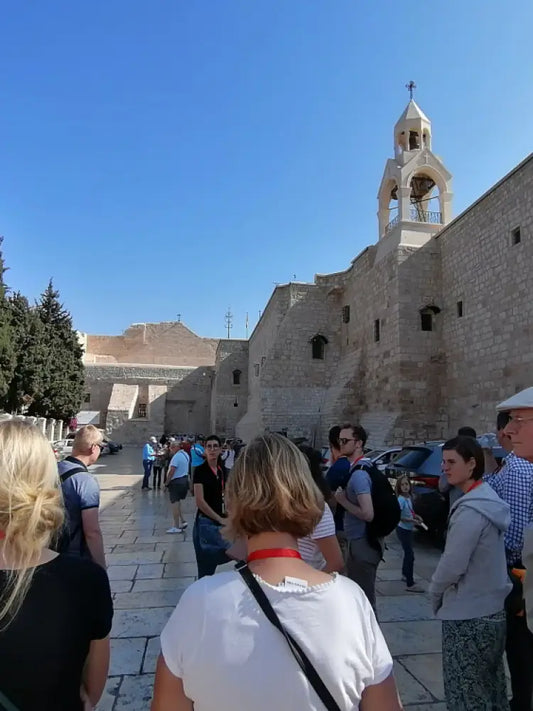
A woman from Minnesota on last month's tour stood completely still in the Church of the Nativity for about four minutes. Nobody moved. Nobody said anything. That's the tour right there.
The Views
On a clear day from the summit, you can see Bethlehem to the northwest, Jerusalem a bit further north, the Dead Sea to the east, and the Judean desert stretching south. The altitude is approximately 758 meters above sea level. In the dry air of this region, the visibility on a good morning can be extraordinary.
This is the view Herod designed. He wanted to see everything.
He wanted to be seen.
How to Combine Herodium With Your Holy Land Itinerary

Mount of Olives Jerusalem Sunrise , Photo by David Holifield on Unsplash
What Most Pilgrims Miss

What to See in Bethlehem Church of the Nativity
The rebel synagogue is the first thing. I've already mentioned it. Worth repeating.
The second is the tunnel system. During the revolt against Rome, Jewish fighters dug an elaborate network of tunnels under the mountain. Parts of the tunnel system are accessible today. Walking through them gives you a completely different picture of Herodium's second life, after Herod, when people who despised him turned his palace into a resistance stronghold. I've seen people tear up just standing in the doorway.
The third is something harder to describe. It's the strategic clarity of the view. Herod didn't build here because it was scenic. He built here because he could see threats approaching from every direction: Jerusalem to the north, the desert routes to the east and south, Bethlehem below. When you stand there and understand that, Matthew 2 stops feeling like a distant religious narrative and becomes something immediate. A king. A threat. A city just over that ridge.
Herodium gives you the antagonist's perspective. And that makes the Christmas story, oddly, more real.
Getting to Herodium
Interested in seeing our collection? → Browse Tours to Bethlehem

What to See in Bethlehem Church of the Nativity
From Bethlehem, Herodium is about 20-30 minutes by private car heading southeast. From Jerusalem, allow 35-40 minutes. The route passes near Tekoa, a small village in the hills.
I mean, there is no reliable public bus that goes to the site gate. Local buses occasionally pass through Tekoa village, but the final stretch to the park entrance requires a vehicle. This is not a site you can easily reach by public transport.
The practical options are: drive yourself with a rental car, or join a private guided tour that includes Herodium. We include it on some of our Bethlehem day tours when clients want a full day in the area. If you're looking for a custom private day that pairs Bethlehem with Herodium, our private and day tour options cover both.
Is Herodium Worth Adding to Your Itinerary?

What to See in Bethlehem Church of the Nativity
If you have more than five days in the Holy Land: yes.
This is the part most people overlook: If you are interested in the political and historical world that Jesus was born into, the world described in Matthew 1 and 2: absolutely yes. This is the site that makes that world tangible.
If you only have one day in Bethlehem, I'd leave Herodium for a return trip. The Church of the Nativity, the Milk Grotto, and shepherd's field deserve your first visit. Herodium rewards time and prior context, and if you're rushing to get back before dark, you won't get the full value from it. If you ask me, this is what makes the Holy Land different from any other destination.
But if you've already been to Bethlehem, or if you're building an itinerary that goes beyond the standard stops, Herodium is one of the most meaningful additions you can make. I'm a guide, not a theologian. But from what I've seen, the pilgrims who come here leave with a different understanding of the story they came to find.
I tell every group the same thing before we go in -- put your phone down for five minutes. Just five minutes. Most of them thank me for it afterward.
Key Takeaways
- Herodium is located approximately 12 km southeast of Bethlehem and was built by Herod the Great around 23-15 BCE as his palace fortress and burial site.
- Herod's tomb was discovered in 2007 by archaeologist Ehud Netzer after nearly 40 years of searching; the sarcophagus fragments are housed in the Israel Museum in Jerusalem.
- The site connects directly to the Christmas story: Herod the Great feared the newborn King referenced in Matthew 2:2 and ordered the Massacre of the Innocents (Matthew 2:16-18). From the Herodium summit you can see Bethlehem, 12 km away.
- No reliable public bus serves the site gate; a private car or organized tour is required to visit.
- Allow at least 2-3 hours for a visit that covers both the upper summit and the lower site; it combines well with a Bethlehem morning to make a full day.
If you're putting together your Holy Land itinerary and want help including Herodium, reach out and we'll plan it with you.
Frequently Asked Questions

What to See in Bethlehem Church of the Nativity
Is Herodium worth visiting on a Holy Land pilgrimage?
Yes, especially for pilgrims interested in the historical and political world around Jesus' birth. Herodium is where Herod the Great, the king who feared the Nativity and ordered the Massacre of the Innocents, chose to build his palace and be buried. Standing on the summit and looking toward Bethlehem 12 km away changes how many people understand the geography of Matthew 2.
How do I get to Herodium from Bethlehem or Jerusalem?
From Bethlehem, Herodium is about 20-30 minutes by private car heading southeast. From Jerusalem, allow 35-40 minutes. There is no reliable public bus to the site gate. Most visitors come with a private guide or a rental car.
What is Herodium famous for?
I mean, herodium is famous for two things. First, it was the palace fortress of Herod the Great, built around 23 BCE with an artificially cone-shaped mountain containing a circular palace, Roman baths, and towers. Second, it is where Herod's tomb was discovered in 2007 by archaeologist Ehud Netzer after nearly four decades of searching. The sarcophagus fragments are now in the Israel Museum in Jerusalem.
Was Herodium mentioned in the Bible?
Herodium is not named in the Bible, but Herod the Great appears prominently in Matthew 2. He is the king who met the Magi seeking the newborn King of the Jews, became threatened, and ordered the killing of infant boys in Bethlehem and its surroundings. Herodium was the site Herod chose above all others for his burial, and from its summit Bethlehem is visible 12 km away.
Can you visit Herodium independently without a guide?
You can buy a ticket and walk the site on your own. But honestly, Herodium is a site where a guide adds real value. The rebel synagogue, the tomb history, the tunnel system, and the connection to the Nativity story are not immediately obvious without context. Walking the site alone, you might see ruins and a view. With a guide, you see what those ruins mean.
How long does a visit to Herodium take?
Plan at least 2-3 hours for a visit that includes both the upper summit and the lower site. If you explore the tunnels and take time with the views, 3 hours goes quickly.
Starting the summit in the morning, before the midday heat, is recommended in summer.
What else is near Herodium?
Bethlehem is about 12 km to the northwest. Solomon's Pools, the ancient reservoirs that supplied water to Herodium via aqueduct, are nearby and worth a brief stop. Tekoa, the village associated with the prophet Amos, is close. Continuing southeast, the road eventually leads toward the Jericho area and the Dead Sea, making Herodium a natural stop on a southeast loop from Jerusalem or Bethlehem.
Can I combine Herodium with Bethlehem in one day?
Yes. The standard approach is to start at the Church of the Nativity when it opens in the morning, spend time in Bethlehem including the Milk Grotto and Manger Square, then drive out to Herodium in the early afternoon.
You can finish at Herodium before late afternoon. It makes for a full day, but a well-rounded one.
Herodium is visible from Bethlehem on a clear day. From the rooftops near the Nativity, from the upper floors of the guesthouses on Star Street, you can look south and see it: a low cone of a mountain rising above the hills. I've pointed it out to more people than I can count.
Most of them had no idea what they were looking at.
The man who feared the child born in that square built his palace on that hill. He wanted to look down on the town he couldn't control, to be buried where he had a view of the city that threatened him. He built the mountain higher, shaped it, filled it with luxury and walls and the illusion of permanence.
And the child born in Bethlehem is the one people still make long journeys to find.
That contrast doesn't need commentary. But it's worth going to see with your own eyes.
Elias Boaz is a licensed tour guide from Bethlehem , birthplace of Jesus Christ , and the founder of Elijah Tours. He has guided thousands of pilgrims through Bethlehem, Jericho, and the Jordan River Valley , and coordinates Holy Land tours with trusted licensed guides across the region. He writes to help visitors truly understand what they're seeing.