Most first-time Holy Land pilgrims say the same thing afterward: the physical reality of the sites moved them far more than they expected. The places are real, ancient, and touchable.
From a local guide's perspective, what changes people isn't the information about where they are. It is the experience of actually being there, in the body, on the ground, with the stones under their feet.
I've been guiding tours out of Bethlehem for a long time. I've walked with groups from the United States, South Korea, Germany, Brazil, the Philippines, Australia. Church groups, families, solo travelers, people who came to pray and people who came skeptical. And after enough of those tours, you start to notice the patterns. You notice what catches people off guard. You notice the moment when something breaks through. And you notice what they say, in the van on the way back to Jerusalem, or in the message they send you six months later from home.
In my experience leading tours, this is some of what they say.
What People Expect vs. What the Holy Land Actually Delivers
Having grown up in Bethlehem, to be honest, most pilgrims arrive with a mental image that has been built over decades. Sunday school illustrations. Christmas pageants. Stained-glass windows. A kind of soft-lit, quiet version of these places that lives in the imagination.
The actual Holy Land is louder than that.
The church of the holy sepulchre, for instance, is honestly not the serene candlelit space many people picture. On a busy morning, it is competing liturgies from multiple Christian traditions happening simultaneously, the smell of incense thick in the air, tour groups pressing through narrow doorways, pilgrims on their knees on cold stone while others stream past. And then, in the middle of all of that, you get a moment. You find yourself in front of the Stone of Anointing, or you duck into the edicule and touch the rock of Calvary, and suddenly the noise doesn't reach you anymore.
That's what the Church of the Holy Sepulchre actually is. Not one thing, but both things at once.
I walked with a retired pastor from Ohio once, a man who had preached the Resurrection for over forty years. Standing, preached it from memory, given the sermon more times than he could count. He stood inside the edicule at the Church of the holy sepulchre and he could not speak. His wife told me later that he cried for the first time in decades. What he said was: "I knew it. I just didn't know it."
That's the distinction people keep coming back to. Knowing something as information, and knowing it as a place you have stood.
If you're planning to spend time in Jerusalem, our Jerusalem Old City Guide 2026 walks through the four quarters, the main sites, and how to pace your day so you don't rush through something you'll wish you'd slowed down for.

The Moments That Catch People Off Guard

Christian Pilgrimage Jerusalem Group , Photo by Anton Mislawsky on Unsplash
There are a handful of places where I have watched something happen in almost every group, tour after tour, year after year. Not because I orchestrated it. Just because the place does something to people that is hard to explain in advance.
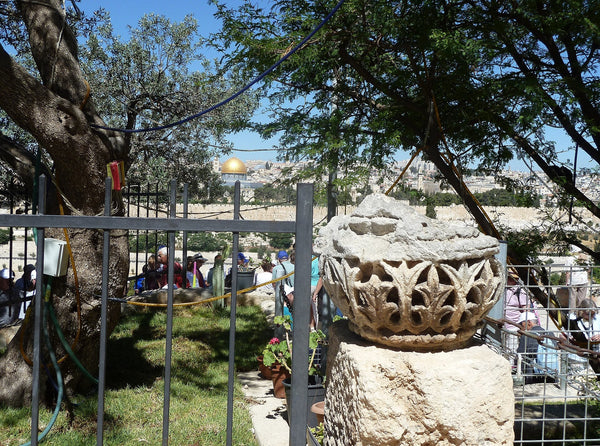
Gethsemane and the Olive Trees
People know the story of Gethsemane. The prayer, the arrest, the disciples sleeping, the weight of what was coming. They know it.
What they don't know, until they're there, is that they can touch it.
The olive trees in the Garden of Gethsemane are among the oldest living things in the entire region. Carbon-dating research has confirmed that several of them are at least 900 years old.
Some scholars believe the root systems are seriously considerably older still. You can stand next to one of those trees, put your hand on the bark, and be touching something that was there during the time of the Crusades, the Byzantine era, possibly earlier.
I had a woman from Texas who stopped walking when we reached the trees. Her group moved on toward the Basilica of the Agony. She stayed. She sat down under one of the old trees and she didn't say anything. I stayed with her. We were there for about twenty minutes. When we rejoined the group she thanked me, and that was it. She didn't explain it and I didn't ask her to.
I grew up three blocks from the Church of the Nativity. As a kid I thought that was just normal. It took guiding thousands of pilgrims here to understand it isn't.
That kind of thing happens in Gethsemane. You can read more about what the site looks like and what to expect in our full Garden of Gethsemane guide for 2026.
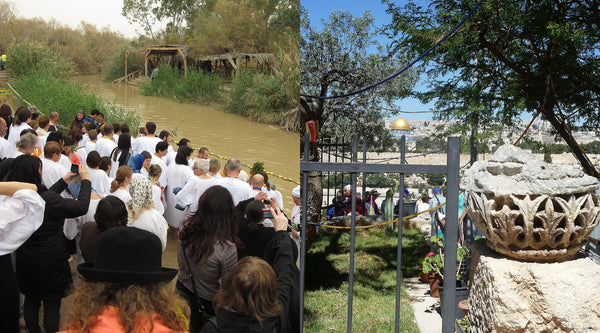
The Jordan River Baptism
Every tour that includes a baptism opportunity at the Jordan River has the same arc. At the start of the day, roughly half the group says they'll sit it out. They're not sure, they're not prepared, they didn't bring the right clothes. By the time we arrive, most of those people end up in the water.
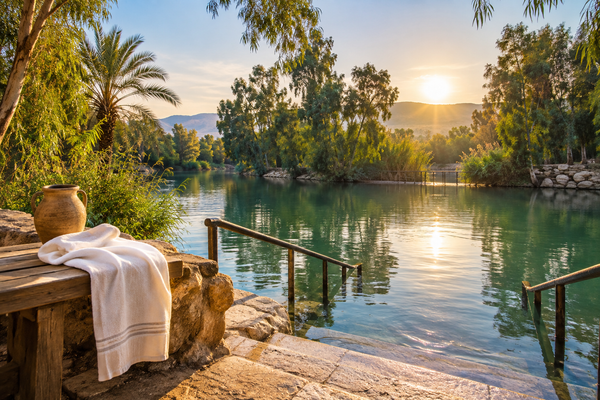
What happens is hard to describe from the outside. You put on a white robe. You walk down the steps into the water. A pastor or a priest says the words, and you go under, and you come back up.
Something changes when a belief becomes a physical act. I'm a guide, not a theologian. But I've stood at that riverbank enough times to know that the expression on someone's face going down into the water and the expression on their face coming back up are not the same. There's a before and an after. You can see it.
Bethlehem and the Grotto
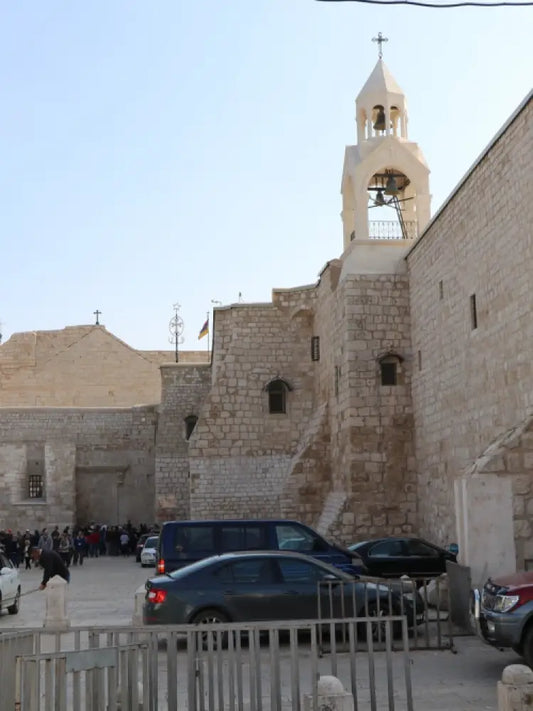
I grew up a few minutes from the Church of the Nativity in Beit Sahour. A guide who's been doing this 30 years would explain it better, but i have walked into that church more times than I could possibly count.
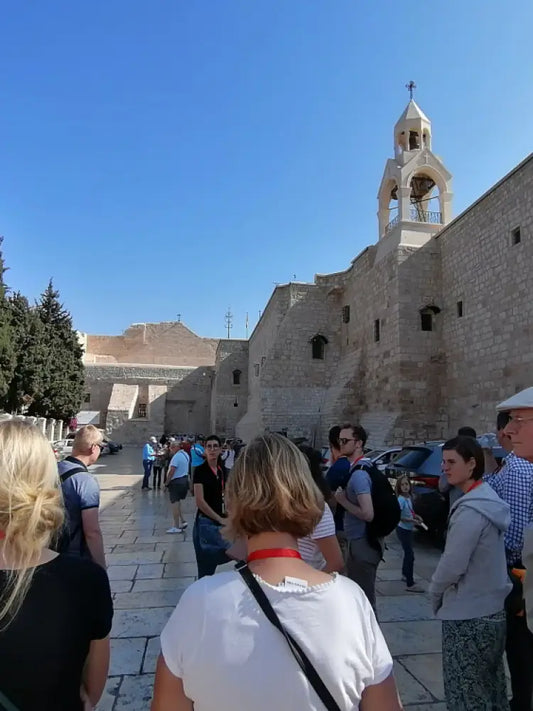
And I still watch people when they go through the Door of Humility.
Honestly, The doorway is just under four feet tall. You have to bow to enter. That was not an accident when it was built. And when you duck through that low entrance and straighten up inside and let your eyes adjust to the interior, there is almost always a moment of stillness.
Then you go down to the Grotto. The small cave beneath the church where, by Christian tradition, Jesus was born. You kneel on the marble floor. You reach down and touch the 14-pointed silver star that marks the spot.
A group of pilgrims from South Korea came through last spring. When they reached the Grotto they began to sing, quietly, together, without any coordination I had seen. They sang for ten minutes. Nobody told them to stop. The other pilgrims in the church waited, or they joined. Nobody interrupted.
The marble in that Grotto is worn smooth from millions of hands across many centuries.
That says something that no tour script can say.
What Pilgrims Actually Say When They Get Home
Interested in seeing our collection? → Browse Tours to Jerusalem

How to Plan a Holy Land Pilgrimage Holy Land Trip Planning
The message I hear most often, in some form, after tours conclude: "It made the Bible feel true."
Not "feel more real." Just: true. A thing that had existed in the mind as text and story and faith now has coordinates, stones, air, temperature.
That shift, the grounding of something abstract in something physical, is what people describe when they talk about why the Holy Land affected them differently than they expected.
The Things They Didn't Expect to Feel
People consistently describe surprise at how physical the whole experience is. The stone under your feet. The heat in summer, the cold in the hills in winter. The smell of frankincense in the churches. The way the light falls across Jerusalem at dawn when the stones go orange and everything looks like a painting.
Several pilgrims have described what I can only call a kind of release. A question they had carried for years finding something on the ground here, not necessarily an answer in words, but something that settles. I hear that description from very completely different people, in very different ways, after very different tours. It comes up enough that I've stopped finding it surprising.
I should mention -- Star Street is quiet today. Fridays are like that. But the messages from last month's pilgrims keep coming in, so I keep writing.
What They Wish They'd Known Before Coming
More time. This is the single most consistent thing I hear. Everyone wants more time. They wish they had booked ten days instead of seven, or fourteen instead of ten.
The second thing they wish they'd known: slow down. The pace of a large-group bus tour, moving from site to site on a tight schedule, leaves people feeling like they checked items off a list rather than walked through something.
There's a real difference between visiting a place and spending time in it.
The third thing: hire a local guide. Not the guide assigned by a hotel or packaged through an agency that has never been to the Holy Land themselves.
Someone who actually lives here, knows the sites from the inside, and can tell the difference between the information in the guidebook and what actually matters to stand in front of.
If you want the kind of tour where you can slow down and actually be in the places you came to visit, take a look at our private tours. The difference between a private guide and a group bus comes down to whether you're watching the place from a distance or actually inside it.
What They Tell Their Friends
"You have to go." That's the sentence. Not "it was wonderful" or "it was a meaningful experience" or any of the softer, safer ways of saying it. Just: you have to go. Said the way you say something you genuinely mean.
Here's the thing: Many of the groups I've worked with over the years have come back. Some have come back two or three times, each time bringing a new family member or a friend who heard the sentence and finally booked the trip. That is how most of my repeat groups form. One person goes. They come home and say you have to go. The next year, a different group arrives.
Planning Your Own First Holy Land Pilgrimage

How to Plan a Holy Land Pilgrimage Holy Land Trip Planning
Real talk: If you're thinking about going for the first time, here is my honest advice, based on watching thousands of people do this.
How Long Should You Go?
Seven days is the minimum to touch the major sites in any meaningful way. Jerusalem alone, done properly, takes two to three days. Add Bethlehem, Galilee, Jericho, the Dead Sea, and Masada, and you need ten days to not feel rushed. If you can do fourteen, do fourteen.
The 10-day Holy Land itinerary guide on the Elijah Tours blog is worth reading before you start planning. It breaks down what's realistic for each region.
What seven days covers: Jerusalem's Old City (the four quarters, Church of the Holy Sepulchre, Garden Tomb, Western Wall), Bethlehem and the Nativity Church, Jericho, the Dead Sea. That's the core.
What ten days opens up: Galilee, Nazareth, the Sea of Galilee, Capernaum, the mount of beatitudes from Bethlehem, the Jordan River at Yardenit.
The full biblical geography. The north is different from the south, and both matter.
Do You Need a Guide?
Yes. My honest answer is yes, for most pilgrims. Not because you can't find the sites on your own (you can), but because knowing what you're looking at changes what you experience.
Standing in front of the Church of the Holy Sepulchre without context, you see a building. With context, you understand that the structure above you incorporates Calvary (Golgotha), the tomb of Christ, the stone of anointing, and the site of the finding of the True Cross, all within the same walls, the result of nearly 1,700 years of building, destruction, rebuilding, and theological dispute across multiple Christian traditions. That context doesn't make the site more religious. It makes it legible.
A local guide carries a different relationship to these places than a guide who learned about them from a textbook. I grew up here. I know when the crowds thin out at the Church of the Nativity (early morning, before 8 AM). I know which door to use at the Garden Tomb to avoid the main queue. I know which families have run the olive wood shops on Star Street in Bethlehem for three generations. That's not information you find in a guidebook.
When to Come
My personal recommendation: autumn. September and October. The summer heat has broken, the Christmas crowds haven't arrived yet, and there is a quality of light in October on the Jerusalem stone that is genuinely different from any other time of year. The sites are manageable. You can take your time.
Spring is also excellent, particularly around Holy Week. The Via Dolorosa procession on Good Friday is unlike anything I have witnessed anywhere in the world. But it is crowded. If Holy Week matters to your faith and you want to be in Jerusalem for it, plan early and be patient with the crowds.
Summer is busy and hot, especially from June through August. All the sites are operating, the days are long, and many family groups come during school holidays. It's not wrong, just demanding.
December, for authentic christmas in bethlehem, is worth experiencing once. Manger Square on Christmas Eve, the midnight mass, the way the whole town feels during that week. If that matters to you, go. But book months in advance, because accommodation around Bethlehem at Christmas fills up early.
If you're planning a first visit and want to understand what kind of pacing works best, our day tours from Bethlehem and Jerusalem let you structure a longer stay around specific sites without committing to a single itinerary.
Key Takeaways
Interested in seeing our collection? → Browse Tours to Bethlehem
A few practical things worth knowing before you finalize plans.
Safety. Tours are running. Bethlehem is open. The sites are accessible. The question I get most often is whether the region is safe to visit in 2026. It is, for tourists visiting the sites described here. Your guide will give you an honest, current picture of conditions when you arrive.
Checkpoints. Getting from Jerusalem into Bethlehem involves crossing a checkpoint. With a guide who makes this crossing regularly, it takes a few minutes, not an hour. It's practical logistics, not an obstacle.
Booking directly. Booking through a local guide or a local company means your money goes to people who actually live here, and it means your guide is someone you can reach directly with questions before, during, and after the tour.
What to bring. Modest clothing that covers shoulders and knees (required at most churches). Comfortable walking shoes, not sandals. Water. Cash for the markets and small purchases. And patience, because sometimes in the Holy Land, something unexpected happens and it turns out to be the best moment of the whole trip.
What You Should Know

How to Plan a Holy Land Pilgrimage Holy Land Trip Planning
- First-time pilgrims almost universally report that the physical, tactile reality of the Holy Land sites moved them far more than they anticipated.
- The Garden of Gethsemane, the Grotto of the Nativity, and the Jordan River baptism site are consistently the most emotionally affecting experiences for Christian pilgrims.
- Most people wish they had booked more time. Ten days is a better first visit than seven.
- A local guide changes what you see, not just where you go. The difference is between visiting a place and understanding it.
- Autumn (September-October) is the best season for a first Holy Land visit: cooler temperatures, manageable crowds, and excellent light.
The pastor from Ohio, the one who stood in the edicule and couldn't speak, had one more thing to say. I heard it on the last morning of the tour, outside the hotel in Jerusalem, before the group's van left for the airport.
He said: "I've been telling people about this place for forty years. I should have come forty years ago."
Then he laughed. And then he got on the van.
If you're still deciding whether to come, reach out through our contact page.
Tell me what you're looking for. I'll tell you what's actually possible.
Frequently Asked Questions

How to Plan a Holy Land Pilgrimage Holy Land Trip Planning
What do first-time visitors say about the Holy Land after their tour?
Almost universally, first-time visitors say the physical experience of the sites moved them more than they expected. The phrases I hear most often are "it made my faith feel real" and "I wish I had come sooner." Many say the most powerful moments were ones they hadn't particularly anticipated, such as touching the ancient olive trees in Gethsemane or stepping through the Door of Humility into the Church of the Nativity.
Is the Holy Land what you expect it to be?
Usually not, in the best possible sense. Most pilgrims arrive expecting something quieter and more controlled than what they find. The sites are busy, layered with history, and operated by multiple Christian communities with different traditions. But that complexity is part of what makes the experience feel real rather than staged. The Holy Land is a living place, not a museum.
What is the most moving moment for Christian pilgrims in the Holy Land?
Different people are moved by different sites, but the ones I see affect people most consistently are: the Grotto of the Nativity in Bethlehem, where pilgrims kneel and touch the silver star marking the traditional birthplace of Jesus; the Garden of Gethsemane, particularly the ancient olive trees; and the Jordan River baptism site, where many pilgrims choose to be baptized or renew their baptismal vows. Standing inside the Church of the Holy Sepulchre is also something that people describe as unlike anything else they have experienced.
Do you need a guide to visit the Holy Land as a Christian pilgrim?
For most pilgrims, yes. The sites are findable without a guide, but what a local guide provides is the context that makes them meaningful. Knowing what you are looking at, which layer of history you are standing in, what the competing traditions are and why they matter, changes the experience from sightseeing to understanding. A local guide from the region also knows the practical details: which door to use, when the crowds thin, where to eat, how to navigate the checkpoints. That knowledge is worth the investment.
Is it safe to visit Bethlehem in 2026?
Yes. Tours are running, Bethlehem is open to visitors, and the Church of the Nativity and other sites are fully accessible. The most common entry route is from Jerusalem via a vehicle checkpoint, which with an experienced guide takes only a few minutes. For the current situation on the ground, the best source is your guide, who can give you an honest, real-time picture before and during your visit.
What is the best time to visit the Holy Land for a first trip?
Autumn, specifically September and October, is my recommendation for first-time visitors.
Temperatures are cooler than summer, crowds are lighter than Christmas or Holy Week, and the quality of light on the Jerusalem stone in October is genuinely remarkable. Spring is also excellent if you can coordinate with Holy Week, though it is significantly more crowded. December is unforgettable for Christmas in Bethlehem, but accommodation books out early and the crowds are intense.
How long should a first Holy Land pilgrimage be?
Seven days is the minimum to see the core sites without feeling rushed: Jerusalem's Old City and its main holy sites, Bethlehem, Jericho, and the Dead Sea. Ten days is a much better first trip, adding Galilee (the Sea of Galilee, Capernaum, Nazareth, the Mount of Beatitudes) and giving you breathing room in each place. Fourteen days allows you to actually slow down and absorb what you're seeing, rather than moving from site to site on a schedule. Almost every pilgrim who does seven days says afterward they wish they had booked ten.
Elias Boaz is a licensed tour guide from Bethlehem , birthplace of Jesus Christ , and the founder of Elijah Tours. He has guided thousands of pilgrims through Bethlehem, Jericho, and the Jordan River Valley , and coordinates Holy Land tours with trusted licensed guides across the region. He writes to help visitors truly understand what they're seeing.