
Jericho is the world's oldest continuously inhabited city — about 10,000 years old — and sits 258 meters below sea level in the Jordan Valley. For Christian pilgrims, it's Zacchaeus's town, the Mount of Temptation, and the gateway to the Jordan River baptism site. Most pilgrims spend half a day in Jericho.
📝 In This Article
- Why Jericho Matters (and Why Most Pilgrims Underestimate It)
- The 5 Sites Every Christian Pilgrim Should See in Jericho
- How to Combine Jericho with Other Sites: The Full-Day Loop
- Practical Logistics — Getting There, Costs, Best Season
- What Most Tours Skip (The Local Insider Section)
- What You Should Know
- Frequently Asked Questions
- Related Reading
They should give it a full one.
I've driven the road from Bethlehem to Jericho more times than I can count. Forty minutes, give or take. And every single time I pull into that city, the air feels different — heavier, warmer, slower. That's the elevation drop doing its thing. You dont read about it in a guidebook. You feel it the moment you step out of the car.
Here's the honest version of what to expect, what to skip, and what most tours miss.
Why Jericho Matters (and Why Most Pilgrims Underestimate It)
Look — if you're planning a Holy Land pilgrimage and somebody tells you Jericho is "just a quick stop," that person hasn't actually walked it. Call me biased, but nothing beats being here in person.
Not gonna lie — the Bible references stack up fast. Joshua marched around its walls. Elijah and Elisha crossed the Jordan here. Jesus passed through on his way to Jerusalem and called Zacchaeus down from a tree. He healed blind Bartimaeus on the road out. The Good Samaritan parable? That happened on the Jericho road — the actual road, the one that climbs from this valley up to Jerusalem. That road still exists. I drive it constantly.
And it's old. Not "ancient sites" old. Old old. Carbon dating at Tell es-Sultan puts continuous habitation back to roughly 10,000 BCE — the Pre-Pottery Neolithic period. Archaeologists have peeled back 23 distinct layers of city. The mud-brick walls Joshua's army marched around are buried about eight meters below where you'll stand at the visitor platform. Eight meters of human history, stacked right under your feet.
Here's something worth knowing: the geographic part nobody warns you about — Jericho sits at 258 meters below sea level. Most people dont feel it until they're there and suddenly realize they're slightly out of breath on a slope that shouldnt be hard. The air is denser. Pressure is different. Locals call it the lazy effect. I call it good for older pilgrims — your knees thank you.
If you've been told to skip Jericho because it's "remote," ignore that. It's one of the most under-rated stops in any pilgrimage itinerary, and most tour companies do it badly — quick photo, push on. Don't do that.
The 5 Sites Every Christian Pilgrim Should See in Jericho
Tell es-Sultan (Ancient Jericho)
This is the archaeological mound — the actual remains of the city Joshua walked toward. UNESCO listed it as a World Heritage site in 2023, finally. Took them long enough.
You walk up wooden boardwalks built right over the excavation. Look straight down into a Neolithic stone tower from around 8,000 BCE — the oldest known stone tower in the world. Twenty-three occupation layers beneath you, representing every civilization that mattered in the Levant: Canaanite, Israelite, Persian, Hellenistic, Roman, Byzantine, early Islamic. Every single one.
I'm not a theologian, but practical bit: entry is around 22 NIS (about $6 USD), open daily 8 AM to 5 PM in winter, 8 AM to 6 PM in summer. Give it 60–90 minutes. Bring water. There's barely any shade. Worth every minute.
The full story is in our Tell es-Sultan walking guide, but here's the part that gets people on-site: most visitors think Joshua's walls would be near the top of the mound. They're not. Way down inside it. You're standing on cities built on top of cities built on top of cities. That's the thing that makes pilgrims go quiet. Every time.
(I just grabbed Arabic coffee. The kind with cardamom. You cant write about pilgrimage routes without proper fuel.)
Mount of Temptation & the Cable Car
About 350 meters above the city, carved into a cliff face, sits the Greek Orthodox Monastery of the Quarantal. Quarantena. Forty days. As in — the tradition that this is where Jesus fasted in the wilderness after his baptism (Matthew 4:1-11). Standing below it and looking up, you immediately understand why this place was chosen. It feels remote in a way that's hard to describe.
Two options to get up there.
The cable car runs from the edge of Tell es-Sultan to a station near the monastery — about 75 NIS round trip ($21 USD), takes maybe 6 minutes. The views over the Jordan Valley as you ride are honestly some of the best in the entire Holy Land. I've taken that cable car dozens of times and I still look out the window like it's the first.
The alternative is hiking — steep switchbacks, about an hour up, more if you're stopping for photos (you will). I tell pilgrims over 60 to take the cable car without hesitation. Pilgrims under 40 with knees that work — try the hike at least one way. Coming down is easier than going up. Think about that.
The monastery itself was built into the rock face in the 6th century, expanded later, and is still active today. The little chapel inside has the stone where tradition says Jesus sat during the temptation. Monks live there. Photography rules vary depending on which monk is in charge that day — ask politely before you raise your phone.
Zacchaeus's Sycamore Tree
Luke 19. You know the story.
Short tax collector climbs a tree to see Jesus, Jesus stops, calls him down by name, dines at his house, Zacchaeus's life turns completely inside out. One of the most quoted conversion stories in the New Testament. Simple, personal, impossible to forget.
There's a sycamore tree in central Jericho that locals point to as the tree. Honest truth — that exact tree probably isn't 2,000 years old. It's maybe 600 to 800 years old, depending who you ask. But sycamores reproduce from roots, and there's been a tree on or near this spot for as long as anyone can document. The tradition is older than the tree.
Most tour buses stop here for thirty seconds. Photo, gone. That's not the way to do it. Read Luke 19 out loud at the tree. Five minutes. The whole story. Pilgrims who do this tell me it's the moment Zacchaeus stops being a Sunday school character and starts being a real person. I've watched it happen. It shows.
Hisham's Palace (Qasr Hisham)
Honestly, this is the one Christian pilgrims most often skip — and really, truly shouldn't. (Side thought: most people who book a tour have no idea how much of the experience is about the in-between moments -- the walks, the conversations, the unexpected stops.) It's an 8th-century Umayyad palace from the early Islamic period, but the centrepiece is one of the most extraordinary mosaic floors anywhere in the world. Full stop.
The Tree of Life mosaic in the bathhouse — recently restored and now sheltered under a permanent cover — is 800 square meters. Eight hundred. You walk above it on a viewing platform and look down. Lions, gazelles, a tree heavy with fruit, all in colors that are still vibrant after 1,300 years. Most pilgrims I bring here weren't expecting much. They leave talking about it for the rest of the day.
There's a full breakdown of Hisham's Palace here if you want the deeper history.
Entry is around 22 NIS, allow 45 minutes. Every single visit is worth it.
Why does it matter for Christian pilgrims specifically? Because the Holy Land is layered. You cant honestly understand this place if you only see the explicitly biblical sites. Jericho's whole story is one civilization arriving after another, each one building on what came before. Skipping the Umayyad layer is like tearing a chapter out of the book. The story doesnt make sense without it.
The Jordan River Baptism Site — Qasr el-Yahud
About 12 kilometers from central Jericho, on the western bank of the Jordan River. This is the traditional site of Jesus's baptism by John the Baptist (Matthew 3, Mark 1, Luke 3, John 1). I've stood here with pilgrims from every continent. The reaction is almost always the same — silence first, then tears.
The Greek Orthodox and Catholic monasteries on this bank were closed for decades because of mines from the 1967 war. The area was cleared in 2018 and 2019, and the monasteries gradually reopened. Some are still being restored.
The river itself is narrower than people expect. Much narrower. You can throw a stone across it easily. The Jordanian baptism site — Bethany Beyond the Jordan — is literally on the other bank, maybe 10 meters away. You can see pilgrims standing there from where you stand. Same river. Same bend. Same spot.
Bring a white robe if you want to do a baptism renewal — most pilgrims do, and there's no shame in it; some of the most moving moments I've witnessed in 20 years of guiding happened right here at the water's edge. Robes are rentable on-site for a few dollars if you didn't pack one. Bring a towel. Bring a small bottle if you want to take Jordan water home — locals do it, pilgrims do it, nobody minds.
Entry is free. Opens 8 AM. Small security checkpoint at the entrance — quick, just routine. Don't let it throw you.
For more on the river and its meaning, our full Jordan River guide goes deeper.
How to Combine Jericho with Other Sites: The Full-Day Loop

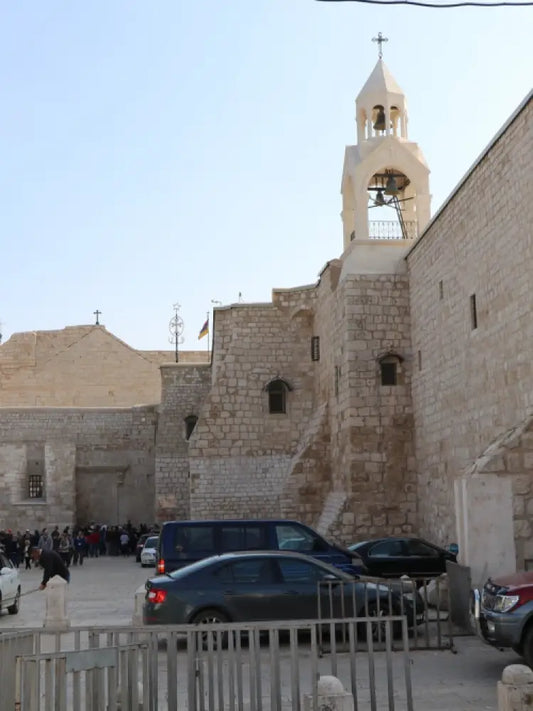
a church with a cross hanging from it's side — Photo by Lisa Forkner on Unsplash
The classic itinerary that actually makes sense: Bethlehem → Jericho → Dead Sea → back to Bethlehem (or up to Jerusalem). One day. The geography lines up perfectly and you're never backtracking.
Roughly 8 hours. That's the difference between seeing Jericho and actually living it.
Bethlehem to Jericho is 40 minutes by private car. Jericho to the Dead Sea is another 25 minutes south. Dead Sea to Jerusalem is 45 minutes back up. Clean, logical, no doubling back.
The 4-hour version exists because that's what cruise-ship day-trips force people into. If you're flying in for a real pilgrimage, do the 8-hour loop. Not close to a question.
We run this exact loop as part of our Day Tours from Bethlehem and Jerusalem — private car, no rush, you decide how long at each stop.
Practical Logistics — Getting There, Costs, Best Season

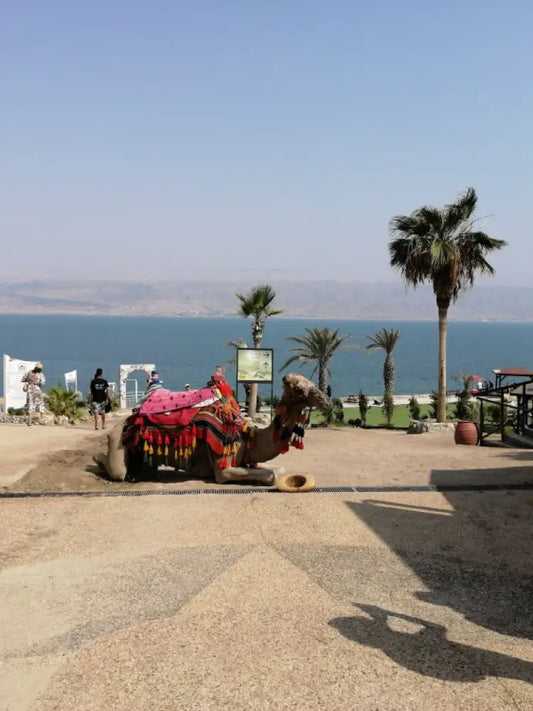
people walking on street near concrete building during daytime — Photo by Levi Meir Clancy on Unsplash
From Bethlehem: 40 minutes by private car, no public bus. The road cuts through Wadi al-Nar — the Valley of Fire. Bring your camera. The name is accurate.
From Jerusalem: 35–50 minutes by private car. Public buses run from Damascus Gate area but are inconsistent. I wouldn't rely on them.
Checkpoints: Depending on your route, you may pass through Checkpoint 300 between Bethlehem and Jerusalem at some point in the day. Here's the practical breakdown of what to expect — it's not a big deal, but knowing what's coming helps. First-timers always appreciate the heads-up.
Currency: Israeli shekels work everywhere. US dollars work at major sites and tour-friendly shops. Cards work at Hisham's Palace and Tell es-Sultan; smaller spots are hit or miss.
Best season: November through March. December and January are ideal — 18-22°C during the day, light jacket at night, almost nobody else around. April and October are second-best. Avoid June, July, August — Jericho hits 42°C+ in summer and that's genuinely punishing. Not an exaggeration. The full summer breakdown for the Holy Land is here — Jericho is the hottest stop on any standard itinerary, no question.
Total cost per person if you do all five sites yourself: roughly 120–150 NIS in entry fees (Tell es-Sultan, Mount of Temptation cable car, Hisham's Palace). Qasr el-Yahud and Zacchaeus's tree are free. Add transport. Add lunch — small local restaurant on Ein el-Sultan Street, about 60 NIS per person, gets you mansaf or maqluba and honestly it's incredible.
What Most Tours Skip (The Local Insider Section)

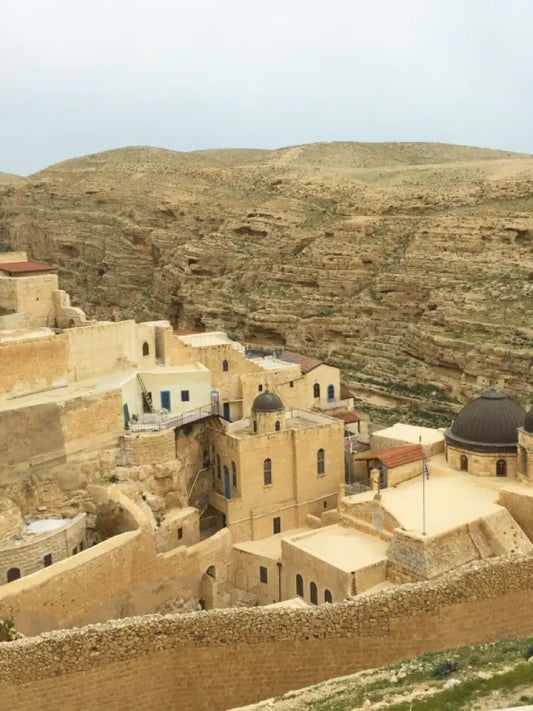
aerial view of buildings near ocean — Photo by Thalia Tran on Unsplash
Here's where I get a little opinionated.
Elisha's Spring (Ain al-Sultan) — five minutes walk from Tell es-Sultan, free, and most tours don't even mention it. This is the spring 2 Kings 2:19-22 talks about — the bitter water Elisha healed with salt. The water is still drinkable today. Locals fill plastic bottles from it. You should too. Drink it at the source. It's something.
(Funny thing -- I started writing this at 7am and it's almost noon. Got pulled into a long conversation with a first-time pilgrim who had a hundred questions. Worth it every time.)
Wadi Qelt overlook — on the road from Jerusalem to Jericho there's a viewpoint over the Wadi Qelt canyon, with the St. George Monastery clinging to the cliff face below. It's not on most itineraries because tour buses cant easily stop and turn around there. A private car can. Pull over, ten minutes, one of the most striking views in the entire country. People photograph it, fall silent, then photograph it again.
The bakery on Ein el-Sultan Street — small place, no English sign, makes za'atar bread fresh from a wood-fired oven all morning. I wont name it because they're not on Google Maps and they don't need to be (I keep meaning to write a whole separate post about this part specifically and never do -- consider this your preview). Your guide knows the one. Three shekels. You'll think about that bread for a week.
And one more thing — the moment that happens at Tell es-Sultan, almost without fail. You're standing on what looks like an ordinary hill. The guide explains that every layer beneath your feet is a full city. Twenty-three of them. The walls Joshua's army marched around are down there, buried deep. And pilgrims go quiet. Then someone says — I've heard this maybe two hundred times — "How am I just learning this now?" I've seen people tear up just standing at the entrance. No joke. That's Jericho. That's the whole point.
Key Takeaways
- Jericho is the lowest (258m below sea level) and oldest (~10,000 years) continuously inhabited city on earth -- and this is the one most people overlook
- The five must-see sites for Christian pilgrims are Tell es-Sultan, Mount of Temptation, Zacchaeus's sycamore tree, Hisham's Palace, and Qasr el-Yahud (Jordan River baptism site).
- It pairs naturally with the Dead Sea as a single full-day loop -- you get the idea
- Best time to visit is November through March; summer pushes 42°C+ and is genuinely punishing.
- Total entry fees for all paid sites: roughly 120–150 NIS per person. Qasr el-Yahud and Zacchaeus's tree are free.
🌱 Plan Your Holy Land Tour


Frequently Asked Questions

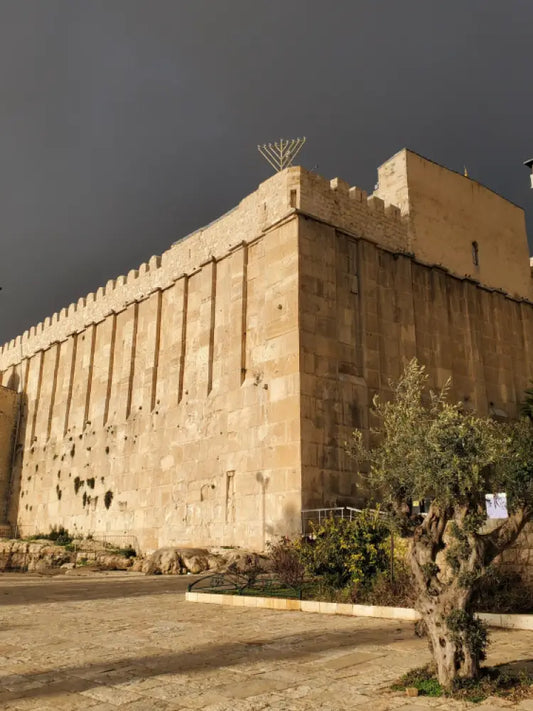
brown mosque at daytime — Photo by Toa Heftiba on Unsplash
Is Jericho really the world's oldest city? Yes. Tell es-Sultan, the archaeological mound at the edge of modern Jericho, shows continuous human habitation dating to roughly 10,000 BCE. UNESCO recognized this with World Heritage status in 2023. It's the oldest known continuously inhabited city on earth — 23 distinct civilizational layers have been excavated.
How do I get from Bethlehem to Jericho in 2026? By private car, the drive is about 40 minutes through the Judean Desert via Wadi al-Nar. There's no direct public bus from Bethlehem. Most pilgrims either book a private day tour or hire a taxi for the day. From Jerusalem, the drive is 35-50 minutes; some public buses run from the Damascus Gate area but the schedule is inconsistent.
Where exactly was Jesus baptized — Qasr el-Yahud or Bethany Beyond the Jordan? Both. They're literally across the river from each other — the same baptism site, viewed from opposite banks. Qasr el-Yahud is the western (Israeli/Palestinian) side, and Bethany Beyond the Jordan is the eastern (Jordanian) side. Christian tradition since the Byzantine era places Jesus's baptism at this exact bend of the river. Most pilgrims visit whichever side their itinerary brings them to.
Can you see Tell es-Sultan, Mount of Temptation, and Hisham's Palace in one day? Yes, easily — all three plus Zacchaeus's tree fit comfortably in a half-day (about 4 hours). Adding Qasr el-Yahud (Jordan River) and the Dead Sea pushes it to a full 8-hour loop. The sites are within 15 minutes of each other; the longest leg is Qasr el-Yahud at 12 km from central Jericho.
What's the cable car up the Mount of Temptation actually like? About 75 NIS round trip ($21 USD), takes 6 minutes each way, and gives you what I'd call the best aerial view of the Jordan Valley in the country. The car is enclosed (good for hot days) and runs continuously. The alternative is a steep one-hour hike — fine for fit pilgrims, brutal for anyone over 60 or struggling with knees.
Is Jericho safe for Christian pilgrims in 2026? Yes. Jericho has been one of the calmest stops in the Holy Land for years and remains so in 2026. Tourism here is steady, the sites are open, and local hospitality is genuine. Standard travel sense applies — don't carry valuables unnecessarily, dress modestly at religious sites, and travel with a licensed guide or trusted driver if it's your first time.
How much does a Jericho day trip cost? For a private day tour from Bethlehem or Jerusalem covering all five sites plus the Dead Sea, expect roughly $180-280 USD per person depending on group size and inclusions. If you DIY the trip, entrance fees alone are about $35-45 USD per person, plus transport. Lunch at a local restaurant runs around $15-20.
Do I need a guide to visit Jericho, or can I go alone? You can technically go alone, but you'll miss most of what makes it meaningful. The sites have minimal signage — Tell es-Sultan is essentially incomprehensible without someone explaining the layers, and Hisham's Palace needs context to land. If you're a confident solo traveler with Bible in hand, you can manage. For most pilgrims, a licensed local guide is the difference between a checkbox visit and a real one.
Related Reading

green trees under white clouds during daytime — Photo by Tetiana SHYSHKINA on Unsplash
- Tell es-Sultan in Jericho: Walking Through the World's Oldest City
- Hisham's Palace in Jericho: A Desert Masterpiece of Art and History
- Why Most Tourists Skip Jericho — And Why That's a Huge Mistake
- The Jordan River: A Sacred Place of Baptism, Renewal, and Faith
- Visiting the Holy Land in Summer: Heat, Crowds, and How to Do It Right
Here's something worth knowing: if you're planning a Holy Land pilgrimage and Jericho is on your list — give it the full day it deserves.
If you'd like us to drive it with you, our private Holy Land day tours cover this exact loop, no rush, no group of 40 strangers crowding the Tree of Life mosaic. Or just send us a note — we answer every email ourselves.
Either way: come. The city has been waiting 10,000 years. A few more weeks won't hurt.
Elias Boaz is a licensed tour guide from Bethlehem — birthplace of Jesus Christ — and the founder of Elijah Tours. He has guided thousands of pilgrims through Bethlehem, Jericho, and the Jordan River Valley — and coordinates Holy Land tours with trusted licensed guides across the region. He writes to help visitors truly understand what they're seeing.




0 comments