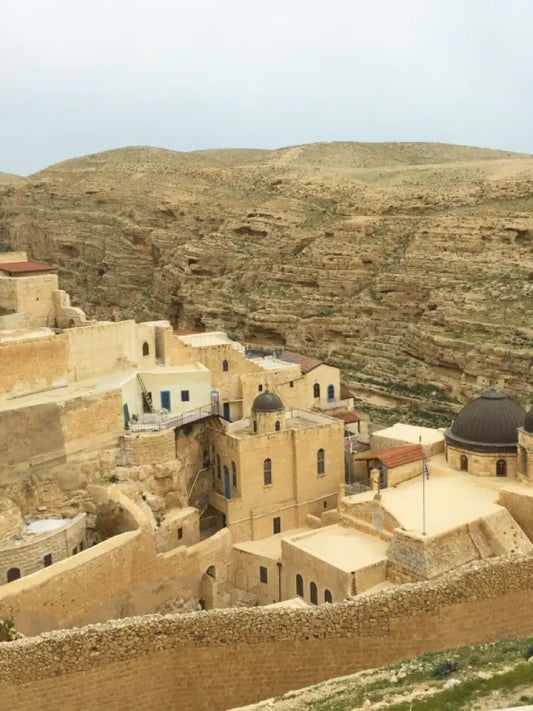
Mar Saba is one of the most striking monasteries in the Holy Land, but its visitor rule needs to be clear before anyone makes the journey: men may enter during visiting hours, while women may not enter the monastery. Women can still see the monastery and the Kidron Valley from the outside observation area traditionally called the Women's Tower.
That is not a small detail to discover at the gate. It changes how couples, families, church groups, and private tours should plan the stop.
Mar Saba can be meaningful for a mixed group, but only when the day is designed honestly. The outside view should be treated as a real destination, not as a waiting area for the women while the men disappear inside.
Why Mar Saba Is Different

Mar Saba does not sit beside a busy square or a coach parking lot. The monastery rises from the cliffs of the Kidron Valley in the Judean Desert east of Bethlehem. The walls, towers, chapels, caves, and terraces look as if they grew out of the rock.
Saint Sabas came to the Holy Land in the fifth century and became one of the central figures of Palestinian monasticism. The Jerusalem Patriarchate's account of Saint Sabas places his arrival in the Holy Land around 456. The monastery that bears his name remains an active Greek Orthodox community, not a museum arranged around tourist convenience.
That distinction explains a lot. Visiting rules are part of the monastery's religious life. Silence matters. Modesty matters. The person at the gate, not an old blog post or screenshot, has the final word about entry on the day.
You do not need to agree with every rule to plan around it respectfully. You do need to know the rule before you go.
Can Women Visit Mar Saba?
Yes, women can visit the Mar Saba area and see the monastery from outside. No, women cannot enter the monastic complex.
The Christian Information Center's current opening-hours list marks Mar Saba as men only. The project's verified fact record says the same and adds the practical point many short tour descriptions omit: women can view the monastery from the Women's Tower just outside.
The Palestinian tourism listing for Mar Saba describes that observation point as one of the visit's highlights. From there, the monastery can be understood in its full setting. You see the fortified upper walls, the buildings pressed into the cliff, and the deep desert valley below.
For many visitors, that wide view is the most memorable part of the stop. It reveals why early monks came to this landscape in search of solitude. The exterior is not a consolation prize. It is the only place where the whole complex and the geography around it make visual sense.
What women should expect
A well-planned visit for women should include:
- A clear explanation of the men-only rule before departure
- Enough time at the viewpoint to see the monastery and canyon without being rushed
- Context about Saint Sabas and desert monastic life
- A safe meeting point and agreed time if men in the group enter
- A route that does not leave women alone merely because the itinerary was written around male entry
What it should not include is a promise that someone can negotiate an exception. Do not ask a guide to challenge a living monastery's admission rule at the gate.
What Men Can Expect Inside

Men who arrive during visiting hours may be admitted into the monastery, subject to the decision of the community on that day. The important word is may.
Mar Saba is not a timed attraction with every room guaranteed. Religious services, feast days, community needs, maintenance, and other local conditions can change what is accessible. A responsible itinerary never guarantees a particular chapel, relic, monk encounter, or interior route.
Inside, the experience is devotional rather than theatrical. Move quietly. Follow instructions. Do not wander away from the permitted route or treat private monastic spaces as scenery for a photo session.
If your main interest is photography, the outside panorama is the stronger plan anyway. If your main interest is Orthodox monastic tradition, make that clear when arranging the day so the guide can protect the time without promising what the monastery itself controls.
Current Hours and the Days to Avoid
The current CICTS holy-place schedule lists Mar Saba's visiting hours as 9:00 to 14:00. It lists Wednesday and Friday as closed.
That schedule is the best published planning reference available for the site, but it should not be treated like a guarantee printed on a cinema ticket. Confirm close to the visit, especially around Orthodox feast days or when regional conditions are changing.
Do not build a Wednesday or Friday desert day around interior entry. On an open day, arrive with a buffer rather than at the end of the listed window. The road, the walk to the viewpoint, and group movement all take real time.
Clothing, Terrain, and What to Carry
Modest dress is the respectful choice for any active monastery. The Palestinian tourism guidance recommends modest clothing and sturdy shoes. For men hoping to enter, long trousers and covered shoulders are the sensible standard. Women at the exterior viewpoint should also dress for a religious setting and the desert, not only for a photograph.
Bring:
- Closed shoes with reliable grip
- Water, especially in warm weather
- Sun protection and a hat
- A light extra layer when the morning is cool or windy
- Only the bag you can comfortably carry over uneven ground
The Judean Desert can look gentle from a distance. Up close, surfaces can be rocky, dusty, sloped, and exposed. Do not assume the viewpoint is step-free or suitable for every mobility aid. Ask about the exact vehicle drop-off, walking surface, steps, railings, shade, and available seating for your group's route.
That conversation is more useful than asking whether the site is simply "accessible." Accessibility depends on which part of the visit you mean.
How to Plan Mar Saba for a Mixed Group

The simplest plan is to make the exterior panorama the shared centerpiece. Everyone arrives together, hears the same explanation, and has time to take in the valley. If eligible men then enter, the rest of the group should have a deliberate plan rather than an unstructured wait.
For a private group, decide these points in advance:
- Does anyone intend to enter, or is the group choosing an exterior-only visit?
- How long will the group allow for possible male entry?
- Where exactly will everyone meet afterward?
- Is anyone uncomfortable on uneven ground or in exposed sun?
- Which other Bethlehem-area stop matters most if access changes?
The current Mar Saba and Orthodox monasteries private tour pairs the desert with Orthodox and Bethlehem sites. It is designed as a private route, which makes the group split and timing easier to discuss before the day begins.
Read the live tour page for the current proposed stops, then send the group's genders, denominations, mobility needs, pickup location, and spiritual priorities before booking. This is particularly important if the plan includes Saint Theodosius Monastery. Its own current CICTS listing has a separate Orthodox-Christian admission restriction, so it should never be assumed that every monastery follows the same rule.
Travelers building a broader Bethlehem day can also compare Bethlehem tours and private tours. A private format does not change a monastery's rules. It simply makes it easier to design the rest of the day around them.
What to Pair With Mar Saba
Interested in seeing our collection? → Browse Tours to Bethlehem
Mar Saba belongs naturally with Bethlehem and the desert east of the city. It does not belong in an overloaded day that also tries to cover every major site in Jerusalem, Jericho, and the Dead Sea.
Good companions depend on the group's priorities:
- Orthodox pilgrims may want a monastery-focused route, with every access rule confirmed separately.
- First-time Bethlehem visitors may prefer Shepherds' Field and the Church of the Nativity area after the desert.
- Travelers interested in the wilderness can pair the panorama with another carefully chosen Judean Desert stop instead of rushing through several monasteries.
Our guides to Saint George's Monastery in Wadi Qelt and the Holy Monastery of Saint Gerasimos explain two other desert monastic settings. They are not substitutes with identical access, hours, or geography. Each needs its own current check.
If Bethlehem is the anchor, read Bethlehem Beyond the Nativity before filling the schedule. The better day is often one desert monastery plus meaningful Bethlehem time, not a checklist of distant names.
Is Mar Saba Worth It for Women?

Yes, for many women it is worth the journey. The strongest reasons are the landscape, the exterior architecture, the history of desert monasticism, and the chance to understand a living tradition in its physical setting.
But the honest answer depends on what you want from the day.
Choose Mar Saba if:
- You care about Orthodox monastic history
- The Judean Desert landscape is part of the experience you want
- You are comfortable with an exterior-only visit
- Your group will give the viewpoint real time
Choose another stop if:
- Entering the sacred building is essential for every person in the group
- The gender restriction would make the day feel divisive
- The terrain does not suit your mobility needs
- You have only a few hours and Bethlehem's central sites are your priority
There is no need to pretend every famous place is right for every traveler. A good tour is not measured by how many names appear in the itinerary. It is measured by whether the day fits the people taking it.
Frequently Asked Questions
Can women enter Mar Saba Monastery?
No. The current CICTS visitor listing identifies Mar Saba as men only. Women may visit the outside area and view the monastery from the observation point traditionally called the Women's Tower.
Can non-Orthodox men enter Mar Saba?
The current public listing says men only and does not add an Orthodox-only condition for Mar Saba. Admission is still controlled locally by the monastery, so no man should treat entry as guaranteed.
What days is Mar Saba closed?
The current CICTS schedule lists Wednesday and Friday as closed. The published hours on other days are 9:00 to 14:00. Confirm again near the actual visit.
Is the Women's Tower inside the monastery?
No. It is an outside observation point associated with the traditional limit on women's entry. It provides a view across the valley toward the monastery complex.
What should I wear to Mar Saba?
Wear modest clothing suitable for an active monastery and closed shoes suitable for uneven desert ground. Men hoping to enter should wear long trousers and cover their shoulders.
Can couples and mixed groups visit together?
Yes. Mixed groups can share the outside panorama and explanation. If men plan to enter, agree in advance on the time, meeting point, and meaningful plan for everyone remaining outside.
Plan the Rule, Then See the Place
The men-only rule is the first practical fact to understand about Mar Saba. It should not be hidden, softened, or discovered after a long drive. Once the group understands it, the real planning can begin: who wants to enter, who wants the panorama, how much time the desert deserves, and what belongs afterward.
Mar Saba is powerful because of the relationship between faith and landscape. The monastery is there, but so are the cliffs, the silence, the distance, and the discipline that shaped the community.
If you want help deciding whether Mar Saba fits your group, contact Elijah Tours with your travel date, pickup location, group makeup, mobility needs, and the two stops that matter most to you.
Elias Boaz is a licensed tour guide from Bethlehem, birthplace of Jesus Christ, and the founder of Elijah Tours. He has guided thousands of pilgrims through Bethlehem, Jericho, and the Jordan River Valley, and coordinates Holy Land tours with trusted licensed guides across the region. He writes to help visitors truly understand what they're seeing.