Most first-time visitors need 3 to 5 hours for a focused Bethlehem visit. That is enough for the Church of the Nativity area, the Milk Grotto, and Shepherds' Field when access and traffic cooperate. Choose a full day if you want a slower pace, time for lunch, and sites beyond the center.
The honest question is not how many sites can fit on a list. It is how much of Bethlehem you want time to notice.
These ranges match Elijah Tours' current Bethlehem half-day and full-day formats as of September 2026. They are not promises that every stop will take the same number of minutes. Religious services, traffic, checkpoint conditions, group pace, and site access can all change the order.
The Short Answer: Half a Day Works for the Essentials
A half-day is a good choice when Bethlehem is one part of a larger Holy Land itinerary. It can give you a meaningful first visit, but only if the route stays focused.
The core usually looks like this:
- Manger Square and the Church of the Nativity
- The Milk Grotto, a short walk from the Nativity area
- Shepherds' Field in nearby Beit Sahour
- A brief look at local olive wood craft, if time and the chosen tour allow
That is already a full half-day. Bethlehem is not difficult because the sites are spread across hundreds of kilometers. It is difficult because sacred places run on living religious schedules, roads can slow down, and visitors naturally want more time once they arrive.
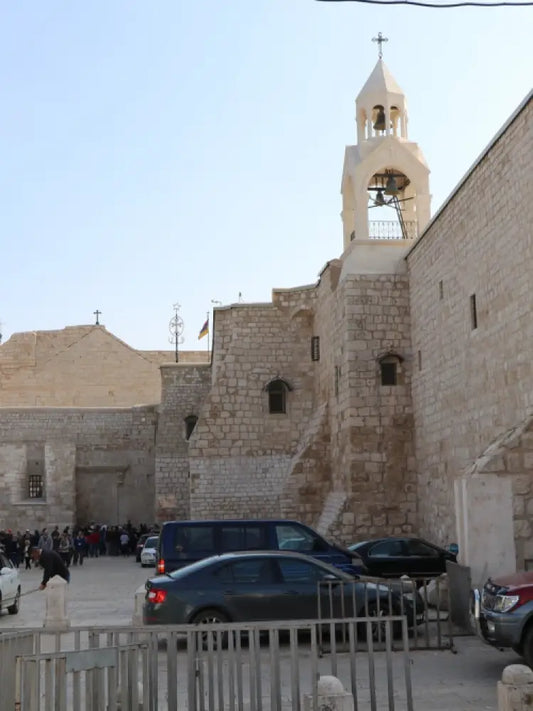
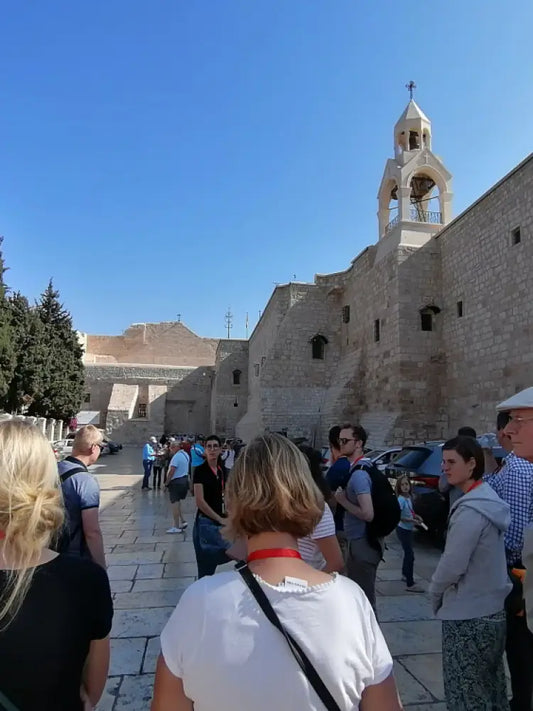
The Church of the Nativity deserves more than a photograph at the Door of Humility. Even when the Grotto cannot be entered, the basilica, its long history, Saint Catherine's Church, and Manger Square need context. Our Church of the Nativity visitor guide explains the site in more depth.
And then there is the Milk Grotto. It is close enough to be overlooked precisely because visitors assume they can squeeze it in at the end. Read the Milk Grotto guide before deciding whether it belongs on your non-negotiable list.
What You Can Actually See in 3 to 5 Hours
Manger Square and the Church of the Nativity
Start with the reason most Christian pilgrims come. The church stands on Manger Square, so the first two stops are naturally connected. Still, do not build the whole morning around a guaranteed visit to the Grotto of the Nativity.
The Christian Information Center lists restricted visiting windows during restoration of the Grotto of the Nativity. Access can change, so entry cannot be guaranteed. Check its current opening information close to your travel date; plan time for the basilica and Manger Square, subject to services and visitor access.
This is exactly why a good Bethlehem itinerary needs a second plan. If one interior is unavailable, the guide should shift the time into the basilica, Saint Catherine's Church, the Milk Grotto, or another relevant stop. A closed door should change the sequence, not ruin the whole visit.
Milk Grotto
The Milk Grotto is near the Nativity complex, but it has its own atmosphere and tradition. A rushed group can walk in and out quickly. A thoughtful visit needs enough time to understand why families and pilgrims come here, then a few quiet minutes inside.
The site normally closes for a midday break and can also close on Catholic feast days. That makes the order important. If you arrive near the break, visiting Shepherds' Field first may be wiser than standing outside and losing part of the half-day.
Shepherds' Field
Shepherds' Field sits in Beit Sahour, not directly on Manger Square. It therefore requires a vehicle transfer and should not be treated as a five-minute add-on. The biblical connection to Luke 2 is central, but the place also gives the Bethlehem story a wider landscape.
There are different Christian traditions and sites associated with Shepherds' Field. The dedicated Shepherds' Field guide helps you understand what a tour is actually including.
When a Full Day Is Worth It

A full day is not simply a half-day with twice as many stops. The real benefit is breathing room.
You can spend longer at the main churches, stop for lunch without watching the clock, and add one or two places outside the compact Nativity area. Depending on the itinerary and current access, that may include Herodium, Solomon's Pools, or viewpoints toward monasteries in the Judean Desert.
Herodium is the clearest example. It is a separate archaeological destination outside central Bethlehem, and it needs travel time plus time on the site. Trying to add it to a short Bethlehem visit turns the day into a race. If it matters to you, read our guide to Herodium near Bethlehem and choose a full-day plan.
A full day also helps if your group includes:
- A traveler who needs regular seated breaks
- Children who do better with a slower pace
- Someone who wants time for prayer rather than only explanations
- A photographer waiting for cleaner compositions and changing light
- Family members with different priorities
More time does not remove every access issue. It simply gives the guide room to adapt without sacrificing the whole experience.
Half-Day or Full-Day: A Practical Decision Matrix
Interested in seeing our collection? → Browse Tours to Bethlehem

Here is my position: if Bethlehem is mainly a must-see stop between other plans, choose the half-day and protect the essentials. If Bethlehem is one of the reasons you are coming to the Holy Land, give it the full day.
Starting in Jerusalem Changes the Calculation

Travelers often count only the time printed beside the tour. They forget the meeting point, vehicle transfer, and the possibility of changing vehicles on the way into Bethlehem.
Starting in Bethlehem gives you more usable local time. Starting in Jerusalem is convenient for many visitors, but the travel logistics become part of the day. Pickup location, road conditions, and checkpoint procedures can affect the timing in either direction.
Do not stack a fixed lunch reservation or timed Jerusalem entry immediately after a Bethlehem half-day. Leave a buffer. If the next plan cannot move, tell the tour operator before booking so the route can be assessed honestly.
For current route choices, read how to travel from Jerusalem to Bethlehem. If you are comparing departures, the tours from Jerusalem collection shows the current range of options.
How to Protect the Time You Have

The best time-saving tool is not speed. It is a clear priority list.
Before the day, choose two non-negotiable places. For most first-time Christian visitors, those will be the Church of the Nativity and Shepherds' Field. If the Milk Grotto matters more to you than a shop stop or long lunch, say that early.
Then do these five things:
- Confirm the current site access. Do this again close to the visit, especially for the Grotto of the Nativity.
- Wear church-ready clothing. Covered shoulders and knees prevent an avoidable delay at the Church of the Nativity.
- Carry valid photo ID. Keep it easy to reach during travel between Jerusalem and Bethlehem.
- Do not promise yourself every stop. Pick a backup site or an optional stop that can be removed without disappointment.
- Tell the guide about mobility needs. A slow walker can have a good half-day, but the sequence and expectations must be adjusted.
The wider Bethlehem tours collection is useful when you want to compare focused and extended itineraries without forcing the wrong format onto your day.
Key Takeaways
Interested in seeing our collection? → Browse Day Tours
- Three to five hours is enough for a focused first visit, not for every sacred, historical, and local layer of Bethlehem.
- A full day is most valuable for pace and flexibility, not just for collecting more stops.
- The Grotto of the Nativity has restricted visiting windows during restoration, so no itinerary should guarantee entry.
- Starting point and travel conditions affect usable sightseeing time, especially when the tour begins and ends in Jerusalem.
- The right choice depends on your priority. Choose a half-day for the essentials, and a full day when Bethlehem itself is central to the journey.
Frequently Asked Questions

Can you see Bethlehem in half a day?
Yes. A focused 3 to 5 hour visit can usually include Manger Square, the Church of the Nativity area, the Milk Grotto, and Shepherds' Field when access, traffic, and the group's pace cooperate. It will not cover every site around Bethlehem.
Is one full day enough for Bethlehem?
Yes, one full day is enough for the main Christian sites plus lunch and one or two selected places outside the center. It also allows a slower pace. Travelers who want local neighborhoods, repeated church visits, or early and evening atmosphere may prefer to stay overnight.
How long should I allow for the Church of the Nativity?
There is no reliable fixed time because services, queues, and access can change. Allow a meaningful part of the visit for the basilica and nearby Saint Catherine's Church. During restoration, the Grotto has restricted visiting windows and entry cannot be guaranteed.
Can I visit Bethlehem and Jerusalem on the same day?
Yes, a planned combined tour can cover selected highlights in both cities. The compromise is depth. Jerusalem's Old City and Bethlehem can each fill a day, so a combined itinerary must use a short priority list and leave room for travel conditions.
Should I stay overnight in Bethlehem?
Stay overnight if you want to experience the Old City outside the busiest visiting hours, prefer a gentler pace, or plan more than one Bethlehem-area day. A day trip is enough for the main sites, but it does not show every side of the city.
What happens if the Grotto of the Nativity is closed?
The visit can still include the Church of the Nativity basilica, Manger Square, Saint Catherine's Church, the Milk Grotto, and Shepherds' Field, subject to their own access. Check the current restricted Grotto visiting windows before travel and keep an alternative plan if entry is unavailable.
Give Bethlehem the Right Kind of Time

You do not need several days to understand why Bethlehem matters. But you do need enough space in the schedule to stop treating it like a photograph between two transfers.
Decide what Bethlehem is for you. Is it one essential stop in a wider journey, or is it one of the reasons for the journey? Once that answer is clear, the right amount of time usually becomes clear too. If you want help matching the route to your priorities, contact Elijah Tours with your starting point and must-see sites.
Elias Boaz is a licensed tour guide from Bethlehem , birthplace of Jesus Christ , and the founder of Elijah Tours. He has guided thousands of pilgrims through Bethlehem, Jericho, and the Jordan River Valley , and coordinates Holy Land tours with trusted licensed guides across the region. He writes to help visitors truly understand what they're seeing.