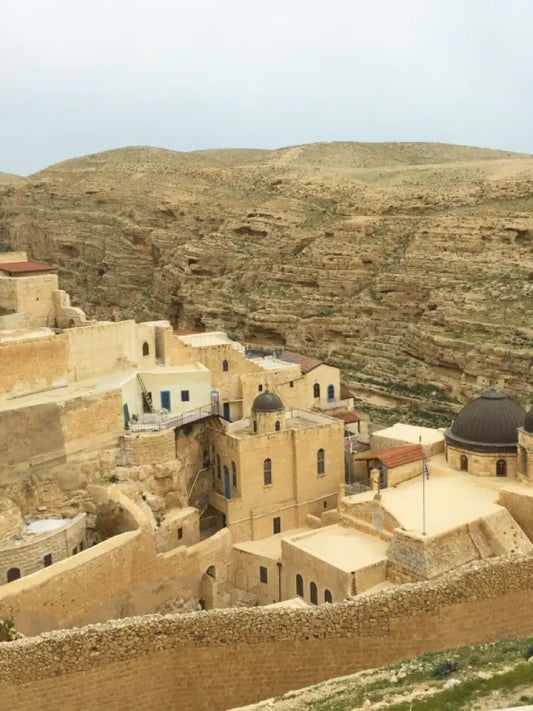
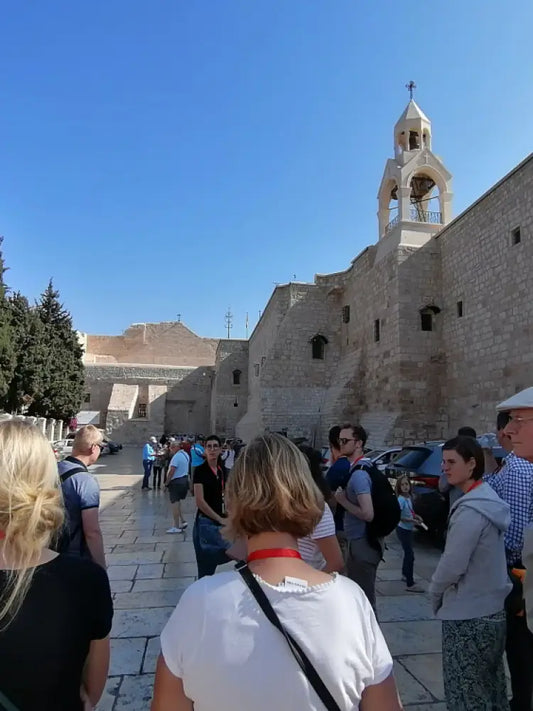
About 28,000 Christians live in the Bethlehem governorate today — the cities of Bethlehem, Beit Sahour, and Beit Jala combined — making up roughly 11% of the local population. They are not visitors. They are not a memory. Almost 2,000 years of unbroken presence. Descendants of the first-century Christian community, still here, still going to the same churches, still burying their dead in the same hills.
📝 In This Article
- How Many Christians Actually Live in Bethlehem Today?
- The Three Cities That Make Up Christian Bethlehem
- Who Are Palestinian Christians? (And Why That Phrase Confuses Pilgrims)
- Comparison: The Main Christian Denominations in Bethlehem
- Living Faith — What Sunday Actually Looks Like in Bethlehem
- Where to Actually Meet the Christian Community as a Pilgrim
- Is Bethlehem Safe for Christian Tourists in 2026?
- What You Should Know
- FAQ
- Related Reading
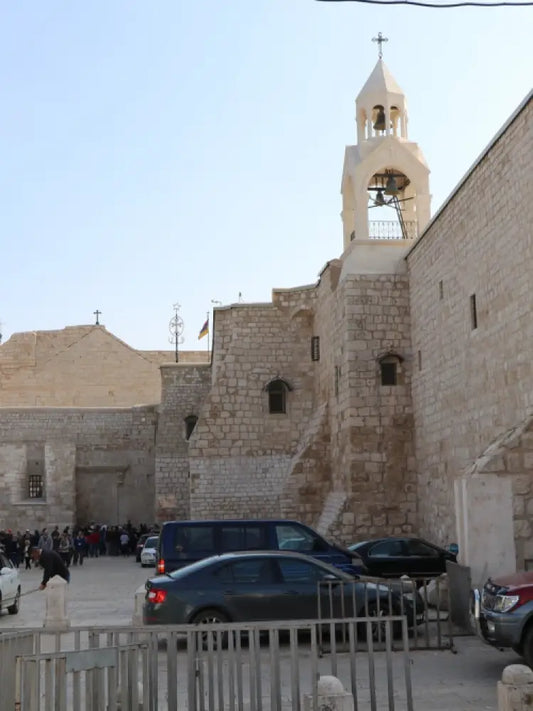
I'm not a theologian, but from what I understand, most pilgrims dont know this. They come in, see the church of the nativity, buy a wooden cross from a shop on Manger Square, and leave. Never meet a single Bethlehem Christian. That bothers me — genuinely bothers me — because the community is the most living part of the story, and its sitting right there waiting to be met.
I grew up in Beit Sahour, about a fifteen-minute walk from the Grotto. I could be wrong here, but my grandmother walked to the Nativity every Friday morning until she was genuinely 84. Three different church bells woke me up most days — Lutheran, Latin, and St. George's Greek Orthodox, all going at the same time, all slightly out of sync with each other. Thats the soundtrack of Christian Bethlehem. You dont forget it. You really dont.
How Many Christians Actually Live in Bethlehem Today?
Short answer: about 28,000, across the broader Bethlehem governorate, as of 2026. Roughly 11% of the local population.
It wasnt always like that. In 1947, the area was roughly 85% Christian. The change is mostly economic and demographic — emigration to Chile, the United States, and Australia over the last 70 years, plus higher birth rates in the Muslim community. There are now more Bethlehemite Christians living in Santiago, Chile than in Bethlehem itself. Look up "Belenistas chilenos" sometime. An entire diaspora, full cultural calendar, Lebanese-Palestinian Arabic mixed with Spanish. Its something.
But the community here is not disappearing. The Latin Patriarchate of Jerusalem (re-established in 1847) keeps parish records showing a stable Christian population in Beit Jala and Beit Sahour over the last decade. The families that stayed, stayed. Many of them have been in the same houses for 300 to 400 years. Giacaman, Nassar, Khoury, Banoura, Tabash, Salah, Canavati, Handal, Bandak — these are not new arrivals. These are families whose ancestors carved olive wood for pilgrims when the Ottomans were still running the place. Some of them are still carving.
The Three Cities That Make Up Christian Bethlehem
When people say "Bethlehem" they usually mean Manger Square and the Church of the Nativity. The Christian community is actually spread across three connected towns. Call me biased, but nothing beats being here in person.
Bethlehem Proper
This is what tourists see. Manger Square, the Nativity, Star Street, the Old City with its low stone arches and narrow lanes that smell like za'atar and diesel in the morning.
The Christian families clustered here are mostly Catholic, with strong Orthodox presence around the Nativity itself.
Population today: roughly 28,000 total, about 25% Christian.
Beit Sahour
My hometown. East of Bethlehem proper. This is the "Shepherds' Field" town — the place where, according to Luke's gospel, the angels appeared to the shepherds the night Jesus was born. The Catholic Shepherds' Field (run by the Franciscans) and the Greek Orthodox Shepherds' Field are both worth visiting. Most pilgrim groups miss the second one entirely. Big mistake. The two sites feel completely different from each other — different silence, different weight. You get the idea.
Population today: about 14,000, around 70% Christian. Highest Christian percentage of the three.
Wait — actually Beit Jala edges it out slightly. Let me explain.
Beit Jala
West of Bethlehem on the next hilltop over. Famous for apricots in spring, for the Cremisan Monastery wine (Salesian monks, been making it since 1885), and for the highest Christian percentage in the West Bank. Think about that.
Population today: roughly 16,000, around 75% Christian.
The two big churches are the Greek Orthodox St. Nicholas and the Catholic Annunciation. Both worth more time than most itineraries give them. Think about that.
Here's the part most people overlook: these three towns function as one community. The kids go to the same schools — often the Catholic ones, De La Salle, Talitha Kumi, Terra Sancta. Families intermarry across all three. A wedding in Beit Sahour pulls guests from every direction. If you only walk Manger Square and leave, you've seen maybe a third of actual Christian Bethlehem. For practical movement between Jerusalem and these towns, the logistics are simpler than most pilgrims expect — I wrote about that in detail in What Actually Happens at Checkpoint 300. Not even close.
My father used to say that people dont come here to see stones -- they come to feel something they can't name. I think about that every time I start a new tour.
Who Are Palestinian Christians? (And Why That Phrase Confuses Pilgrims)
Heres the thing — a lot of pilgrims arrive thinking "Palestinian" and "Christian" are two different categories that dont overlap. They're not. Bethlehem Christians are Arabic-speaking, ethnically Arab, and have been Christian since the time of Pentecost. The book of Acts mentions "Arabs" hearing the apostles speak in their own language on Pentecost morning. Those are, more or less, our ancestors. Worth sitting with that.
Palestinian Christians are the people who never left. We're not converts. We're not recent. The denominations split off over centuries of theological disputes — Constantinople, Rome, Antioch, Alexandria pulling in different directions — and most Bethlehem families can tell you exactly which split their family landed on, and roughly when. That kind of memory runs deep here. Worth it.
The main denominations you'll encounter:
- Greek Orthodox — the largest community, oldest in the city. Liturgy is in Arabic and Greek.
- Latin Catholic — under the Latin Patriarchate of Jerusalem, established in 1099 during the Crusades, restored in 1847.
- Syriac Orthodox — small but ancient, liturgy still partly in Aramaic. The language of Jesus, more or less.
- Armenian Apostolic — present at the Nativity since the fourth century. They control the north transept of the church.
- Melkite, Lutheran, Anglican, Coptic — smaller communities, but all here.
Comparison: The Main Christian Denominations in Bethlehem
If you want to visit, the Latin Mass at St. Catherines is the most welcoming for visiting pilgrims who arent fluent in Greek or Arabic. The priest will switch between English, Italian, Polish, and Arabic depending on the crowd. Ive seen him do all four in a single service. Completely naturally. Thats the difference.
Living Faith — What Sunday Actually Looks Like in Bethlehem

people walking on street near buildings during daytime — Photo by Diane Picchiottino on Unsplash
Sunday in Bethlehem is loud. Not chaotic loud. Layered loud. The Lutheran bells ring at seven sharp. The Greek Orthodox bells of St. George come in about a minute later — deeper, slower -- and if you've ever been to Bethlehem during pilgrimage season you know exactly what I mean, the streets are packed but theres this energy thats hard to describe, almost like the whole hillside is vibrating. Then the Latin bells of St. Catherine. The morning call to prayer from the Omar Mosque on Manger Square folds into the same air. People walk to church in suits and dresses, kids in formal clothes, grandmothers in lace head coverings. The cafes on Star Street fill up after the 8 AM Mass — you can spot the Catholic crowd by the prayer cards still in their hands. Every single one.
Easter is the loudest week of the year. The Holy Fire procession from Jerusalem's Holy Sepulchre to Bethlehem brings thousands into the Old City. Christmas, obviously, is its own thing — midnight Mass at St. Catherine's, broadcast worldwide, with the Latin Patriarch presiding. If youre planning a trip around either of those, thats an entire post on its own — see Best Time to Visit Bethlehem in 2026. That matters.
But the part nobody writes about is the ordinary Sunday. The Beit Sahour Greek Orthodox church on a regular February morning and the families showing up with grandkids. I'm not a theologian, but from what I understand, the smell of qahwa (cardamom coffee) drifting in from a house next door. A guy fixing his car in the alley while the bell rings right over his head, not even looking up. Thats the rhythm. Thats the part you cant fake. No question.
Where to Actually Meet the Christian Community as a Pilgrim

Men sit together on a rug in a field. — Photo by Wietse Jongsma on Unsplash
Most tours dont give you time for this. You get an hour at the Nativity, fifteen minutes at the Milk Grotto, twenty minutes to buy souvenirs, and youre back on the bus to Jerusalem. You can do better than that. Here's how. Think about that.
Eat where families eat
- Afteem — on Manger Square, just below the Peace centre. The Afteem family has been making falafel here since 1948. The grandmother still works the kitchen.
- Singer Cafe — owned by the Singer family for three generations, -- you get the idea
- Hosh Al-Syrian Guesthouse — quiet courtyard in the Old City, family-run, serves musakhan and maqluba like its supposed to taste. -- and this is the one most people overlook
- Casa Nova — Franciscan-run dining hall next to St. Catherine's, simple Italian-influenced food, the priests eat there too.
Buy olive wood directly from carving families
Skip the gift shops near the bus drop-off. Walk fifteen minutes up Star Street toward the Milk Grotto. The carving workshops there — the Giacaman, Bandak, Salah families — are still doing the work by hand. A nativity set carved from a tree pruned in Beit Jala in 2019. You can ask where the wood came from. They'll show you the workshop. Some of them will let you sit and watch. That matters.
A piece of olive wood from Bethlehem has been a pilgrim souvenir since at least the sixth century. UNESCO inscribed the Church of the Nativity and the Pilgrimage Route in 2012 — partly because of this continuous tradition of pilgrimage and craft. That matters.
Stay in a family-run guesthouse
Casa Nova, Hosh Al-Syrian, St. Joseph, Jacir Palace if you want grander — all of these put your money back into the Christian community. Versus the chain hotels in Jerusalem, where your stay supports a corporation. No question. And I'm not just saying that because I've spent my life guiding people here.
Attend a Sunday service
Even if youre not Catholic, Mass at St. Catherines is open. Show up at 11:30. Dress nicely — no shorts, shoulders covered. Sit in the back. You'll hear the Latin choir, watch families bring their kids forward for blessings, walk out into Manger Square through the same low door pilgrims have used for 800 years. Its free. It takes an hour. And it puts you inside the community instead of standing beside it, looking in. Worth it.
If you'd rather have a guide who can actually arrange these stops thoughtfully instead of running the standard 90-minute Nativity loop, that's the kind of thing we do on a private day. The difference is structural — group tours cant deviate, private tours can. I wrote a longer comparison in Private Holy Land Tour vs Group Tour in 2026 if you want the full breakdown. Big difference.
My phone is blowing up with messages from a group I guided last month -- they want to come back already. That's honestly the best feedback there is.
Is Bethlehem Safe for Christian Tourists in 2026?

a group of men sitting on top of a stone structure — Photo by Najmul H. Hossain on Unsplash
Yes. Honestly, yes.
Tours are running. Checkpoints are open every day from early morning until late. Private tour groups cross from Jerusalem and back without trouble. Sunday Mass at St. Catherines happens every week without exception. The cafes on Star Street are full. The carving workshops are open. Christmas Mass 2025 happened. Easter 2026 happened. Things are functioning. Not even close.
Whats different from a "normal" year is the size of groups. Big buses are rare. Most pilgrimages running in 2026 are private tours of 2 to 8 people. The advantage is real — the Nativity is quieter than it has been in 20 years. You can actually pray in the Grotto without a tour group of 50 pushing in behind you. The disadvantage is that the families and shops that depend on pilgrim traffic are feeling it -- which, come to think of it, is exactly what happened when a church group from Ohio visited last month and stood completely silent at the site for a full three minutes. That kind of stillness is rare now. And it works.
The single best thing you can do as a Christian visitor is just come. Pay for the meal. Buy the olive wood. Tip the carver. Sit in on a weekday Mass. Your presence here is the thing that keeps the community here. The community is the thing that keeps the story real. Big difference.
Key Takeaways
- About 28,000 Christians live in the Bethlehem governorate as of 2026 — roughly 11% of the local population, spread across Bethlehem, Beit Sahour, and Beit Jala.
- Bethlehem Christians are descendants of the first-century Christian community. They never left. They are Arabic-speaking, ethnically Arab, and have been Christian since the time of Pentecost.
- Five main denominations: Greek Orthodox (largest, ~52%), Latin Catholic (~33%), Syriac Orthodox (~7%), Armenian Apostolic (~5%), and other minorities (~3%).
- The best way to meet the community is to eat at family-run restaurants (Afteem, Singer Cafe, Hosh Al-Syrian), buy olive wood directly from carving families on Star Street, and attend Sunday Mass at St. Catherine's at 11:30 AM.
- Tours are operating normally in 2026 — private day tours cross daily from Jerusalem, the Nativity is open, and Christmas/Easter liturgies continue uninterrupted. (this one especially)
🌱 Plan Your Holy Land Tour


FAQ

a large building with a tower — Photo by Jonny Gios on Unsplash
How many Christians live in Bethlehem today in 2026? About 28,000 Christians live in the broader Bethlehem governorate (Bethlehem, Beit Sahour, Beit Jala) as of 2026, making up roughly 11% of the local population. In 1947, the area was approximately 85% Christian — the change is mostly the result of decades of emigration, especially to Chile and the United States.
Are Bethlehem Christians the same as the early Christians? Yes, more or less. They are the direct descendants of the original Christian community that formed here in the first century. The book of Acts mentions "Arabs" at Pentecost — those are, broadly, the ancestors of today's Palestinian Christians. The community has been continuously Christian for nearly 2,000 years.
What language do Bethlehem Christians speak? Daily life is in Arabic. Church services vary by denomination — Greek Orthodox liturgy uses Arabic and Greek, Latin Mass is mostly in Arabic and English, Syriac Orthodox liturgy retains some Aramaic (the language Jesus spoke), and Armenian services are in Classical Armenian.
Is it safe for Christian tourists to visit Bethlehem in 2026? Yes. Private day tours cross from Jerusalem to Bethlehem daily without issue. The Nativity, the Milk Grotto, Shepherds' Field, and the carving workshops are all open. Group bus tours are reduced, which means the holy sites are less crowded than they have been in years — a quiet upside for serious pilgrims.
Where can I attend Christmas Mass in Bethlehem? Latin midnight Mass on December 24 is held at St. Catherine's Church, adjacent to the Church of the Nativity. The Latin Patriarch of Jerusalem presides. Tickets are required and limited — book through the Latin Patriarchate website months in advance. Greek Orthodox Christmas (January 7) celebrations happen inside the Nativity itself.
Related Reading

a group of people walking around a stone building — Photo by Jonny Gios on Unsplash
- What Actually Happens at Checkpoint 300: A Guide From Your Bethlehem Host
- Best Time to Visit Bethlehem in 2026: Christmas, Easter, Summer, or Fall?
- Private Holy Land Tour vs Group Tour in 2026: An Honest Comparison
- See all our Bethlehem Tours — most include time at family-run sites, not just the standard Nativity stop.
If youre planning a pilgrimage and want to actually meet this community instead of just glimpsing it from a bus window — reach out. I'll put together a day that includes a workshop visit, a family meal, a Sunday Mass if your timing works. Thats the kind of pilgrimage that stays with people.
The other kind, the rush kind, fades by the time they land back home.
Come. The community is here. It would mean something to them, and probably to you.
Elias Boaz is a licensed tour guide from Bethlehem — birthplace of Jesus Christ — and the founder of Elijah Tours. He has guided thousands of pilgrims through Bethlehem, Jericho, and the Jordan River Valley — and coordinates Holy Land tours with trusted licensed guides across the region. He writes to help visitors truly understand what they're seeing.