As a Bethlehem-based tour guide, the Dead Sea sits about 430 meters below sea level, making it the lowest exposed land area on Earth. You float automatically, without effort, because the water is roughly 10 times saltier than the ocean. From Jerusalem it takes about 75 minutes to reach by car, and from Bethlehem around 50. It is open in 2026, accessible, and unlike anything else on a Holy Land itinerary.
The One Thing Everyone Gets Wrong Before They Arrive
Most people picture the Dead Sea like the ocean. Warm, blue, a little salty. They expect to wade in, cool off, and float the way you might float in the Caribbean with a bit of extra effort.
Having grown up in Bethlehem, it is not like that at all.
From years of guiding visitors here, the water is thick. Almost syrupy. And the buoyancy is not gradual - it is immediate and a little alarming. The moment you sit back, your legs rise up before your torso, and for a second it feels like the water is trying to tip you upside down. It does not work like regular swimming. If you tense up and try to control it, you will struggle. If you relax and let go, you stay up.
I tell every group I bring here the same thing before they step in: do not put your face in the water. Do not splash. Keep your hands out of your eyes. If it gets in your mouth, which I hope it does not, try not to swallow. The bitterness is honestly extreme and a rinse with fresh water is the only thing that helps. I have watched grown adults start laughing and then immediately start panicking because their feet went up and their eyes got splashed. It happens. Bring fresh water and stay calm.
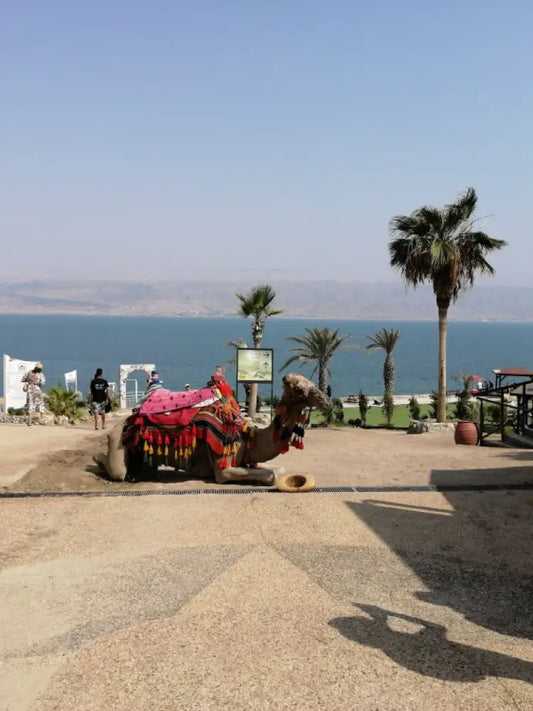
And this part matters. The other thing: the water is not blue and it is not inviting the way a swimming pool looks. On most days it has a slight greenish or brownish tint near the shore. The shore itself is covered with white salt crust. The air smells mineral-rich, slightly sulfurous depending on where you are standing. None of that is a problem. It just takes a minute to adjust to the reality of where you actually are - a hypersaline lake in the middle of a desert, sitting below every other place on earth.
Floating in the Dead Sea: What It Actually Feels Like
Here is honestly what no travel article tells you clearly: you do not learn to float in the Dead Sea. You just float.
Your body is less dense than the water, so you stay on the surface the same way a piece of wood does. There is no technique to master.
What you do have to learn is how to be comfortable with it. The instinct is to move your arms and legs to stabilize yourself. You do not need to. Lie back, keep your arms slightly out to your sides, relax your neck, and the water holds you. Most people take about two minutes to trust it, and then -- well, actually, they stop moving entirely and just sit there looking at the sky. That is the moment.
How long to stay in the water. Fifteen to twenty minutes is enough. The minerals pull moisture from your skin at a rate that becomes uncomfortable if you stay longer. You will feel it - a tightening, a slight stinging on any dry or sensitive skin. When that starts, get out.
Rinse with fresh water immediately after leaving the water. Not eventually, not after you sit in the sun for a bit. Right away.
Honestly, the salt residue will dry on your skin and become intensely itchy if you leave it.
I'll be straight with you: One rule I give before every Dead Sea visit: do not shave for at least 24 hours before.
Any small cut, any razor nick, any abrasion you forgot about - the salt finds it. Every single time. That matters.
The mud. You will see people coating themselves in black mud along the shoreline. This is the same mineral-rich mud sold in cosmetics stores worldwide. It is free. It is right there on the shore. Coat yourself, wait about 15 minutes while it dries, then rinse with fresh water. Whether it does what the labels say is not for me to say - but it is the experience everyone expects, and it costs nothing.
Ein Gedi: The Site Most Day-Trippers Skip
Ein Gedi is a desert oasis beside the Dead Sea. Before adding a hike, check the official Israel Nature and Parks Authority update for the exact trail you intend to use; flood damage has changed access.
Most tour groups heading to the Dead Sea do not stop here. That is their loss. Think about that.
The biblical connection: First Samuel 23 and 24 associate David with the wilderness of En Gedi. That tradition adds meaning to the landscape, but it does not establish a particular modern visitor route as the exact cave in the story.
Trail access checked October 17, 2026: INPA reports continuing flood restoration. Its current update describes modified routes for experienced hikers and an open ancient synagogue. Advance registration is required separately for each site. Choose a confirmed route and observe its own entry cutoff; do not rely on an older Nahal David waterfall itinerary.
The Ancient Synagogue of Ein Gedi. Near the kibbutz, there is a Byzantine-era synagogue with a well-preserved mosaic floor. It dates to approximately the 4th to 6th centuries CE. Most day-trippers have no idea it exists. Worth 20 minutes if you are already at Ein Gedi.
If you want to go deeper into the kind of Holy Land sites most visitors miss, our full Masada 2026 guide covers the Roman-era fortress just south of here in full detail. Think about that.
The Masada + Dead Sea Combo: How to Structure Your Day
Real talk: This is the most common Holy Land day trip for a reason. Masada is approximately 20 minutes south of Ein Bokek by car. You can do both in a single day without rushing, if you plan the order correctly. Every single one.
The right order. Masada first, Dead Sea float in the afternoon.
Masada in the morning means cooler temperatures and thinner crowds. The cable car opens at 8am. If you want the sunrise, you start the Snake Path before dawn and reach the summit as the sun comes up over Jordan. If you are not interested in the sunrise specifically, take the cable car and arrive at the top by 8:30 or 9am, see the site, and be back at the base by 11am before the heat becomes punishing. Not even close.
If you want Masada, Ein Gedi and a Dead Sea beach in one day, plan the route around confirmed trail reservations, heat restrictions and travel time. Do not assume a standard waterfall hike is available. Ein Bokek is south of Ein Gedi, so visiting both can involve backtracking depending on your start and return points.
What most people drive past without stopping. On Route 90, driving north from Masada toward the Dead Sea beach, look west. The large earthen ramp you see rising to the cliff face is the Roman siege ramp built by the Tenth Legion in 73 CE. It is the actual structure, and it is still there, visible from the road. Almost no one stops. Almost no one knows what they are looking at. If you have a guide, ask them to slow down at that point. It is worth seeing.
For the full story of Masada, the palace, the siege, the scroll room, and what the ascent is actually like, read our complete Masada 2026 guide. That's the difference.
Day Trip Options at a Glance
Interested in seeing our collection? → Browse Tours to Jerusalem
Getting There: From Jerusalem and From Bethlehem

brown rock formation during sunset , Photo by Cristina Gottardi on Unsplash
From Jerusalem, the standard route is Route 1 east toward Jericho, then Route 90 south along the Jordan Valley. Total driving time is roughly 75 minutes, sometimes more if there is traffic near the Jericho junction. This is the kind of thing that drives me crazy about generic tour packages.
Worth it.
From Bethlehem, the route is shorter. Head south on Route 60 through the Judean Hills, connect to Route 90, and drive south.
About 50 to 60 minutes total, depending on conditions at the junction. That's the difference.
Groups traveling with a private guide often stop in Jericho on the way to the Dead Sea. It adds about 30 to 45 minutes to the trip but gives you a genuine biblical site stop (the ancient tel at authentic tell es-sultan, the Mount of Temptation cable car, the Zacchaeus sycamore) before you get to the water. We have a full guide to planning that stop here: Jericho Holy Land Guide 2026.
Big difference.
There is no convenient public bus route to the Dead Sea beach area. Shared taxis to Jericho are possible from Jerusalem, but the southern leg to Ein Bokek is difficult without a car. Most pilgrims use a private guide or join a group tour. If you want to see what that looks like for the Dead Sea specifically, we run dedicated Dead Sea day tours from Bethlehem and Jerusalem. That's the difference.
What the Bible Says About the Dead Sea Region

a large body of water surrounded by rocks , Photo by Avi Theret on Unsplash
This area comes up in scripture more than most pilgrims realize before they arrive.
Genesis 13 describes Lot looking east from the hill near Bethel and choosing the well-watered plain of the Jordan. The cities of Sodom and Gomorrah are traditionally located in the southern end of the Dead Sea region.
The geography makes sense if you read it while standing there. That matters.
First Samuel 23 and 24 connect David’s story with En Gedi. Read the landscape in that biblical context without assuming a currently accessible trail identifies the exact cave.
And it works.
Ezekiel 47:8-9 records a vision of a river flowing eastward from Jerusalem toward the Dead Sea, making its waters fresh and alive with fish (this is one of those things where I could go on for an hour -- ask me in person sometime and I will). Pilgrims who know this passage often stand at the shore and think about it.
And it works.
And Qumran, about 30 minutes north of the main beach area, is where the Dead Sea Scrolls were discovered in 1947. A Bedouin shepherd found the first jars in a cave. The visitor center and cave views can be added to a Dead Sea day without extending the trip significantly. If you are doing Jericho, Qumran, and the Dead Sea in sequence, plan a full day with an early start. And it works.
Practical Logistics for 2026

Which beach to use. Ein Bokek is the main access area. There are free public sections of beach with basic access, and there are resort beaches attached to the hotels in the area. The resort beaches cost money but have changing rooms, showers, sun loungers, and fresh water stations. On a hot day, that access is worth paying for. On a cooler day in winter, the free public section is perfectly fine.
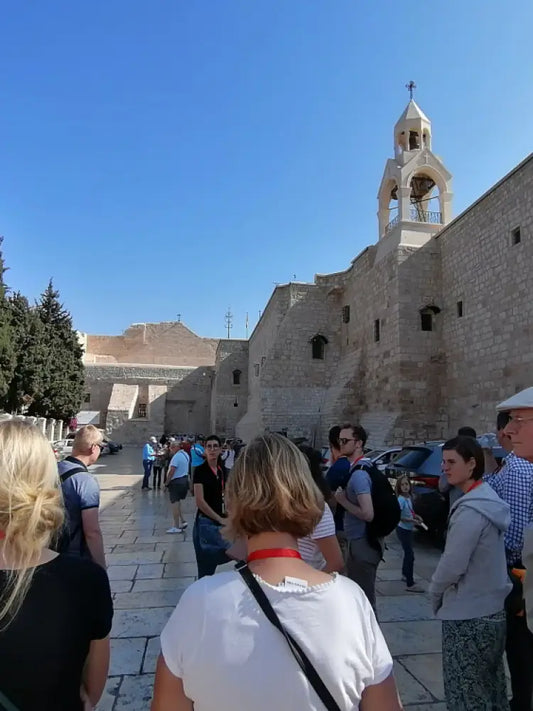
Outside the window, a group is walking toward Manger Square. I guided a group from Canada through here last week -- complete from Bethlehem silence the whole way in. That never gets old.
What to wear. Old swimwear - the salt destroys elastic and leaves white residue on fabric after drying. It does not wash out entirely -- this actually reminds me of a conversation I had with a first-time pilgrim named Susan who came back a second time just because of this, but I'll save that for another post. Bring something you do not mind wearing once or twice before retirement. Old shoes or sandals for the water entry, because the salt crust on the shore is sharp and uncomfortable on bare feet. A full change of dry clothes for afterward.
One of the things I always say -- this place doesn't need explaining. It just needs showing. Every group figures that out within the first hour.
What to bring. Several large bottles of fresh water, minimum two liters per person just for rinsing. The kiosks sell fresh water at the beach but bring your own as backup. High-SPF sun protection is essential. The below-sea-level position means the atmosphere is slightly thicker, but the UV is still intense, especially from late morning onward.
Summer warning. June through August, the Dead Sea area can hit 42 to 45 degrees Celsius. Many tour operators suspend midday visits during these months. If you are visiting in summer, the window for the Dead Sea is before 9am or after 4pm. Neither is ideal. If your pilgrimage dates fall in summer and the Dead Sea is important to you, plan it as an early morning stop before continuing south to Masada, not as an afternoon activity.
If you want to plan a full Holy Land pilgrimage that builds in the Dead Sea, Masada, and Jericho as part of a week-long itinerary, take a look at our day tours from Jerusalem and Bethlehem for options that cover multiple sites in a single day. Worth it.
Key Takeaways
Interested in seeing our collection? → Browse Tours to Bethlehem
- The Dead Sea sits approximately 430 meters below sea level, the lowest exposed land area on Earth.
- The water is roughly 10 times saltier than ocean water, producing total and immediate buoyancy; you cannot sink.
- Limit time in the water to 15-20 minutes and rinse with fresh water immediately afterward.
- Ein Gedi may be an additional stop only after checking the current trail restrictions, required registration and your group’s hiking ability.
- The Masada and Dead Sea combination is the most popular day trip from both Jerusalem and Bethlehem; the correct order is Masada first (early morning), Dead Sea float in the afternoon.
- October to April is the recommended visiting window; summer temperatures in this region regularly exceed 43 degrees Celsius.
A Note From the Road

brown mosque at daytime , Photo by Toa Heftiba on Unsplash
A woman from western Pennsylvania came on one of my tours three years ago. She had been planning this trip for six years. When she stepped into the Dead Sea, her legs floated up and she laughed, that involuntary laugh you get when something surprises your body. Then she went quiet. She floated there for probably ten minutes without saying anything. When she got out and we handed her fresh water to rinse, she said: "I expected to feel like I was on vacation. This felt like I was in scripture.". That's the difference. Call me biased, but nothing beats being here in person.
That is the response I hear most often at the Dead Sea, and I never tire of it. Every single one. You know what I mean?
Related Reading

a view of the old city of jerusalem , Photo by David Holifield on Unsplash
- Visiting Masada in 2026: A Complete Guide to the Sunrise Hike, Cable Car, and What You'll Actually See
- Jericho Holy Land Guide 2026: The World's Oldest City for Christian Pilgrims
- How to Plan a 7-Day Holy Land Pilgrimage Itinerary in 2026
If you are planning to come and want to build the Dead Sea into a larger pilgrimage, we are happy to talk through the logistics. Reach out here and we can put together something that actually fits your trip.
Frequently Asked Questions
Can I visit the Dead Sea and Masada in the same day?
Yes, and most pilgrims do exactly that. The practical order is Masada first in the early morning, when it is cooler and the cable car is running, and the Dead Sea float in the afternoon after the heat of the day has peaked. A private guide or organized day tour is strongly recommended because the driving logistics between Masada, Ein Gedi, and the beach are straightforward but time-sensitive.
How long should I spend at the Dead Sea?
Two to three hours is usually enough for a float, a mineral mud session, a full rinse, and a rest. If you are adding Ein Gedi, plan three to four additional hours for the hike. A combined Ein Gedi and Dead Sea day typically runs six to seven hours total from arrival to departure.
Is there anything to do at the Dead Sea besides floating?
There are other places to consider in the region, including Masada, Qumran and Ein Gedi. They have separate entry arrangements, and Ein Gedi currently has trail restrictions. Choose one or two priorities and confirm the day’s route instead of assuming every site fits around a beach visit.
What should I wear and bring to the Dead Sea?
Bring old swimwear that you are comfortable ruining (salt degrades elastic and leaves permanent residue), old shoes or sandals for the salt-crusted shoreline, several large bottles of fresh water for rinsing, and high-SPF sun protection.
A full change of dry clothes is essential. Do not shave for 24 hours before your visit.
Is the Dead Sea worth visiting in 2026?
Yes. The site is fully accessible, tours are running, and the Ein Bokek beach area is open with both free and paid beach access.
The combination of geological uniqueness (the lowest point on Earth, complete buoyancy) and biblical significance (the En Gedi region, the Sodom plain, the Qumran scrolls) makes it unlike any other stop on a Holy Land itinerary.
Can I get to the Dead Sea without a tour?
Technically possible, but complicated. Shared taxis run from Jerusalem to Jericho. From Jericho, local transport south to the Ein Bokek beach area is available but irregular. You get the idea.
Thing is, Most pilgrims find the logistics easier with a private guide or a group tour, which also gives you context for what you are seeing along the way.
Elias Boaz is a licensed tour guide from Bethlehem , birthplace of Jesus Christ , and the founder of Elijah Tours. He has guided thousands of pilgrims through Bethlehem, Jericho, and the Jordan River Valley , and coordinates Holy Land tours with trusted licensed guides across the region. He writes to help visitors truly understand what they're seeing.
Current trail information: official INPA Ein Gedi page. Check it again before travel.