A Bethlehem day tour can work well with older parents when the route matches what they can comfortably do. Before booking, discuss walking, standing, steps, vehicle changes, and the total length of the day. Age alone does not decide whether the tour fits. Their actual pace and recovery needs do.
The current Bethlehem, Jericho and Jordan River full-day shared tour is a long, structured group day. It combines guided touring in Bethlehem with scheduled stops in the Jordan Valley and Jericho. That breadth is appealing, but it also means the group cannot set every pause around one traveler.
Start With Ability, Not Age
Two travelers of the same age may need very different plans. One may walk comfortably but tire after lunch. Another may handle distance but struggle with stairs. A third may need a seat every ten minutes or require a folding walker in the vehicle.
Ask your parents to describe a normal outing in practical terms. How long can they walk before resting? Can they climb a full flight of stairs? Can they stand in a slow queue? Does heat make them tire faster? Can they get into and out of a tour vehicle several times?
Use their answers when speaking with the tour operator. "My mother walks slowly" is vague. "She can walk for about fifteen minutes, then needs a seated break, and avoids stairs" gives the team something useful to assess. You do not need to send medical records. Describe the help, pace, and equipment the traveler actually needs.
Avoid treating a good morning as proof that the whole day will be easy. A full-day route adds repeated walking, vehicle transfers, attention, noise, and changing weather. Plan for how your parent usually feels late in the day, not only at the first stop.
Understand the Current Shared Tour
The published Bethlehem, Jericho and Jordan River route is approximately 8 to 11 hours. Bethlehem is the guided part of the day. The later Jericho and Jordan River portion is described as self-guided with organized stops. The product page also says a vehicle change may be required at checkpoints.
The listed route includes Shepherds' Field, the Church of the Nativity, the Milk Grotto, a local olive wood stop, Qasr al-Yahud at the Jordan River, and Jericho sites. The sequence and actual access can change. Entrance fees in Jericho, food, and drinks are not included in the current listing.
This format suits travelers who enjoy a broad biblical route and can keep pace with a group. It may be a poor fit for someone who needs an individual escort, long seated rests, an entirely step-free route, or the freedom to leave each stop early. A shared itinerary cannot promise the same flexibility as a private vehicle and guide.
Do not assume that "full-day" means continuous walking. There is substantial road time between regions. Do not assume the vehicle makes the day easy either. Getting out, walking to a site, waiting, returning to the vehicle, and repeating that pattern can become tiring.
Break the Walking Into Real Tasks

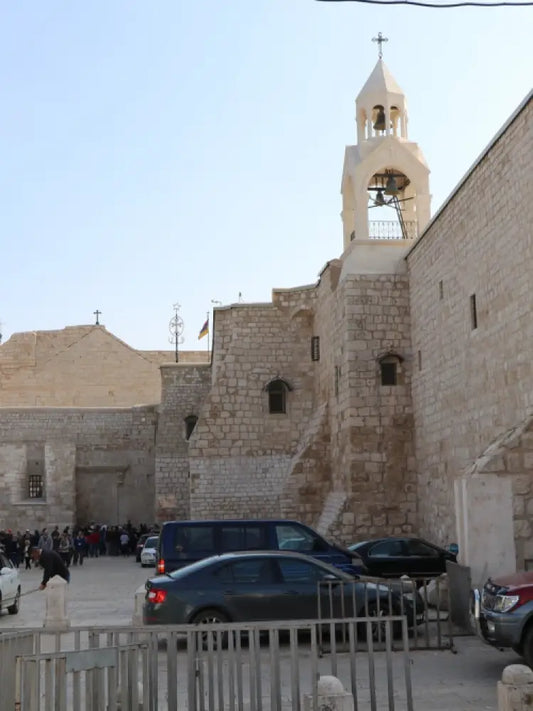
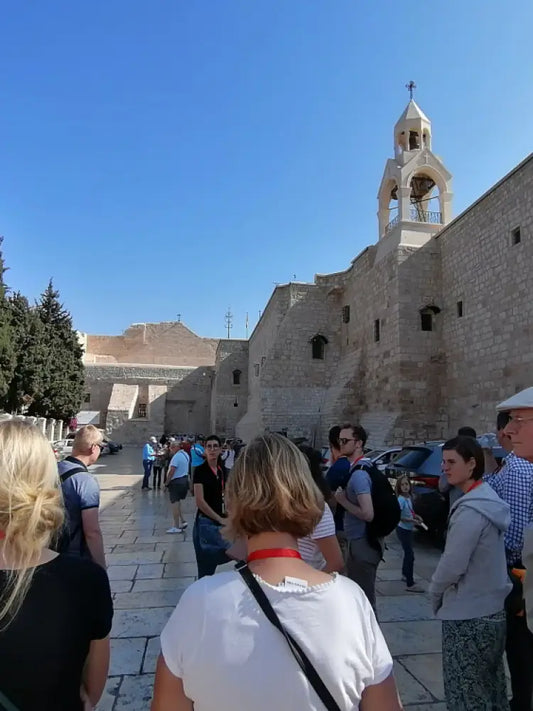
Manger Square in Bethlehem. Photo: Bukvoed via Wikimedia Commons (CC BY 4.0).
It is more useful to discuss tasks than to ask for one total walking distance. A day can include a short walk from the vehicle to an entrance, standing while tickets or group instructions are handled, steps inside a church complex, another walk across an open area, and a return to the vehicle.
Ask about these situations before paying:
- Distance from the likely vehicle drop point to each main stop.
- Steps, slopes, uneven paving, or narrow passages on the planned route.
- Whether a cane, folding walker, or compact wheelchair can travel in the vehicle.
- Where seated breaks are realistically available.
- Whether the traveler can skip a stop and safely remain with the vehicle, if permitted.
- How quickly the group must return after each self-guided stop.
Conditions can differ by day. A closer drop point may be unavailable. A busy service can change the entrance flow. A route that works for a folding cane may not work for a larger mobility device. Ask for an assessment of the actual equipment and booking date rather than a general promise that the tour is accessible.
If your parent uses a wheelchair, send the folded dimensions and explain whether they can transfer into a standard seat. If they cannot transfer, say so clearly. "Wheelchair user" does not tell the operator whether a standard tour vehicle or the site route can meet the need.
Treat the Church of the Nativity as a Variable
The Church of the Nativity is often the emotional center of a Bethlehem visit, but entering the complex and reaching the Grotto are different questions. The Grotto is below the main church level, and access can involve steps, queues, and restrictions controlled by the site.
The Christian Information Center's official timetable, checked on October 18, 2026, says Grotto visits are restricted during maintenance and construction. It also says closing times vary and visitors should call to confirm. That information can change, so a published timetable is not a guarantee of entry on the tour date.
For a parent who cannot manage steps or a long wait, decide in advance what would still make the visit meaningful. Seeing the basilica, spending time in the church complex, or praying in another accessible part of the site may be worthwhile even if the Grotto is not practical. Ask the tour team what can be reasonably planned, and avoid making the whole day depend on one interior space.
Separate desire from necessity. "We hope to visit the Grotto if current access and my father's mobility allow" gives the guide room to make a safe decision. "The Grotto must be guaranteed" asks the operator to promise something controlled by the church authorities.
Plan for Standing and Waiting
Planning your visit? → Explore Tours to Bethlehem
Families often focus on distance and forget standing. Waiting near an entrance, listening to an explanation, regrouping, or passing through a busy area can be harder than a short walk. Historic sites do not always have a bench at the point where the group must wait.
If standing is the main limit, say so. Ask whether a lightweight folding seat is practical and permitted, whether a walking aid with a built-in seat can travel in the vehicle, and where the day normally offers a proper rest. Never block an entrance or rely on sitting on historic stonework.
Build recovery time into the previous evening and the next morning. A traveler who can complete the route may still need a quiet evening afterward. Avoid scheduling another demanding activity immediately after the expected return.
Food, water, medication, and restroom timing also affect stamina. Bring medication in its original travel container and keep it with the traveler, not in luggage that may be separated from the group. Carry water unless the operator gives different instructions, and eat before fatigue becomes a problem. The current tour does not include food and drinks.
Prepare for Vehicle Changes and a Long Day

Orthodox Shepherds' Field church in Beit Sahour. Photo: Bukvoed via Wikimedia Commons (CC BY 4.0).
The product page says a vehicle change may be required at checkpoints. Ask what that normally involves for your selected pickup point. A traveler may need to exit one vehicle, move with the group, and enter another. The exact distance and wait cannot be assumed in advance.
Tell the team about mobility equipment before booking. Vehicle storage is limited, and a large wheelchair, walker, or suitcase can change what is possible. Ask whether the equipment stays with the traveler throughout the route and who is expected to handle it.
The day also covers very different elevations and environments. Clothing should be easy to add or remove, while still meeting the modest dress expectations for churches. Choose stable, closed shoes with reliable grip. Avoid new shoes that have not been worn on a full outing.
A small day bag is easier than several loose items. Include water, any regular medication, a light layer, sun protection, a simple snack if appropriate, and the passport requested by the current tour instructions. Keep hands free for railings and vehicle entry.
Send a Useful Mobility Note Before Booking
Put the access question in writing before paying. A clear message can be brief:
We are considering the Bethlehem, Jericho and Jordan River shared tour on [date]. My parent can walk for about [time or distance] before a seated rest. They [can/cannot] manage a flight of stairs and use a [cane, walker, folding wheelchair]. They [can/cannot] transfer into a standard vehicle seat. Standing for more than [time] is difficult. Please tell us whether the shared route is a reasonable fit, what vehicle changes are expected, and which stops may be unsuitable.
Add the actual pickup location, number of guests, and any firm timing constraints. If the team says the shared format is unsuitable, take that seriously. The goal is to choose a day your parent can enjoy, not to prove that they can finish the longest itinerary.
Keep the written reply. Reconfirm if the traveler's ability, equipment, hotel, or group size changes. An accessibility discussion is specific to the details you gave. It is not a blanket guarantee for every route or site condition.
Know When This Route Is Not the Right Fit
The shared full-day route may not be suitable when a traveler needs continuous one-to-one assistance, must avoid all steps, cannot tolerate unpredictable waiting, or needs frequent unscheduled rest. It may also be too demanding when fatigue increases sharply after a few hours.
Do not hide a limitation because you are worried the answer will be no. Discovering the mismatch at a checkpoint or church entrance is harder for the traveler and the rest of the group. An honest assessment before booking protects everyone's day.
If Bethlehem is the main priority, ask the company what currently offered option best matches the traveler's limits. Do not assume that a shorter title, a private label, or a higher price automatically guarantees step-free access. The route, vehicle, site conditions, and assistance still need confirmation.
For families still comparing the regional day with Jerusalem, the guide to Bethlehem and Jericho or private Jerusalem explains the difference in pace, guide format, and geography. Jerusalem generally concentrates more walking in the Old City, while the regional shared tour adds more road time and fixed group stops.
A Simple Family Decision Checklist
Planning your visit? → Explore Day Tours
The tour is more likely to fit if all of these are true:
- Your parent is comfortable with an 8 to 11 hour outing.
- They can manage repeated short walks and vehicle entry.
- Their required mobility equipment fits the confirmed vehicle arrangement.
- They can follow fixed meeting times with limited unscheduled breaks.
- They understand that Grotto access and other site details can change.
- The operator has reviewed the specific limitations in writing.
Pause before booking if any of these are true:
- You need a promise of a completely step-free route.
- Your parent cannot wait or stand without immediate seating.
- They require physical assistance the tour team has not confirmed.
- Missing one interior site would make the entire day unacceptable.
- The group schedule leaves no margin for their normal recovery needs.
Key Takeaways
- Plan around actual walking, standing, step, transfer, and fatigue limits rather than age.
- The current shared route is a structured 8 to 11 hour day with guided Bethlehem touring and later self-guided stops.
- A vehicle change may be required, so ask how equipment and transfers are handled.
- Grotto access is currently restricted during maintenance and remains date-dependent.
- Send mobility details before booking and wait for a route-specific reply.
Frequently Asked Questions
Is the Bethlehem, Jericho and Jordan River tour suitable for older adults?
It can be, but age alone is not enough to decide. The traveler should be comfortable with a long group day, repeated short walks, some standing, vehicle entry, and fixed meeting times. Ask the operator to assess the specific mobility needs before booking.
Is the shared tour wheelchair accessible?
Do not assume that it is. Vehicle capacity, transfer ability, the size of the wheelchair, drop points, and individual site routes all matter. Send those details in writing and wait for confirmation for the selected date.
Can a traveler skip a stop and stay in the vehicle?
That depends on the stop, driver arrangements, parking rules, and safety. Ask before booking. Do not rely on the vehicle being available or permitted to wait at every site.
Is entry to the Grotto of the Nativity guaranteed?
No. The official timetable checked on October 18, 2026 says Grotto visits are restricted during maintenance, and access can change. Ask for the current situation, but understand that the site authorities control entry.
What mobility information should I send?
Send the traveler's comfortable walking time, step and standing limits, mobility equipment, ability to transfer into a vehicle seat, pickup location, and need for seated breaks. Concrete details produce a more useful answer than saying only that someone walks slowly.
Protect the Meaning of the Day
A good pilgrimage day is not measured by the number of stops completed. Choose the route that leaves your parent enough energy to understand where they are, pray if they wish, and return without being pushed beyond a reasonable limit. Clear questions before booking make that kind of day more likely.
Elias Boaz is a licensed tour guide from Bethlehem, birthplace of Jesus Christ, and the founder of Elijah Tours. He has guided thousands of pilgrims through Bethlehem, Jericho, and the Jordan River Valley, and coordinates Holy Land tours with trusted licensed guides across the region. He writes to help visitors truly understand what they're seeing.