-- Elias Boaz, Elijah Tours
Having grown up in Bethlehem, Bethany, known today as Al-Eizariya, is where Jesus raised Lazarus from the dead. It sits about 3 kilometers east of Jerusalem, on the eastern slope of the Mount of Olives. The Tomb of Lazarus is still there. You can walk down into it. Most pilgrim tours either skip it entirely or give it twenty minutes. Both are mistakes.
What Actually Happened in Bethany -- and Why It Still Matters
Most people know the story in outline. Lazarus was sick. Mary and Martha sent word to Jesus. Jesus delayed -- deliberately, John tells us. By the time he arrived, Lazarus had been in the tomb four days. Martha came out to meet him. Mary fell at his feet. Jesus wept. Then he called Lazarus out of the tomb.
As local guides often point out, what people forget is that this is one of the longest, most detailed miracle accounts in any of the four Gospels. It is not a brief healing story. It is a full chapter: sisters in grief, a crowd watching, religious leaders skeptical, and Jesus moved visibly by sadness before doing something nobody in the crowd expected. John 11:43 records the words directly: "Lazarus, come out."
The name of the village keeps the memory alive. Al-Eizariya is derived from the Latin "Lazarium," the place of Lazarus. That naming has been continuous for roughly 2,000 years. This is not a site reconstructed from guesswork. Christian pilgrims were visiting this spot and recording it as early as the 4th century.
After guiding many groups through the Holy Land, and Bethany was not only a miracle site. This was where Jesus stayed when he was near Jerusalem. Mary, Martha, and Lazarus were his friends in a very particular way. He came back to their home repeatedly. He ate there. He rested there. On the night before the triumphal entry into Jerusalem, he was in Bethany. The Church of the Holy Sepulchre, the Via Dolorosa, the mount of olives from Bethlehem -- these are the grand dramatic sites. Bethany is quieter, and in some ways closer.
The Tomb of Lazarus: What You Are Actually Descending Into
Here is what most travel descriptions leave out. The tomb is not a grand underground space. It is 24 steps carved into bedrock, leading down to a burial chamber that is small, low, and dark. At the base, the passage narrows. You have to crouch.
The smallness is the thing. I have brought hundreds of groups here -- pilgrims from the United States, South Korea, Nigeria, Brazil, the Philippines. In almost every group, someone goes quiet at the bottom. Not from exhaustion. From something harder to name.
A group from Texas comes to mind. They had been cheerful all morning on the Mount of Olives, joking with me about the heat and taking photographs. When we descended into the tomb, the chatter stopped. One man, who had barely paused for a breath since we'd left Jerusalem, turned around at the bottom and said, very quietly: "I didn't expect it to be this small."
I said: "Neither did Lazarus."
He laughed. Then he got very quiet again.
The history of the site adds another layer. A Byzantine church originally stood over the tomb from around the 4th century. In the 16th century, the structure above was converted to a mosque, which still stands today. To restore access for Christian pilgrims, the Franciscans cut a separate entrance into the rock. The opening you descend through now is that Franciscan cut. You pay a small fee to the local caretaker at the entrance and go down single file. There is no elaborate lighting, no gift shop at the bottom. Just the stone and the darkness and the 24 steps.

The Church of Saint Lazarus: Barluzzi's Understated Masterpiece
Twenty meters from the tomb entrance is the Church of Saint Lazarus. It was built in 1954 by Antonio Barluzzi, the Italian architect responsible for some of the most affecting church buildings in the Holy Land. If you have been to the authentic garden of gethsemane, you have seen Barluzzi's Church of All Nations. If you have stood at the viewpoint on the Mount of Olives near Dominus Flevit, "the place where Jesus wept," that was also Barluzzi.
He had a consistent approach: modest, even austere on the outside. Then the interior opens and the light is different. The mosaics in the Church of St. Lazarus depict three scenes: Jesus learning of Lazarus's death, Jesus weeping at the tomb, and the resurrection itself. The facade mosaic shows Jesus in the act of calling Lazarus out. The whole building is in service of one story.
Franciscan friars manage the site. It is usually quiet, even on busy Jerusalem days. That is partly because most tours do not include it, and partly because it sits on the far side of the Mount of Olives from the main tourist flow. For pilgrims who make the trip, the silence itself becomes part of the experience.
This is the kind of site that does not announce itself.
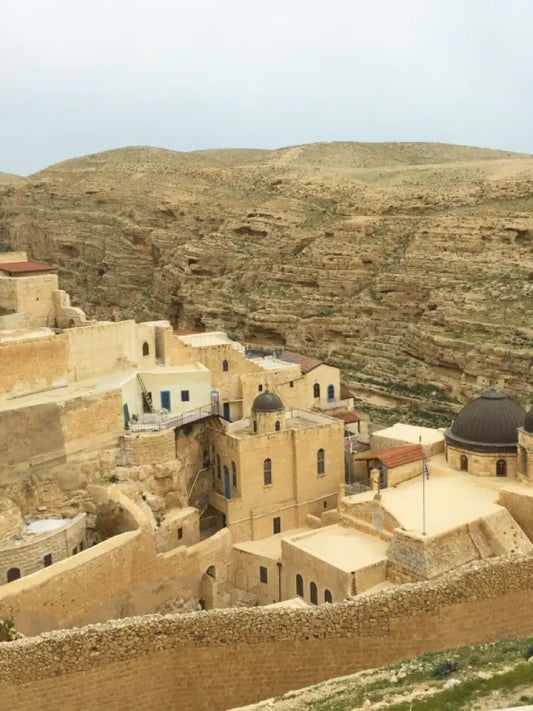
If you have visited Saint George's Monastery in Wadi Qelt, you know the type: a place that does not compete for attention and is better for it.
The Greek Orthodox Church of Mary and Martha
Interested in seeing our collection? → Browse Tours to Jerusalem
A short walk from the Franciscan church is the Greek Orthodox Church of Mary and Martha. It is smaller, more worn, and in a different key altogether. Where the Franciscan church is considered and precise, this one feels more immediate, more used.
The Orthodox tradition places equal emphasis on all three siblings -- Mary, Martha, and Lazarus -- and that shows in how the church is arranged and what is honored there. Martha, in particular, gets more attention here than in most Western Christian contexts. It was Martha, after all, who came out to meet Jesus on the road and said the words that John 11:27 records: "I believe that you are the Messiah, the Son of God."
Worth fifteen minutes, at minimum. If you are building a full picture of Bethany as a place where real people lived and jesus actually knew them, this church fills in what the Franciscan site leaves open.

What Most Pilgrims Miss: The Bigger Context

Mount of Olives Jerusalem Sunrise , Photo by David Holifield on Unsplash
Here is what most visitors do not realize about Bethany. Three separate and significant Gospel events are tied to this village or its immediate neighborhood.
The first is the Raising of Lazarus -- the reason most people know the name at all.
The second is the Anointing. John 12:1-8 places it six days before Passover, at the home of Lazarus. Mary anoints Jesus's feet with expensive perfume. Judas objects. Jesus says: "She bought it so that she might keep it for the day of my burial." The same house. The same family. A few days before everything changes.
The third is less known. Luke 24:50-51 records the Ascension as taking place near Bethany: "When he had led them out to the vicinity of Bethany, he lifted up his hands and blessed them. While he was blessing them, he left them and was taken up into heaven." Bethphage, the village where Jesus sent the disciples to fetch the donkey before the triumphal entry into Jerusalem (Mark 11:1-3), is about a kilometer away. Some traditions associate the Ascension site more precisely with the Mount of Olives.
Put it together: the Anointing, the triumphal entry's starting point, the Ascension. All within a few kilometers of the Tomb. For anyone doing a Holy Land pilgrimage focused on Holy Week -- and many group tours are exactly that -- Bethany completes the geography in a way nothing else does.
If you are organizing a group pilgrimage and trying to figure out what to include, our guide to planning a church group pilgrimage to the Holy Land walks through the decisions in detail.
How to Visit Bethany in 2026: Practical Information

The simplest and most flexible approach is a private car or guided tour from Jerusalem. Bethany is 15 to 20 minutes from the Old City by road. On a private tour, you stop for as long as your group needs. You are not chained to anyone else's schedule.
If you are wondering how many days to allow for the Holy Land overall, this guide on Holy Land pilgrimage length breaks down the 7-day vs. 10-day question honestly.
Best combination: Mount of Olives panorama and viewpoint, Dominus Flevit, Garden of Gethsemane in the morning, then Bethany in the early afternoon before the midday heat peaks. This gives you the full eastern approach to Jerusalem in a single half-day. It works well because all of these sites are on or around the same ridge.
A few practical things to know before you go:
- Dress modestly at both churches. Bare shoulders and shorts are not appropriate.
- Women should bring a head covering for the Orthodox church.
- Wear shoes you can navigate 24 uneven stone steps in.
- Go on a weekday morning if you can. Friday afternoons are not ideal for timing.
- The tomb entrance involves a small fee paid to the local caretaker on site.
We include Bethany as an add-on to several of our Jerusalem tours and it can be built into any of our private tours for groups who want the full story.
Where Bethany Fits: A Quick Reference
Interested in seeing our collection? → Browse Tours to Bethlehem
Key Takeaways
- Bethany (Al-Eizariya) is about 3 km east of Jerusalem's Old City and can be added to any Jerusalem or Mount of Olives visit without a major detour.
- The Tomb of Lazarus involves 24 narrow, rock-cut steps down into a small burial chamber. Know this before you go if you or someone in your group has mobility concerns.
- The Franciscan Church of Saint Lazarus, built by Antonio Barluzzi in 1954, contains some of the most striking biblical mosaics in the Holy Land. It is usually quiet even when nearby sites are busy.
- Three major Gospel events -- the Raising of Lazarus, the Anointing, and (in the vicinity) the Ascension -- are all tied to Bethany and the immediate area.
- Most pilgrim itineraries skip Bethany entirely. For those who include it, it consistently ranks among the most affecting stops of the entire trip.
Related Reading
- Saint George's Monastery in Wadi Qelt -- another site that rewards the effort to reach it
- Rachel's Tomb in Bethlehem -- a biblical tomb with continuous veneration, on the edge of Bethlehem
- Planning a Church Group Pilgrimage to the Holy Land in 2026 -- full logistics guide for organized groups
Frequently Asked Questions
Can I visit the Tomb of Lazarus in Bethany?
Yes. The Tomb of Lazarus in Al-Eizariya is open to visitors. You pay a small fee to the local caretaker at the entrance and descend 24 rock-cut steps into the burial chamber. The passage at the base is narrow and low -- arrive prepared to crouch.
Is Bethany the same as Al-Eizariya?
Yes. Al-Eizariya is the modern Arabic name for ancient Bethany. The name comes from the Latin "Lazarium," meaning the place of Lazarus. Christian pilgrims were identifying and visiting this site by at least the 4th century, and it has been continuously recognized since then.
How do I get from Jerusalem to Bethany?
By private car or guided tour, Bethany is 15 to 20 minutes from Jerusalem's Old City. This is by far the simplest option. It puts the site within comfortable reach as a half-day addition to a Jerusalem visit. Public transport options exist but add planning complexity.
How long does it take to visit Bethany?
Plan 1.5 to 2 hours to see the Tomb of Lazarus, the Franciscan Church of Saint Lazarus, and the Greek Orthodox Church of Mary and Martha at a reasonable pace. If your time is short, focus on the tomb and the Franciscan church -- those two together take about an hour.
Can I combine Bethany with the Mount of Olives?
Yes, and this is one of the better combinations in the Holy Land. The Mount of Olives, Dominus Flevit, and the Garden of Gethsemane are all on the same ridge, just a short drive from Bethany. Many private tours do the full eastern approach to Jerusalem in a single morning, ending with Bethany.
What is inside the Tomb of Lazarus?
At the bottom of 24 steps is a small rock-cut burial chamber -- a few meters across, with a low ceiling carved from natural limestone. There is no ornamentation, no elaborate lighting. The site has not been decorated. The effect comes entirely from the age and plainness of the space.
Is Bethany safe to visit in 2026?
To be honest, yes. Bethany (Al-Eizariya) is regularly visited by Christian pilgrims and organized tour groups.
Going with a licensed local guide is the recommended approach -- it handles logistics and ensures you understand the full context of what you're seeing.
Why do most pilgrim tours skip Bethany?
Itinerary pressure, mostly. Jerusalem alone could fill a week, and Bethany tends to be cut when time is tight. That is a reasonable choice if you have only three days. If you have five or more, it should be on the list. One hour here, done with real attention, is consistently one of the most affecting experiences a pilgrim can have in the Holy Land.
Bethany is three kilometers from the Old City of Jerusalem. In distance, it is almost nothing. In what happened there, it changes the geography of the entire New Testament. If you are building your itinerary and looking for one more site to include -- include this one. It does not need a full day. It only needs your full attention.
If you would like to include Bethany as part of your Holy Land visit, reach out to us here and we will build it into your itinerary.
Elias Boaz is a licensed tour guide from Bethlehem , birthplace of Jesus Christ , and the founder of Elijah Tours. He has guided thousands of pilgrims through Bethlehem, Jericho, and the Jordan River Valley , and coordinates Holy Land tours with trusted licensed guides across the region. He writes to help visitors truly understand what they're seeing.