Ein Karem is a small village in the western hills of Jerusalem, roughly 5 kilometres from the Old City. It is the traditional birthplace of John the Baptist and the site of Mary's Visitation to her cousin Elizabeth, described in Luke 1. Two Franciscan churches mark these events. Both are open to visitors, both are free, and both are almost entirely absent from the standard Holy Land pilgrimage itinerary. That is a loss worth correcting.
What Is Ein Karem and Why Does It Matter?
In my experience leading tours, I'm no expert in this, but here is honestly the thing most visitors do not realize: the story of Christmas does not begin at the Church of the Nativity in Bethlehem. It begins, in Luke's Gospel, in a village in the hills of Judah, with a woman named Elizabeth who is old and barren and suddenly, impossibly, six months pregnant with a son.
Having walked these routes with travelers, when Mary learns she is carrying Jesus, she does not stay home. She travels to see Elizabeth. That journey, and the moment of arrival described in Luke 1:39-45, is one of the most human scenes in the entire Gospel. Two women, both carrying something they cannot fully explain, standing in a doorway together. John leaps in the womb. Mary begins the Magnificat.
Ein Karem is where that happened.
The village has been a pilgrimage site since at least the Byzantine era. The name in Hebrew means "spring of the vineyard," referring to a natural spring in the center of the village that still flows today. Christian communities have lived here, built here, and kept these sites for centuries. The Franciscan Custody of the Holy Land has managed both main churches since the seventeenth century.
And yet. Ask a typical tour operator what is on a Jerusalem day and you will hear the Old City, the Mount of Olives, the authentic garden of gethsemane, maybe the City of David. Ein Karem rarely makes the list. It requires going in a different direction. Most bus tours cannot justify a 40-minute detour for a site that does not photograph as dramatically as the Dome of the Rock.
That is exactly why it is worth going.
The Church of St. John the Baptist
The Church of St. John the Baptist sits at the base of the village, near the main square. The foundations trace to the fifth century, though the current Franciscan building dates substantially to 1621, with an eighteenth-century renovation that added the bell tower.
It is not a grand church. It is not meant to be.
You enter through a small courtyard containing fragments of ancient Byzantine mosaic, protected under glass in the floor. The mosaics are seriously remnants from an earlier church that once stood on this ground. They are easy to walk past.
Don't.
To be honest, the nave is small, with painted frescoes depicting scenes from the life of John the Baptist: his birth, his preaching in the desert, his baptism of Jesus in the Jordan River, his death at the hands of Herod. The art is not what you came for, but it tells the story clearly.
The Grotto
What you came for is the grotto. You descend a short staircase to the left of the main altar, and you find yourself in a low-ceilinged cave, naturally cooled even in August. At the center of the floor is a marble star. The inscription reads: "Hic Praecursor Domini natus est." Here the Forerunner of the Lord was born.
It is honestly almost identical to the star beneath the altar of the Church of the Nativity in Bethlehem, which marks the spot of Jesus' birth. I have taken dozens of groups to Bethlehem, and the star there always moves people, even when the church is crowded and chaotic. The star in Ein Karem moves people differently, because there is almost no one else there. You can stand in that grotto for five, ten minutes, and the silence is real.
Practical Details
- The church follows a morning and afternoon schedule with a break between sessions. Hours vary between summer and winter. Always confirm current times directly with the Franciscan Custody of the Holy Land before your visit, as schedules can change on religious feast days.
- Photography is permitted in the nave and courtyard. During prayer in the grotto, be respectful and read the room.
- The church is managed by the Franciscan Custody of the Holy Land. No entry fee. A donation box is at the exit.
The Church of the Visitation
Honestly, a short walk uphill from the Church of St. John brings you to the Church of the Visitation, which marks the spot where Mary arrived to visit Elizabeth. The current upper church was completed in 1955, built over a much earlier structure, on foundations that trace to the Crusader period. The lower level is older still.
This is a two-level church, and both levels matter.
Not gonna lie - The lower church is a simple grotto space, cool and dim. It commemorates the cave where tradition holds that Elizabeth hid with the infant John during Herod's massacre of the innocents (Matthew 2:16-18).
Whether or not you accept that particular tradition, the space itself is worth sitting in quietly for a few minutes. It has the feel of a place that has absorbed a great deal.
My daughter asked me this morning why people travel so far just to walk where we walk every day. I told her: because they can feel where it comes from.
The upper church is larger and brighter, with frescoes covering the interior walls depicting the Visitation in detail. But what most visitors come for is not inside the church at all.
The Magnificat in 140 Languages
In the courtyard leading to the upper church, there is a wall of ceramic tiles. On each tile, in a different language and script, is the same text: Luke 1:46-55. The Magnificat. Mary's song. "My soul magnifies the Lord, and my spirit rejoices in God my Savior...".
The tiles represent over 140 languages. Arabic, Amharic, Korean, Portuguese, Malayalam, Swahili, Welsh, Tagalog, Latin. Scripts you may not recognize. Scripts you have never seen before. Every one of them carrying the same words.
I am a guide, not a theologian. But I will say this: standing in front of those tiles and understanding what you are looking at, which is one young woman's prayer rendered in the languages of the whole human world, is one of the more affecting things available to a pilgrim in the entire Holy Land. People cry there. Not dramatically. Quietly.
The Arabic tile is always the one that affects local Arab Christians the most. For many of them, this is the first time they have seen the Magnificat in their own language on a church wall. That means something specific to them, and seeing their reaction has taught me something too, over the years.
Mary's Spring and the Village Itself
Interested in seeing our collection? → Browse Tours to Jerusalem

Mount of Olives Jerusalem Sunrise , Photo by David Holifield on Unsplash
After the churches, do not immediately get back in your car or flag down the bus. Take twenty minutes to walk the village.
Ein Karem has a spring at its center, accessed by a short walk from the main square. The "ein" in the village's name is the Hebrew word for spring, and this spring, sometimes called Mary's Spring or the Spring of the Vineyard, is the one that gives the village its identity. Local tradition holds that Mary stopped here on her journey to visit Elizabeth. The spring is still flowing. It is a pleasant, quiet spot. Not a monument, just a village spring. That is kind of the point.
A woman from Minnesota on last month's tour stood completely still in the Church of the Nativity for about four minutes -- not unlike what my mother always said about hospitality, that the best welcome doesn't need explanation, and honestly the same logic applies to guiding. Nobody moved. Nobody said anything. That's the tour right there.
The village itself has become, over the decades, a neighborhood known for artists and musicians. There are small galleries, a handful of cafes and restaurants, stone houses with flowering gardens. It looks nothing like the overcrowded Old City. After three or four days of pilgrimage through packed churches and market lanes, that contrast is itself a kind of gift.
The Gorny Convent
On the hill above the village, visible from the main square, is the Gorny Convent, a Russian Orthodox monastery complex. Its golden domes, the kind you expect to see above the Moscow skyline, appear suddenly above the Jerusalem hills and look completely out of place in the best possible way. The convent has a small church open to visitors and a garden. The liturgical atmosphere here is entirely different from the Franciscan churches below, which is worth experiencing if you have time and if your group is up for the short climb.
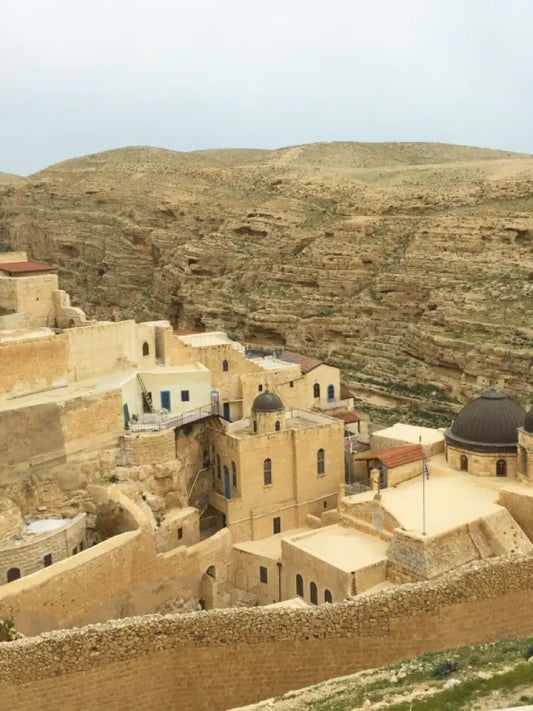
Like Saint George's Monastery in Wadi Qelt, Ein Karem rewards pilgrims who are willing to go slightly off the main circuit.
Worth saying: The more demanding destinations in the Holy Land tend to be the ones people describe years later.
How to Get to Ein Karem from Jerusalem

What to See in Bethlehem Church of the Nativity
By bus: Bus 17 and Bus 17A both run to Ein Karem from central Jerusalem. The ride is roughly 20 to 25 minutes depending on traffic. Ask the driver to call the stop or watch the route on your phone. The bus will drop you near the entrance to the village.
By taxi or private car: From the Old City, Ein Karem is 15 to 20 minutes by car depending on traffic. There is street parking at the entrance to the village. Ein Karem is a pedestrian-friendly village once you are inside it, so leave your car at the bottom and walk up.
By rental car: If you are driving yourself around Jerusalem, Ein Karem is a straightforward route westward from the city center.
The best time to arrive is before 10am. The churches are quiet in the early morning, the light is better, and the village has not yet filled with the midday lunch crowd. If you are visiting in summer (which right now is exactly the situation), early morning also means you avoid the heat of the day.
Combining Ein Karem with Other Jerusalem Sites
Ein Karem works best as a morning stop on a broader Jerusalem day. Here is a structure that works well for many of my groups:.
Now here's what I find interesting: If you are spending a full day in Jerusalem, combining Ein Karem in the morning with the City of David in the afternoon is one of the better ways to structure it. You get the quiet beginning of the story in the hills, and then the archaeological depth of ancient Jerusalem in the valley below the Old City. It is a good pairing thematically too. Both sites feel undervisited. Both are doing heavy historical and spiritual lifting that their visitor numbers do not reflect.
For practical information on building your Jerusalem base, our guide to day tours from Jerusalem covers how we run this route, what is included, and how to combine multiple sites without spending your whole day in transit.
An Honest Assessment

What to See in Bethlehem Church of the Nativity
Let me be direct about one thing.
If your pilgrimage has only four or five days and you have not yet seen the church of the holy sepulchre, the Garden of Gethsemane, Bethlehem, and the Sea of Galilee, do those first. Ein Karem is not the first place I send someone with limited time.
But if you are coming back for a second visit, or if you have a week or more and want to see something that most pilgrims never do, or if you are the kind of person who reads this kind of thing and already knows you want to go beyond the standard circuit, then yes. Go to Ein Karem. Go early. Spend two hours there. It will stay with you.
I took a group of American pilgrims there on the last morning of their trip in 2025. They had spent three days in Jerusalem and Bethlehem. They were exhausted in the particular way that holy places exhaust people, which is not unpleasant but is real. We had the Church of the Visitation entirely to ourselves. A woman from Tennessee found the English Magnificat tile in the courtyard and read it out loud, quietly, to her group. Nobody said anything for a couple of minutes.
That is the kind of moment that only happens when there are no crowds, no schedule pressure, and no one rushing you to the next site.
That is what Ein Karem offers.
That same instinct, to look beyond the obvious, to find the sites that have not been polished into a tourist experience yet, is what I write about in Bethlehem Beyond the Nativity: What Most Pilgrims Miss -- which is something pilgrims always ask about when we're on the route together, and honestly it's one of my favorite questions to answer. Ein Karem is the Jerusalem version of that same idea.
OK so If you are planning a private tour and want to build Ein Karem into your Jerusalem day, our private tours are the easiest way to do it without navigating bus routes on your own.
Key Takeaways
Interested in seeing our collection? → Browse Tours to Bethlehem
- Location and access: Ein Karem is in the western hills of Jerusalem, about 5 kilometres from the Old City. Bus 17 or 17A from central Jerusalem takes roughly 20-25 minutes; a taxi from the Old City takes 15-20 minutes.
- Two churches, one village: The Church of St. John the Baptist (birthplace of John the Baptist) and the Church of the Visitation (site of Mary's Visitation to Elizabeth) are both managed by the Franciscan Custody of the Holy Land. Both are free to enter.
- The Magnificat courtyard: The courtyard of the Church of the Visitation contains ceramic tiles bearing Luke 1:46-55 in over 140 languages. It is genuinely unlike anything else in the Holy Land.
- Plan for mornings: Both churches take a break between morning and afternoon hours. Arrive before 10am for the quietest visit and the best light.
- Dress code required: Covered shoulders and knees at both churches. Bring a light wrap if needed.
Related Reading

What to See in Bethlehem Church of the Nativity
- The City of David Jerusalem 2026 -- pair -- you get the idea
- Saint George's Monastery in Wadi Qelt -- another off-circuit Christian site that rewards the detour
- Bethlehem Beyond the Nativity: What Most Pilgrims Miss -- the same instinct, applied to Bethlehem -- and this is the one most people overlook
If you are planning a visit to the Holy Land and want help building an itinerary that includes places like Ein Karem, you are welcome to reach out to us directly. We know these sites, and we will help you see them the right way. This is the kind of thing that drives me crazy about generic tour packages.
Frequently Asked Questions

What to See in Bethlehem Church of the Nativity
Is Ein Karem worth visiting on a Holy Land pilgrimage?
Yes, especially if you have more than four days or are returning for a second visit. Ein Karem contains two significant biblical sites (birthplace of John the Baptist, site of the Visitation), a remarkable Magnificat courtyard in 140 languages, and a beautiful village atmosphere that is entirely different from the pace of the Jerusalem Old City. It is consistently one of the more moving stops on any extended Jerusalem day.
How do I get to Ein Karem from Jerusalem city center?
Bus 17 or 17A from central Jerusalem goes directly to Ein Karem and takes approximately 20-25 minutes. A taxi from the Old City takes 15-20 minutes. If driving, there is street parking at the village entrance. The village itself is best explored on foot.
What is the biblical significance of Ein Karem?
Ein Karem is the traditional site of two events described in Luke 1. First, the Visitation (Luke 1:39-56), in which Mary, pregnant with Jesus, traveled to visit her cousin Elizabeth, pregnant with John the Baptist. When Mary arrived, Elizabeth recognized the miracle, and Mary responded with the Magnificat. Second, the birth of John the Baptist (Luke 1:57-80), which took place here. Both events are marked by Franciscan churches that are open to pilgrims.
What are the opening hours of the Church of St. John the Baptist in Ein Karem?
The church follows a morning and afternoon schedule with a break between sessions. Hours shift between summer and winter, and the church may be temporarily closed during mass or on feast days. Confirm current hours directly with the Franciscan Custody of the Holy Land before your visit. This is the kind of thing that drives me crazy about generic tour packages.
Can I visit Ein Karem and the Jerusalem Old City on the same day?
Yes. Ein Karem works well as a morning stop (2-3 hours) with the Jerusalem Old City in the afternoon, or vice versa. The most relaxed version is to visit Ein Karem early (before 10am), spend time at both churches and the village, then head into Jerusalem for the rest of the day.
What is the Magnificat and why is it displayed in so many languages in Ein Karem?
The Magnificat is the canticle (prayer-song) that Mary speaks after arriving at Elizabeth's home, recorded in Luke 1:46-55. It begins "My soul magnifies the Lord." The Church of the Visitation in Ein Karem has a courtyard where the Magnificat is displayed on ceramic tiles in over 140 languages and scripts, representing the global breadth of Christianity.
It is one of the most quietly powerful things in the entire Holy Land.
Is there parking available at Ein Karem?
Yes. Street parking is available at the entrance to the village, near the main square and the Church of St. John the Baptist. The village is pedestrian-friendly, so you park at the base and walk. In summer, arriving early means you are more likely to find a spot and avoid the heat.
Which churches are in Ein Karem and who runs them?
Let me put it this way: There are two main churches in Ein Karem open to Christian pilgrims. The Church of St. John the Baptist, at the base of the village, marks the birthplace of John the Baptist. The Church of the Visitation, a short walk uphill, marks the site of Mary's Visitation to Elizabeth. Both are managed by the Franciscan Custody of the Holy Land. There is also the Gorny Convent (Russian Orthodox) on the hill above the village, which has limited visiting hours.
Elias Boaz is a licensed tour guide from Bethlehem , birthplace of Jesus Christ , and the founder of Elijah Tours. He has guided thousands of pilgrims through Bethlehem, Jericho, and the Jordan River Valley , and coordinates Holy Land tours with trusted licensed guides across the region. He writes to help visitors truly understand what they're seeing.