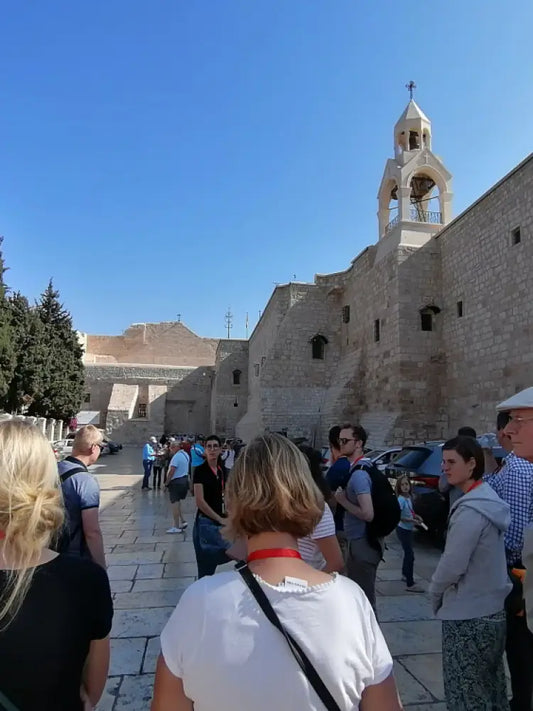
As local guides often point out, the Church of the Holy Sepulchre stands in Jerusalem's Christian Quarter and marks the sites where Christians believe Jesus was crucified, buried, and raised from the dead. It is open daily from about 6:00 AM to 9:00 PM (if you can believe it), entry is free, and it is shared by six Christian denominations under a centuries-old arrangement. If you are coming to Jerusalem, this is the center of it.
📝 In This Article
- Quick Facts at a Glance
- What Is the Church of the Holy Sepulchre?
- What You'll Actually See Inside
- Understanding the Six Denominations
- Church of the Holy Sepulchre vs. Garden Tomb
- How to Visit the Church of the Holy Sepulchre
- Site-by-Site Reference
- What You Should Know
- Related Reading
- Frequently Asked Questions
Having walked these routes with travelers, i've been inside this church more than 400 times. I still slow down at the door.
Quick Facts at a Glance
What Is the Church of the Holy Sepulchre?
After guiding many groups through the Holy Land, this is the site where, according to Christian tradition, Jesus was crucified on a hill called Golgotha (or Calvary), buried in a nearby tomb, and rose from the dead on the third day. For most of Christian history, this location has been considered the holiest on earth.
The history of the building itself is layered. Empress Helena, mother of Emperor Constantine, came to Jerusalem around 326 AD and identified the site. Constantine built a grand basilica over it. That first church was destroyed, rebuilt, partially destroyed again during the Persian invasion of 614 AD, and then rebuilt again. What stands today is largely a Crusader-era structure from the 12th century, though the walls hold sections from much earlier periods.
Six Christian denominations share the church.
Greek Orthodox, Roman Catholic (through the Franciscans), Armenian Apostolic, Coptic Orthodox, Ethiopian Orthodox, and Syriac Orthodox all have designated areas and liturgical schedules inside. They govern the church under what is called the Status -- scratch that -- Quo, an agreement whose roots go back to the Ottoman period. Under the Status Quo, no denomination may change, repair, or alter any part of the shared space without unanimous consent. This is the kind of thing that drives me crazy about generic tour packages.
This is why there is a ladder on the facade.
It sits on a ledge above the main entrance, resting on a window sill, and has been in that exact position since at least 1757. No one can move it (I know, I know), because no one can get all six denominations to agree. Pilgrims notice it and ask me every time. I tell them: that ladder tells you more about the church than most guidebooks do.
What You'll Actually See Inside
The Stone of Anointing
The moment you step through the main entrance, you are looking at a long, flat, pink limestone slab lying on the floor. This is the Stone of Anointing, -- well, actually, sometimes called the Stone of Unction. Tradition holds that this is where Jesus's body was genuinely prepared for burial after being taken down from the cross, in accordance with John 19:39-40.
Pilgrims kneel beside it and press their forehead to the stone.
They press rosaries, family photos, crosses, anything authentic meaningful. You'll sometimes see people lying flat on it, both arms extended.
Nothing gradual about it. You walk in and it's immediately there in front of you.
Calvary / Golgotha (The Crucifixion Chapel)
I could be wrong here, but take the steep staircase immediately to your right after entering. At the top are two small chapels side by side. The right one is the Greek Orthodox Chapel, and the left is the Latin (Franciscan) Chapel.
Worth it.
In the Greek Orthodox Chapel, you can kneel and reach down through an opening in the floor. Under the altar, behind a protective grille, is the actual bedrock of Golgotha, the limestone outcrop that Christian tradition identifies as the site of the Crucifixion. I'm not a theologian, but from what I understand, you touch it. Bare rock.
The Latin Chapel, to the left, has the Altar of the Nailing to the Cross and the Altar of the Crucifixion (Stations XI and XII of the Via Dolorosa). If you plan to walk the Via Dolorosa route through the Old City, know that the final stations (XI-XIV) are inside this building, not outside. The route literally ends here. No question.
Give people time at Calvary. I've watched groups rush through in six minutes because they felt the crowd pressure. That's a mistake. If someone in your party needs to sit with it, let them. And it shows.
The Edicule (The Tomb of Christ)
Walk back down and through the Rotunda, and you'll find the Edicule, a freestanding marble structure in the center of the room. This is the Tomb of Christ. Not even close.
Inside are two small chambers. The first is the Angel's Chamber, named for the angel who, according to Luke 24:4, appeared when the women came to the tomb. The second is the Tomb Chamber itself, where the burial bench is preserved under protective glass. The bench was genuinely exposed and documented during a restoration completed in 2017, the first time it had been seen in centuries. Every single one.
There is almost always a line to enter. If you arrive when the church opens at around 6:00 AM on a weekday, you may walk straight in. By 9:00 AM the queue begins to build. At peak times (midday, Sundays, Holy Week), the wait can be 45 minutes to over an hour. Plan accordingly. That's the difference.
The Chapel of St. Helena and the Finding of the Cross
Descend the stairs in the southeastern part of the church (look for the sign near the Armenian section) and you reach the Chapel of St. Helena. Below that is the Chapel of the Finding of the Cross, hewn directly into the bedrock.
This is where Helena reportedly found the True Cross in 326 AD.
Most visitors never make it here. It is quiet, it is underground, and it feels very old in a way the main floor doesn't quite manage. Worth finding. No question. Makes sense?
Nearby is the Franciscan Chapel of the Apparition, which marks the tradition that the risen Jesus appeared first to the Virgin Mary after the Resurrection. Small, often empty, often missed. Big difference.
The Ethiopian and Coptic Chapels (Rooftop)
I mean, leave the main courtyard, go left, and climb the exterior stairs to the roof. You arrive at a small community of whitewashed cells and a simple chapel. This is the Ethiopian Orthodox monastery, and monks actually live here. Blue sky above, stone walls, quiet. It sits directly on top of the Chapel of St. Helena (this reminds me of something my grandfather always said about this land -- 'it doesn't need introduction, it just needs showing' -- but that's a story for another day). And it shows.
I don't say this to every group because it doesn't fit every visit, but for people who want ten minutes away from the crowds, this rooftop is one of the more peaceful spots in the Old City. Think about that.
Understanding the Six Denominations
Interested in seeing our collection? → Browse Tours to Jerusalem
This is the part most visitors don't fully grasp, and it explains a lot about what they experience. And it shows.
Thing is, The Status Quo means that all six denominations operate simultaneously inside the same building. You will hear competing liturgies, overlapping bells, chanting from three directions at once. Greek Orthodox monks process past Armenian priests past Franciscan friars. On major feast days, the choreography is genuinely complex. Worth it.
Don't interpret the noise as disorder. This is how the building has worked for centuries (I keep meaning to write a whole separate post about this part specifically and never do -- consider this your preview). It takes a visit or two before you stop being thrown by it.
Worth it.
Church of the Holy Sepulchre vs. Garden Tomb

a church with a cross hanging from it's side — Photo by Lisa Forkner on Unsplash
People ask me this all the time, especially Protestant visitors.
The Garden Tomb is a site about 700 meters north of Damascus Gate, outside the Old City walls. It was identified in the 19th century as a possible alternative location for Golgotha and the tomb. The site is serene, well-maintained (if you can believe it), and offers a quieter, garden-like setting for reflection. No question.
Here is what I tell people honestly: the Garden Tomb does not carry the same historical weight as the Church of the holy sepulchre. The scholarly and archaeological consensus has long placed the Crucifixion and burial site inside the current church, at a location that was outside the city walls in the 1st century AD (the walls have shifted since then). The Holy Sepulchre site has been venerated as the authentic location since the 4th century. Think about that.
A woman from Minnesota on last month's tour stood completely still in the Church of the Nativity for about four minutes. Nobody moved. Nobody said anything. That's the tour right there.
But many people find the Garden Tomb spiritually moving regardless.
My suggestion: visit both if you have the time. The Sepulchre for historical depth and the weight of 1,700 years of pilgrimage. The Garden Tomb for quiet and space to reflect. They offer different things. That matters.
How to Visit the Church of the Holy Sepulchre

people near dome theater — Photo by Laura Siegal on Unsplash
Getting There
The church is in the Christian Quarter of the Old City of Jerusalem. The most practical approach is through Jaffa Gate. Once inside the gate, follow the signs through the Armenian Quarter and then the Christian Quarter. It takes about 5-10 minutes on foot. And it works.
From Damascus Gate (if you're coming from East Jerusalem or the Muslim Quarter), follow David Street into the Christian Quarter.
The approach from that direction takes you past the market, and you'll smell the spices before you arrive. That matters. See what I'm getting at?
If you are planning the full day around Jerusalem, the logical sequence is Mount of Olives in the very early morning, then the church before the crowds arrive.
When to Go
Early morning on a weekday. The church opens at approximately 6:00 AM, and the difference between arriving at 6:15 and arriving at 9:00 is significant. On a quiet weekday morning in June, you can enter the Edicule with no wait. At 10:00 AM you may wait 40 minutes.
Avoid Sunday mornings. The Greek Orthodox community holds major services and the building gets dense. Also avoid the days immediately around Christmas, Easter, and Orthodox Holy Week (which falls on a different calendar than Western Easter). During Holy Week especially, the church operates under extraordinary crowd conditions. If you ask me, this is what makes the Holy Land different from any other destination.
A practical tip: the Franciscan procession walks the Via Dolorosa every Friday at 3:00 PM and finishes inside the Holy Sepulchre at the Calvary and Edicule. If your timing allows, joining or following this procession is one of the more meaningful ways to arrive at the church. Every single one.
What to Bring
Covered shoulders and knees are required. If you forget, there are sometimes scarves available at the entrance, but bring your own to be certain. A scarf for women works for both shoulders and hair if needed. Big difference.
Bring a small candle if you want to light one at the tomb. The act of lighting a candle at the Edicule matters to a lot of pilgrims. Candles are available inside for a small donation. Think about that.
I just grabbed Arabic coffee. The kind with cardamom. You can't write about pilgrimage routes without proper fuel.
Leave large backpacks at the hotel if you can. Security checks can slow you down, and large bags are awkward in the narrow interior spaces.
Site-by-Site Reference
Interested in seeing our collection? → Browse Tours to Bethlehem

Key Takeaways
- The Church of the Holy Sepulchre is free to enter. No reservation or ticket is needed.
- Six Christian denominations share the building under the Status Quo agreement, which dates to the Ottoman period. No denomination can alter any shared space without unanimous consent.
- The Edicule (Tomb of Christ) is the central site. Arrive before 7:00 AM on weekdays to enter without a long wait.
- The church is in the Christian Quarter of Jerusalem's Old City, about 5-10 minutes on foot from Jaffa Gate.
- Dress code is enforced: covered shoulders and knees are required for both men and women.
- The famous ladder visible on the outer facade of the church has been in the same position since at least 1757 because no denomination has been able to agree to move it.
Related Reading

brown mosque at daytime — Photo by Toa Heftiba on Unsplash
If you're planning a full day in Jerusalem, our complete guide to the Via Dolorosa walks you through all 14 Stations of the Cross, which end here inside the Holy Sepulchre. Many pilgrims find that walking the route first and then entering the church gives the building its proper context. And it works.
If you're combining Jerusalem with Bethlehem, our guide to traveling from Jerusalem to Bethlehem in 2026 covers all the practical logistics for making that journey, whether by bus, shared taxi, or private tour. That's the difference.
We offer private Jerusalem [day tour](/collections/day-tours-israel)s that include the Church of the Holy Sepulchre with proper time and context, along with the Via Dolorosa, the Mount of Olives, and the Western Wall. A private guide makes a real difference inside the church, because what you're looking at is genuinely layered, and most of it isn't labeled. And it shows.
Frequently Asked Questions

a view of the old city of jerusalem — Photo by David Holifield on Unsplash
What time does the Church of the Holy Sepulchre open?
The church opens at approximately 6:00 AM daily and closes around 9:00 PM. Hours can vary slightly during major liturgical seasons, Christian holidays, and special denominational services. The best time to arrive is at opening, particularly on weekdays, when the Edicule queue is shortest.
Is there a fee to enter the Church of the Holy Sepulchre?
No. Entry to the Church of the Holy Sepulchre is completely free. There are donation boxes inside, and candles are available for a small donation if you want to light one at the tomb. No tickets are sold and no advance reservation is required.
How long should I plan to spend at the Church of the Holy Sepulchre?
Plan a minimum of 90 minutes if you want to see the main sites without rushing. If you intend to enter the Edicule (the Tomb of Christ), add another 30-60 minutes for the queue depending on the time of day and season. A thorough visit, including Calvary, the Stone of Anointing, the Chapel of St. Helena, and the rooftop, takes 2 to 2.5 hours.
Do I need to dress a certain way to enter?
Yes. Both men and women must have shoulders and knees covered. The dress code is enforced at the entrance. A light scarf or shawl over the shoulders works well and is easy to carry. Tank tops, shorts, and short skirts are not permitted.
What is the immovable ladder on the Church of the Holy Sepulchre?
The ladder resting on the ledge above the main entrance has sat in the same position since it appeared in a photograph and etching from 1757. Under the Status Quo agreement, no object in the shared areas of the church can be moved without agreement from all six denominations. Since no agreement has ever been reached about the ladder, it stays.
It has become one of the more quietly famous details in Christian architecture.
Where is the Church of the Holy Sepulchre in Jerusalem?
The church is in the Christian Quarter of the Old City of Jerusalem, near the end of the Via Dolorosa. The easiest approach for most visitors is through Jaffa Gate, then through the Armenian Quarter and into the Christian Quarter following the signs. The walk from Jaffa Gate takes about 5-10 minutes on foot.
What is inside the Church of the Holy Sepulchre?
The main sites inside include: the Stone of Anointing (at the entrance, where Jesus's body was prepared for burial), Calvary and Golgotha (up the stairs to the right, where you can touch the bedrock of the Crucifixion site), the Edicule (the marble structure housing the Tomb of Christ in the central Rotunda), the Chapel of St. Helena (underground, where the True Cross was reportedly found), and the Ethiopian Orthodox rooftop monastery. There are also multiple chapels throughout the building belonging to each of the six denominations.
A man from the Philippines came on one of my groups a few years back. He had saved for the trip for a long time. When we reached the Stone of Anointing, he did not kneel. He did not pray out loud. He put his hand flat on the stone and stood very still for about two minutes. His group had moved ahead. I stayed with him.
To be honest, when he lifted his hand, he said: "I have been reading about this stone my whole life."
That's the thing about this church. You can read about it, watch documentaries about it, look at photographs of it. None of that prepares you for putting your hand on it.
If you are planning to come to Jerusalem, make the Holy Sepulchre the first thing on the first morning. Everything else you see will be different because of it. If you want help putting the visit in context, we're here. Reach out and we'll plan it with you.
Elias Boaz is a licensed tour guide from Bethlehem — birthplace of Jesus Christ — and the founder of Elijah Tours. He has guided thousands of pilgrims through Bethlehem, Jericho, and the Jordan River Valley — and coordinates Holy Land tours with trusted licensed guides across the region. He writes to help visitors truly understand what they're seeing.