Capernaum is where Jesus actually lived during his ministry. Not visited. Lived. This small basalt-stone fishing village on the north shore of the Sea of Galilee is where he called the first disciples, healed the sick, cast out demons, and preached most of what the Gospels record. Today you can stand on the foundation of the synagogue where he taught and walk through the excavated streets of his adopted hometown.
Most pilgrims give Capernaum 45 minutes. That is a mistake.
This is the first-hand guide to visiting Capernaum, by a Bethlehem-born licensed Holy Land guide who has been leading groups here since 2009.
Last updated: April 2026. Sources: Custodia Terrae Sanctae; Studium Biblicum Franciscanum excavation reports; Israel Antiquities Authority; personal field experience.
Why Capernaum Is Different
Most Holy Land sites are traditions. The Via Dolorosa is a tradition. The Upper Room is a tradition. Even the Church of the Nativity marks a spot identified by tradition centuries after the event.
Capernaum is not a tradition. It is an excavation.
The basalt-stone village visible today is the actual town where Jesus lived during his ministry. The streets are real. The houses are real. The synagogue foundation where he taught is real. The Roman milestone markers at the edge of the site still show distances carved in the first century.
When the Gospels say, "He came to Capernaum" (Mark 1:21, Mark 2:1, Matthew 4:13, and a dozen more verses), this is the town they are describing. Matthew called it his own home. Peter owned a house here. Jesus based his entire Galilean ministry out of this fishing village on the northern lakeshore.
Stand at the waterfront and you can see the hills where the Sermon on the Mount was preached, the cove where Jesus called Peter and Andrew, and the spot where the disciples pulled in a miraculous catch of fish.
The Synagogue
The white limestone synagogue at the center of the site is the most recognizable structure in Capernaum.
Built in the fourth century. Directly over the first-century synagogue where Jesus preached.
You can see the original basalt-stone foundation stones from Jesus's time still in place underneath the later white limestone construction. Archaeologists confirm the first-century layer is exactly where you are standing. Mark 1:21 describes Jesus entering "the synagogue" at Capernaum on the Sabbath and teaching with authority. This is that synagogue.
Sit for a minute inside the reconstructed space. Read Mark 1 aloud if you brought a Gospel. The room is probably roughly the size and shape Jesus taught in.
Peter's House
A few meters south of the synagogue, under a modern octagonal church suspended above the excavation, is a first-century stone house that Franciscan archaeologists have identified as the house of Peter, where Jesus healed Peter's mother-in-law (Matthew 8:14-15) and possibly lived during his time in Capernaum.
The identification is based on evidence stacked across 2,000 years: the house shows modifications into a prayer room by the mid-first century; it was later plastered with Christian graffiti (including the name of Jesus in Aramaic); a fifth-century Byzantine octagonal church was built directly over it, and the Byzantines only built octagonal churches over the most significant Christian sites in the Holy Land.
Walk the modern platform above the house. Look down through the glass floor at the excavated rooms below. This is very probably where Jesus ate, slept, and prayed when he was in Capernaum.
The Waterfront
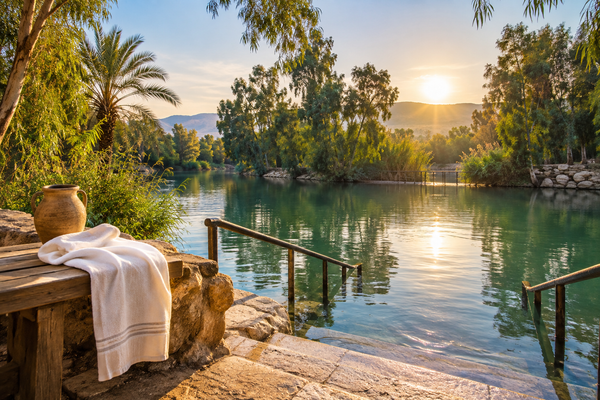
Walk to the lakefront at the south end of the site. Stand at the water.
This is the shore where Jesus called Peter, Andrew, James, and John (Mark 1:16-20). The fishing boats drawn up on the beach today are in exactly the same spots their first-century counterparts occupied. The sightlines across the lake have not changed.
Look west along the shoreline. You can see Tabgha and the hillside of the Mount of Beatitudes a few kilometers away, the route Jesus walked preaching between towns. Ten minutes by car today. A half-day on foot in the first century.
This is a good place to read Mark 4 (the calming of the storm) or John 21 (the miraculous catch and Peter's restoration). The geography makes the Gospel readable in a way no amount of study back home prepares you for.
Practical Info
- Hours: 8:00 to 12:00 and 14:00 to 17:00. Last entries 11:45 and 16:30..
- Entry: ~10 NIS per adult. Franciscan-administered.
- Time needed: 60–90 minutes minimum. A proper visit with time to read and pray at the sites takes 2 hours.
- Dress code: Modest dress (shoulders and knees covered). Hats must be removed inside the church over Peter's house.
- Facilities: Restrooms, gift shop, small chapel for private prayer, shaded benches near the waterfront.
How to Get to Capernaum
Capernaum is on the northern shore of the Sea of Galilee, about 15 minutes by car from Tiberias.
- From Tiberias: 15 minutes by car along Highway 90. No direct bus; taxi or tour vehicle only.
- From Tabgha: 5 minutes by car, 40 minutes on foot along the lakeside promenade (beautiful walk).
- From Mount of Beatitudes: 10 minutes by car, the classic day clusters these three sites together.
- From Jerusalem as a day trip: Possible but punishing (4 hours round-trip driving). Better to overnight in Tiberias.
Combine with These Sites
Capernaum is one piece of what I call the Sea of Galilee cluster, four sites within 10 kilometers of each other that together give you most of Jesus's active ministry.
- Mount of Beatitudes (10 min): Site of the Sermon on the Mount. Hilltop chapel, gardens, panoramic view over the lake.
- Tabgha (5 min): Two churches, Multiplication of the Loaves and Fishes, and Primacy of Peter. Both on the lakeshore.
- Sea of Galilee boat ride (20 min drive to the Tiberias marina): 45-minute sail on a replica first-century boat.
- Magdala (15 min): Mary Magdalene's hometown, newly excavated first-century synagogue.
You can visit all five of these in a full day, ideally with a light lunch around the lake between sites. That is the structure I build for most pilgrim groups.
What Most Pilgrims Miss
Three things groups routinely skip and should not:
The small chapel at the water's edge. Most groups stay at the synagogue and Peter's house. There is a small Franciscan chapel directly on the lakeshore at the south edge of the site, usually empty, that is one of the most peaceful places on the entire Sea of Galilee. Sit there for ten minutes.
The Roman milestone. At the entrance, there is an original Roman road milestone. It is the kind of object pilgrims walk past without reading. Carved in the first century. Jesus would have seen it.
Capernaum of the Greek Orthodox. A short walk east of the main Franciscan site is the Greek Orthodox compound, marked by the distinctive red-domed church you can see from the water. Different atmosphere, equally peaceful, often empty of pilgrim groups.
When to Visit
Spring (March–May) and fall (September–November) are ideal: 20–28°C, soft light over the lake, wildflowers on the hillsides. Book guided visits in advance during Holy Week.
Summer is hot (30–35°C) but the site has some shade near the church. Visit early (right at 8:00 AM opening) to avoid both the heat and the tour buses.
Winter (December–February) is cool (12–18°C) and quiet. Occasional rain but the lake is dramatic under gray skies.
FAQ
Is Capernaum the same as Kfar Nahum? Yes. Kfar Nahum is the modern Hebrew name for the same village. Capernaum is the Greek-derived name used in the Gospels and most Western sources.
Is the synagogue the original one where Jesus preached? The visible white limestone structure is from the 4th–5th century, but it was built directly over the 1st-century basalt synagogue where Jesus taught. You can see original 1st-century foundation stones beneath the later structure.
Do I need a guide at Capernaum? Highly recommended. Without explanation, you will walk through a pile of basalt stones and miss most of what matters. A guide (or a good audio guide) brings the Gospel connections to life.
Can I read the Bible aloud at Capernaum? Yes. Many pilgrim groups do, especially at the synagogue and at the waterfront. Keep your volume respectful of other visitors. The Franciscans welcome Christian groups reading Scripture on site.
How far is Capernaum from Tiberias? 15 kilometers, about 15 minutes by car along the lakeshore road.
Is there a boat ride at Capernaum itself? No, boat rides depart from Tiberias marina and Kibbutz Ginosar. The boat will typically sail past Capernaum and stop near Tabgha for photos.
Planning Your Galilee Visit?
I run private Holy Land pilgrimages that include Capernaum alongside the other Sea of Galilee sites. Licensed since 2009. Small groups. First-hand knowledge. If you are planning a Galilee leg of your pilgrimage, contact me and I can tell you honestly whether what I offer matches what you need.
Related reading: The Complete Galilee Guide, The Complete Jerusalem Guide, The Complete Bethlehem Guide.